In short
1C:Enterprise is the accounting and ERP platform most companies in Russia, Kazakhstan, and much of the CIS run on. Local tax rules, statutory reports, and payroll live in its configurations, so a subsidiary in Almaty or Tashkent almost certainly keeps its books there, whatever the group uses at headquarters.
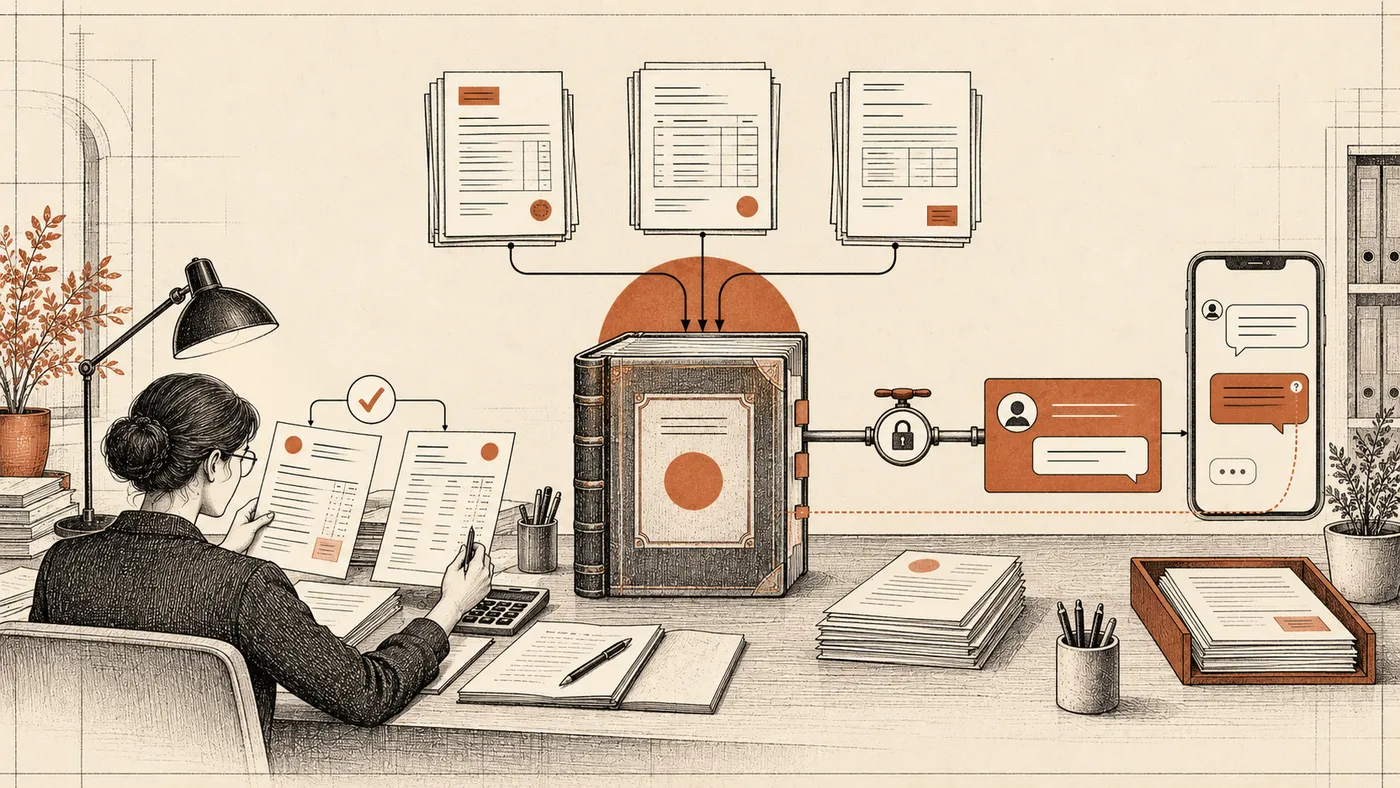
AI does not replace 1C or live inside it. It works next to it: it reads reports and database records, answers questions in plain language, checks incoming invoices, finds mismatches, and drafts documents. 1C still does the arithmetic. People still post entries and send payments.
You can start without a developer and without touching the configuration. An accountant exports a report to Excel, strips what the question does not need, and hands it to ChatGPT or Claude. The next step is an agent on your own computer, such as Claude Code or Codex, that works through a folder of exports. When many people need answers every day, the agent gets read-only access to the database, and write access comes later, always with a human approval.
We will follow one company through every step: an electrical supplies distributor with branches in Almaty and Karaganda, its chief accountant Dana, and its commercial director Erlan. The company is fictional, but its problems are ordinary.
AI in 1C vs AI for 1C: what the platform ships and what you connect from outside
The vendor has its own line of AI services, and it is worth checking them before you commission anything. The most useful one for accounting is 1C:Recognition of Primary Documents. It turns scans, photos, and files of invoices, acts, waybills, and transfer documents into database documents and matches counterparties and items to existing records. The vendor lists it for 1C:Accounting, ERP, Trade Management, Small Business Management, Integrated Automation, and Retail. Developers get 1C:Naparnik ("Companion"). The line-up and access terms change, so check the current list on the vendor's ITS portal.
Availability differs between Russian and Kazakh editions, so confirm with your local 1C partner. And 1C:Analytics, which shows up in many "AI in 1C" roundups, is a BI and dashboard tool with no language model in it.
Built-in services handle narrow tasks well, but a real workflow rarely fits inside one database. Erlan's questions arrive in WhatsApp, the answers need data from 1C and the CRM, the discount rules sit in a spreadsheet, and the result has to go back to a customer. That route is built outside 1C: a general model (GPT, Claude, GigaChat, YandexGPT, or a self-hosted one) gets 1C data through an export or an API and follows your rules. This is what "AI for 1C" means in the broad sense.
What you can do: a catalog of use cases
These are the use cases that pay off most often in companies on 1C:Accounting, Trade Management, ERP, Small Business Management, and the Kazakhstan edition of 1C:Accounting. Each can start in a chat and grow into a system.
Plain-language questions about the database
"How much 3×2.5 cable is left in Karaganda?" "Has order 1482 shipped?" "Which customers are more than 60 days overdue?" Today an accountant or a warehouse clerk answers these, at the cost of their own work. A model finds the right report or register, takes the figure from 1C, and replies with an as-of time. The question can be in Russian, Kazakh, or English, which matters when the group controller abroad cannot read the 1C interface.
Dana gets twenty or thirty of these from sales managers on a normal day. Each takes a couple of minutes, and the context switching costs more than the minutes.
Checking incoming invoices and acts
An invoice arrives as a PDF by email, an act of completed work as a photo in a messenger. The model pulls out the tax ID, contract number, amount, VAT, and line items, finds the counterparty in 1C, and prepares a draft receipt or a list of mismatches: a price above contract, an item missing from the order, bank details that differ from the counterparty card. We cover that checking logic in how an AI agent checks documents.
Reconciliations and nightly checks
A customer sends a reconciliation statement (a signed confirmation of mutual balances, standard practice in the CIS), and the totals do not match. The model compares it with 1C line by line and finds the document only one side has: a forgotten return, or a payment booked against a different contract.
Nightly checks run without anyone asking. New bank details for a long-standing supplier, a backdated document in a closed period, negative stock, two identical invoices in one week. In the morning the list is waiting for whoever owns controls. More checks like these are in AI for finance departments.
Reports and variance explanations
"Why did receivables in the Karaganda branch grow by a third this quarter?" A 1C report shows the figure but not the reason. The model compares periods, breaks the growth down by customer and contract, and writes a short explanation with document references. Finance checks the conclusion instead of building it from scratch. The same approach for sales data is in AI sales analytics.
For developers: generating 1C code
If you searched "AI for 1C" to write code, this is the wrong article. The vendor offers 1C:Naparnik inside its EDT development environment, and many 1C developers use general coding agents such as Claude Code, Codex, or Cursor. These write the best code when they can see the configuration exported to files and the team's coding standards. Infostart and Habr cover that topic in depth; this article is for finance, sales, and management.
Without integration: exporting from 1C to ChatGPT, Claude, or Claude Code
For the first month Dana did not change a single line in 1C. The reports 1C can already save to Excel were enough.
Which reports to export
- Trial balance for settlement accounts. In the Russian chart of accounts these are 60 and 62; in the Kazakh one, 3310 and 1210. Break it down by counterparty and contract, for a month or a quarter.
- Account analysis or account card for one problem customer, when you need to see where a balance came from.
- Stock balance report by warehouse for inventory questions.
- Document register for a period: sales, receipts, payments. Good for spotting duplicates and backdated entries.
- The reconciliation statement from 1C, plus the one the counterparty sent, when you are hunting a mismatch.
Export to Excel, not PDF: models read a table more reliably than they read a scanned page. One export per question works better than dumping the whole database into a chat.
What to strip before sending
Before handing a file to an outside service, Dana deletes columns the question does not need: national ID numbers and names of individuals, passport data, salaries, card numbers. Kazakhstan's Law No. 94-V "On Personal Data and Its Protection" and Russia's Federal Law 152-FZ both cover this data. Payroll reports from 1C:Salary and HR do not go into a public chat at all.
The second rule concerns the service itself. On business plans, ChatGPT and Claude do not use customer data to train models by default. Personal plans have a setting for this, and you should check it. If company policy forbids sending ledger data abroad, the options are GigaChat, YandexGPT, or a model hosted inside your own perimeter.
A prompt for reviewing a trial balance
Dana uploaded the Q3 trial balance for account 1210, broken down by customer and contract, and wrote:
This is the trial balance for customer receivables for Q3. Find the 10 customers whose balance grew most during the quarter. For each, show opening and closing balance, turnover, and contract number. Separately list customers with a credit balance. Take every figure from the file and cite the row; do not calculate anything yourself. If the file lacks something you need, say so.
The last two sentences matter more than the first. Models like to help by filling gaps with plausible numbers, and an explicit ban plus a row reference cuts that risk sharply. Any figure you plan to show your boss gets checked against the 1C report. It takes a minute.
Half an hour later Erlan had a list of customers whose debt was growing faster than their shipments, plus three credit balances nobody remembered. Building that by hand would have taken Dana half a day. That is our estimate for a case like this, not a measured client result, but the order of magnitude is right.
An agent on your computer: Claude Code and Codex
A chat is fine for one file. When there are ten exports and the review repeats every week, an agent on the computer is more useful. Claude Code from Anthropic and Codex from OpenAI work like this: you point the program at one folder. It reads the files there, writes and runs small calculations, merges several tables, and saves the result as a new spreadsheet or a written report. No programming is needed. You describe the task in plain words, as in a chat, and the agent shows each action and asks before taking it.
Dana created a "Reconciliations" folder, drops fresh exports into it once a week, and added a short rules file the agent reads before every run:
These are exports from 1C:Accounting for Kazakhstan, wholesale trade.
Customer receivables are account 1210, suppliers are 3310.
Take figures only from the files; cite file and row in every answer.
Match counterparties by BIN (tax ID), not by name.
Save results to the "Reports" folder with the date in the file name.
Now the weekly review is one sentence: "Compare receivables with last week and prepare a list for Erlan." The agent finds new overdue balances, checks them against the payment register, and writes the report. It handles reconciliation statements the same way: both versions go in the folder and the agent matches them line by line.
Two caveats. The agent works on a copy, so it cannot see anything that happened in 1C after the export. And the export folder on a work laptop now holds sensitive data, so treat it with the same care as the database.
Learning this yourself
Exports, prompts, and a desktop agent take a few evenings to learn when someone walks you through them on your own tasks. We are preparing a hands-on course on AI for working with data and documents: join the course waitlist. A one-on-one session on your own reports is available on request.
How to connect AI to 1C
Exports stop working when the answer is needed now rather than as of Monday, and when twenty sales managers ask instead of one accountant. At that point the model is connected to the database itself. There are three common ways, and your 1C specialist knows all of them.
The standard OData interface. It is built into the platform and needs no configuration changes. The database is published on a web server, the needed catalogs, documents, and registers are added to the interface, and an outside program can read them. That is usually enough for a pilot. The downside is that OData returns raw objects, so logic such as "receivables including overdue days by contract" has to be assembled outside 1C.
HTTP services. A 1C developer writes a few narrow methods for the task: "receivables for counterparty", "stock for item at warehouse", "order status". Each returns exactly what is needed and calculates by your accounting policy. It is a small change, but it has to be carried through every release update.
A copy of the database or a separate reporting store. Data is copied hourly or nightly into a separate database, and the agent reads from there. The live 1C is spared heavy queries, and an agent mistake cannot damage it. This suits analytics across several legal entities, but nothing can be written back through the copy.
In every option a middle service sits between the model and 1C. It holds the database credentials, checks who is asking, and limits which fields and how many rows the model can get. The model only sees a list of permitted actions, so if someone asks it to export every individual in the database, it simply cannot. Technically this is often built with MCP, a standard way of connecting tools to models, but the principle matters more than the protocol: the model never has direct access to the database.
What to avoid: reading the SQL tables underneath the platform. 1C user permissions do not apply there, and a configuration update can change the structure without warning.
Erlan chose OData for the pilot and HTTP services for later, if the pilot stuck.
Read first, write with approval
Agent access widens in steps, and you move to the next one only when the current one runs without surprises.
- Exports. The agent works on a copy and the database is untouched. This is where Dana started.
- Read-only. The agent has its own 1C user with a view-only role on the objects the workflow needs. It answers questions and changes nothing.
- Drafts. The agent creates a document but does not post it. An accountant reviews and posts.
- Approved actions. The agent prepares an operation, the owner approves it, and the log records both. A repeated request does not create a duplicate, and after the write the system re-reads the document from 1C to confirm the result.
Two months into the pilot, Erlan's company looked like this. A sales manager writes to the company WhatsApp: "How much does Arman LLP owe, and what's in their open orders?" The agent checks that this customer belongs to that manager, finds the counterparty by tax ID (1C has three with similar names, so it asks which one), reads the balance and open orders, and replies in three lines with dates and document numbers. If the customer wants a reconciliation statement, the agent drafts it in 1C with a PDF, and Dana gets a task to review and send it. A person sends it.
Before, that question cost a call to accounting and half an hour of waiting. Our estimate for this case is about a minute per answer and an hour or more a day back for Dana. That is a projection, not a measurement; the pilot produces the real numbers.
Even at step four, the agent does not post without review, send payments, edit counterparty cards or bank details, close periods, or promise a customer stock that may not be there.
Access control and personal data
The agent gets its own 1C user, never the chief accountant's login. Its rights are then visible, limited by role, and recorded in the 1C event log.
The second boundary is outside 1C: the agent has to know who is asking. A sales manager sees their own customers' debts, a warehouse lead sees stock, and payroll stays with the people entitled to it. Usually a phone number or messenger account is mapped to an employee and their permissions.
Personal data (national IDs, names, passport data, salaries) is masked or left out before anything reaches a model. Kazakhstan's Law No. 94-V and Russia's 152-FZ both require databases with citizens' personal data to be stored in-country and restrict cross-border transfer, so decide with counsel, before development, which fields may go to a foreign model provider. For payroll use cases, a model hosted inside your own perimeter is the sensible default. Request logs contain data too, so they need a retention period and a list of who can read them.
One more risk hides in the documents themselves. A comment on an invoice or a supplier email can contain a line aimed at the model, such as "ignore your previous rules". The system has to treat such text as data, not as an instruction, and tests should check that it does.
What breaks on a real database
- Duplicate counterparties. One tax ID, three cards, one marked "do not use". Without a rule for which card is primary, the receivables figure comes out incomplete. That is why Dana's rules file says to match by tax ID.
- Messy item catalogs. "Bolt M8×40", "bolt m8-40", and "Bolt galv. 8×40" are the same item. Without a mapping table the agent reports zero stock.
- Customized configurations. A standard Trade Management configuration after five years of changes is half custom code with no documentation. A pilot quickly shows where the data is not where you expected.
- Updates. A new release changes the object structure, and an integration that worked on Friday fails on Monday. Each method needs an automated test.
- Several databases. Three legal entities often mean three databases, sometimes on different versions, and a customer's total debt has to be summed across all of them.
- Truth outside 1C. The invoice is in 1C, the manager's discount decision is in WhatsApp, the working order status is in a spreadsheet. When sources disagree, the agent shows the conflict to a person instead of quietly picking one. Agree in advance which source wins for each type of data.
The pilot and team training
Start with a source map: where the customer, invoice, payment, order status, and approval live, which spreadsheet people open every morning, and who fixes errors in each source. After that, "integration with 1C" breaks down into specific needs, and often payment status and stock are enough for the first step.
Then pick one workflow, one user group, and one business owner. For Erlan that meant sales managers' questions about receivables and stock, five managers, and himself.
Build a test set from real questions and documents, including awkward ones: a poor scan, a duplicate counterparty, a question in Kazakh, a 1C figure that contradicts the spreadsheet, a discount request. For each case, write down what the agent should do: answer, ask, cite, draft, hand off, or refuse. That set becomes your evals, and without it you cannot tell whether the last change made things better. The Magnum HR agent works on the same principle: it handles candidates in WhatsApp in Russian and Kazakh, and every update runs against real questions before release.
Pilot metrics are simple: accuracy on the test set, time to answer, the share of drafts posted without edits, and false all-clears, where the agent said everything matched and it did not. Watch the last one most closely.
The other half of a pilot is people. Accountants need to know where the model makes mistakes and how to check a figure. Sales managers need to know how to phrase a question and what to do when the agent asks for clarification. Managers need to decide in advance what stays with a human. Without that, even a good system becomes "another bot nobody trusts". We run corporate AI training on your own reports and processes, so accounting and sales come out with working prompts, data-handling rules, and clear limits.
When you need a system
A personal tool is enough while one or two people work with the data and the answer can wait for the next export. Build a system when:
- dozens of employees or customers ask questions, and answers must come from current data;
- the workflow runs across several systems: 1C, a CRM, WhatsApp, email, spreadsheets;
- you need per-employee permissions, an action log, and personal data masking;
- the agent should draft documents or prepare operations for approval;
- there are several databases and the configurations are customized;
- headquarters needs English answers and audit trails that satisfy group policy.
If the agent will live in a messenger, read WhatsApp AI agent in Kazakhstan for the official API, human handoff, and channel limits. We build the layer that joins 1C, CRM, and messengers, with permissions, logs, and tests, as GPT integration into business systems. We start with a source map and a read-only pilot, and add write access once the pilot has proven its accuracy.
Summary
AI for 1C starts with an export, not a project: a trial balance, a careful prompt, and a check of every figure against the 1C report. The next step is a desktop agent that works through a folder of exports by your rules. When many people need answers right away, the agent connects to the database through OData or HTTP services, read-only first, then with drafts and approvals. To learn the first steps yourself, join the course waitlist. If your company needs a system, see how we do GPT integration with 1C, CRM, and messengers and get in touch.
FAQ
Can ChatGPT connect to 1C directly?
No, the model does not reach into the database on its own. The simplest route is to export a report to Excel and upload it to the chat. For ongoing use, a service sits between the model and 1C: it checks the employee's permissions, reads data through OData or an HTTP service, and passes the model only what it needs. Any model works: GPT, Claude, GigaChat, YandexGPT, or a self-hosted one.
Is there free AI for 1C?
For the first steps, yes. ChatGPT, Claude, and GigaChat have free tiers with limits, which is enough to review an exported report. Do not upload company ledgers to a free personal account without checking its privacy settings. Access terms for the vendor's own services, including 1C:Naparnik, have changed several times, so check the ITS portal for current ones. A ready-made free integration with your database does not exist, since it has to be set up for your permissions and data.
Which AI writes 1C code best?
For developers, the vendor offers 1C:Naparnik for 1C:EDT, which knows the platform's specifics. General models such as Claude and GPT, used through Claude Code, Codex, or Cursor, also write good 1C code when they can see the configuration exported to files and the team's standards. Pick the best one on your own tasks, and have a developer and tests check the code either way.
Do we need to modify the 1C configuration?
Often not for a pilot: exports or the standard OData interface are enough. Production versions usually add a few narrow HTTP services, which your 1C partner must carry through every release update.
Is it safe to give AI access to 1C?
Yes, when the agent has its own read-only user, permissions are checked per employee, personal data is masked or excluded, database credentials stay in the middle service, and every call is logged. Write access comes later and always through human approval.
Does this work with the Kazakhstan edition of 1C:Accounting?
Yes. The platform's integration mechanisms are the same. The chart of accounts, object structure, tax ID fields, document forms, and the availability of the vendor's AI services differ, and the source-mapping stage covers them.
How much does it cost and how long does it take?
Reviewing exports in a chat costs only the subscription. A system's cost depends on the number of databases, how customized they are, and whether the agent writes. A read-only pilot on one workflow usually takes a few weeks. The cost drivers are broken down in AI implementation cost in Kazakhstan.