
In short
If you run an e-commerce business outside Kazakhstan and want a share of its retail market, Kaspi is where the buyers are. It is not one of several marketplaces to consider; for most physical-goods categories it is the marketplace, tightly fused with the payment app and consumer credit that almost everyone in the country already uses. That concentration is the opportunity and the catch. You cannot treat Kaspi like a channel you bolt onto an existing Amazon or eBay operation. Entering it means setting up local ground: an entity, a Kazakh bank account, local logistics, and a pricing discipline built for a market that fights on price harder than most Western sellers expect.
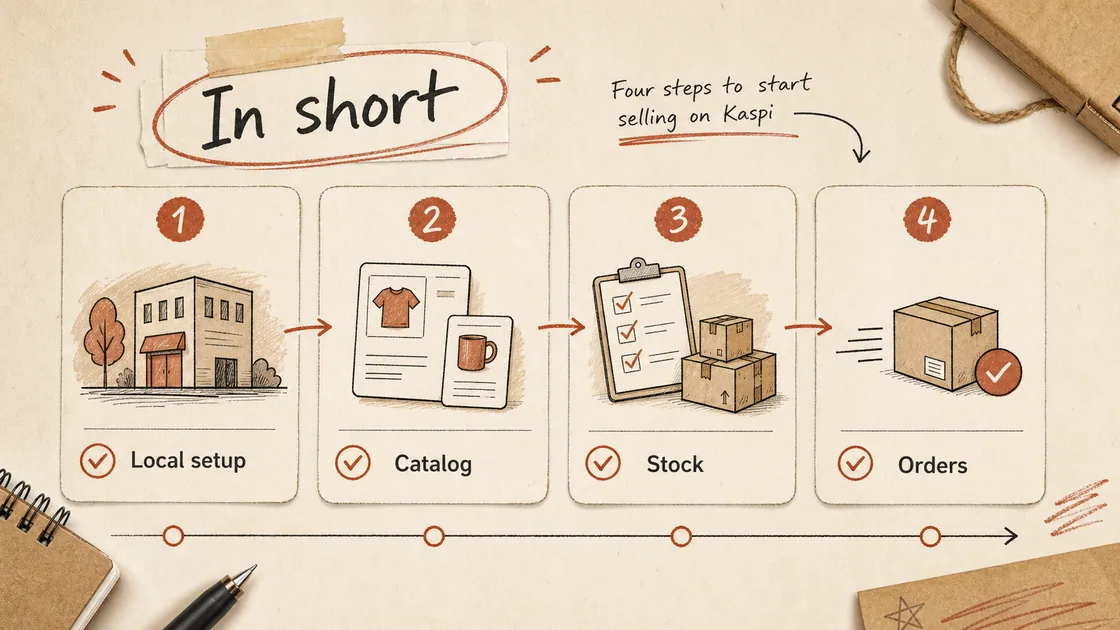
This guide walks the entry path for a foreign seller, from the legal setup to the operational reality of holding a seller rating once you are live.
The barrier most foreign sellers underestimate: you sell locally, not remotely
Kaspi is not a cross-border platform in the way Amazon lets a Chinese supplier ship to a US buyer. To run a Kaspi store you operate as a local business. In practice that means one of two routes.
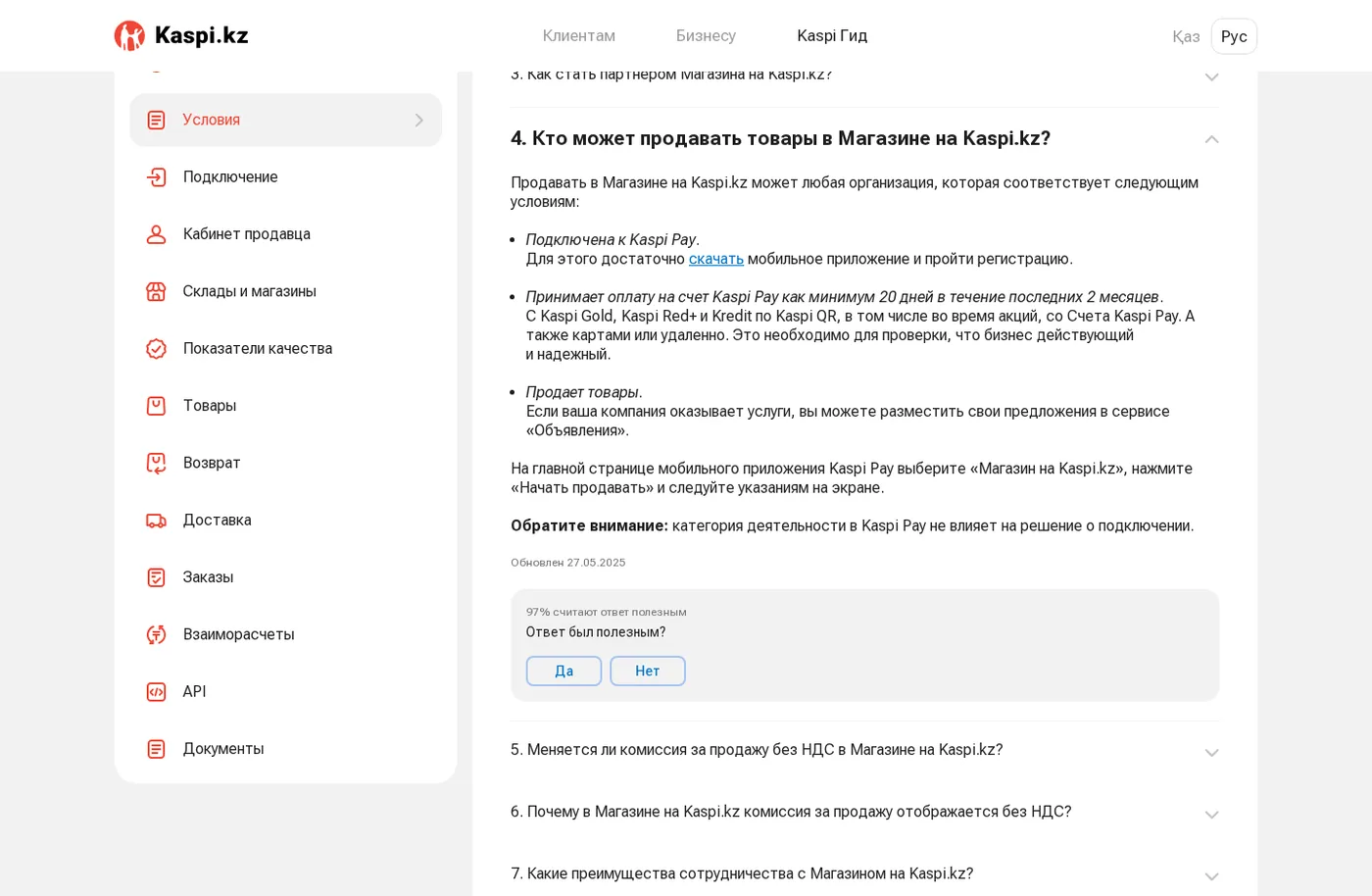
Source: the official guide.kaspi.kz seller eligibility page, public page captured in July 2026.
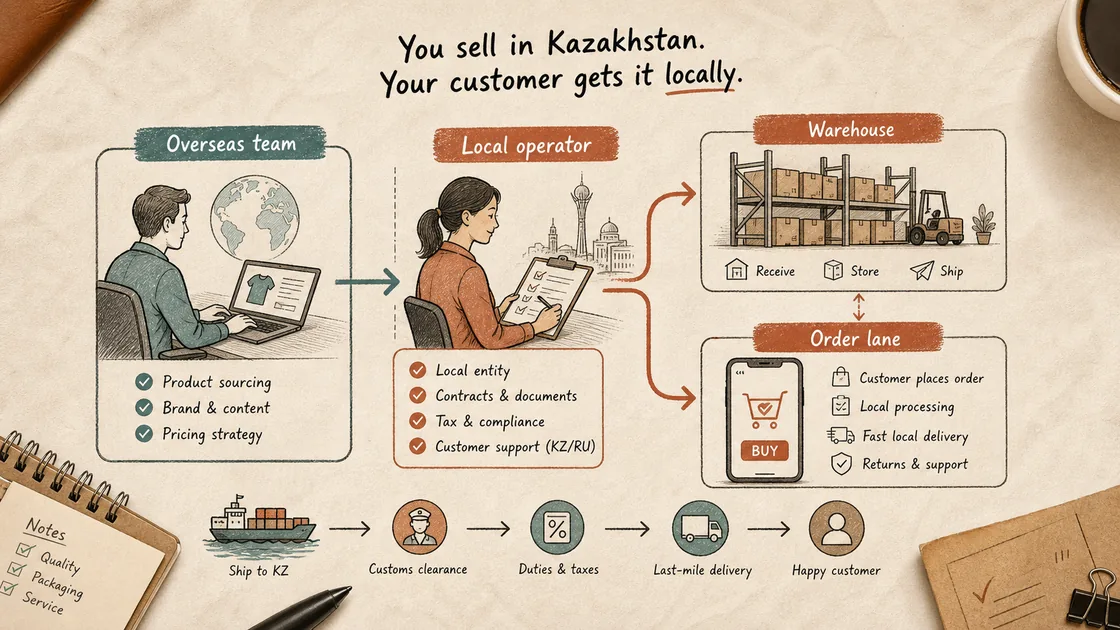
The common route is a Kazakh legal entity. You register a local company (an LLP, called TOO locally) or work through a resident entity, open a business account with Kaspi Bank, and connect Kaspi Pay. Kaspi wants to see the account is real: expect to run genuine payments through it for a couple of months before the store is fully trusted. This is deliberate friction against shell accounts.
The other route is registering as a non-resident seller, which carries extra paperwork: an extract from your home trade register in the dossier, and for an individual, proof of legal stay plus a local tax number (IIN). For most companies, standing up a local entity ends up cleaner than fighting the non-resident path case by case.
Either way, budget time and a local partner or agent. The registration steps are not hard individually, but they assume you already have a Kazakh bank relationship and address, which is the part a foreign founder does not have on day one.
The 2026 VAT change you have to plan around
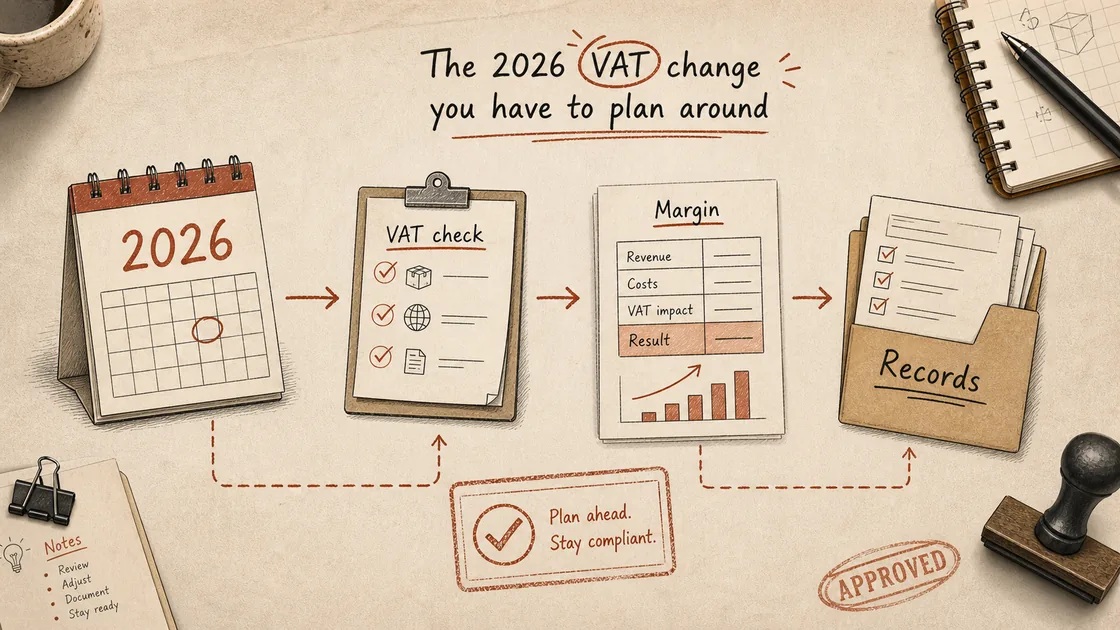
The tax ground shifted recently, and it changes the math for foreign sellers. Kazakhstan introduced VAT registration rules for foreign digital and internet companies effective January 1, 2026: foreign companies supplying goods or services to individual customers in Kazakhstan must register in a dedicated register with the State Revenue Committee, generally within a month of the first payment from a Kazakh customer. Regulators also signalled they can block foreign marketplaces that do not comply. The detail matters and interacts with your entity structure, so read the KPMG summary of the 2026 foreign-company VAT rules and get local tax advice before you price anything. The point for planning is simple: VAT is not an afterthought you reconcile later, it belongs in your unit economics from the first SKU.
What Kaspi takes: commissions by category
Kaspi earns a commission on every sale, and it varies by category. Publicly reported marketplace take rates sit around 9–10% of transaction value on average, but the per-category number is what you price against, and it ranges roughly from the mid-single digits to the mid-teens. Thin-margin categories like phones and electronics carry lower commissions; apparel, home goods, and accessories carry higher ones. Kaspi publishes the current rates in its partner guide and revises them, so confirm your category before you set a price.

The mistake to avoid is pricing off gross markup. Buy at 100, sell at 120, and the 20 feels like profit until commission, acquiring, delivery, and returns eat most of it. Price from the number that actually lands in your account. Build a simple per-SKU model: cost, category commission, logistics, packaging, expected returns, and now VAT. If you cannot show a defensible margin after all of that, the SKU will not survive the price war described next.
Price and the race to the bottom
Kaspi shows multiple sellers competing inside a single product card, and buyers overwhelmingly click the cheapest one. That design produces a constant price war. Sellers undercut each other by a single tenge, the rivals respond, and a listing can drift 15% cheaper over a day than it was that morning.
Undercutting is allowed and, when you start with zero reviews, it is close to the only lever you have: a buyer has no reason to trust an unknown seller except a lower price. The trap is doing it by hand. Competitor prices move every 15–30 minutes, and no human can sit in the cabinet resetting numbers all day. You either fall behind and lose orders, or cut too deep and sell at a loss without noticing.
The discipline that works is a hard floor. Decide the price below which the sale loses money, and never cross it, no matter what the card shows. Chasing the top slot below your floor is not a strategy; it is paying customers to take your inventory. Once volume justifies it, hand the price race to an automated repricer instead of your own attention.
Seller rating: why identical products sell at different speeds
Price is not the whole story. At equal prices, buyers pick the higher-rated seller, and the gap between a 4.9 and a 4.3 shows up directly in sales. Kaspi computes the rating from how you handle orders: confirmation speed, on-time handover, cancellations, returns, and review content over a recent window. It rewards operational reliability, not intent.
The things that sink a new seller's rating are mechanical. Cancelling an order because the item was not actually in stock. Missing the handover deadline so a buyer reaches an empty postomat locker. Confirming so slowly the buyer cancels first. Each event pushes you down in the card, and climbing back takes longer than the fall. Reviews are their own discipline: they resist honest gaming, and Kaspi is reasonably good at catching fake ones. What works is boring — the real product in real condition, careful packaging, an honest delivery window, and a calm reply when something goes wrong. One well-handled complaint often does more for you than ten easy five-stars.
Delivery and fulfillment
Kaspi offers several delivery schemes, and the choice affects both cost and rating.
Pickup means the buyer collects from your point of sale. It is cheap and keeps you in control, but only works if you have a physical location in a convenient place and staff to hand goods over — rarely the case for a foreign seller on day one.
Kaspi's own delivery and its postomat lockers let the platform move the item to the buyer. Lockers sit in Kaspi branches, convenience stores, malls, and fuel stations across the major cities, and buyers collect at their convenience. This is the natural default for an entrant without local storefronts, at the cost of logistics fees and strict handover deadlines: miss the window, lose rating.
Own courier or postal delivery gives reach into regions the platform serves less well, but puts all the responsibility for timing and condition on you. For a foreign seller, the realistic starting posture is local warehousing plus Kaspi delivery, so you are not promising a two-day window you cannot physically keep from abroad.
Mistakes foreign sellers make first
A short list of where the money leaks in the first months.
Pricing without commission, logistics, and now VAT baked in, so a "profitable" SKU is quietly unprofitable — the most expensive mistake because you do not see it until you close the month.
Setting prices by hand and walking away, then wondering why orders dried up when rivals moved below you within days.
Letting stock drift out of sync so the card shows availability you do not have. The order arrives, you cancel, the rating drops. A couple of those and you are off the top slot.
Promising a delivery window that assumes a local supply chain you have not built yet — the classic error of running Kaspi like a remote export channel instead of a local operation.
Drowning in buyer questions. "In stock?", "when will it arrive?", "another color?" — the same handful of messages, dozens of times a day, in a chat channel you were not staffed to answer.
Automating the repetitive layer
Do the first weeks by hand on purpose; that is how you learn where it actually hurts. Once you pass a dozen orders a day, three areas repay automation.
Pricing is first. A repricer compares competitor prices in the card and holds your position without dropping below the floor you set. It removes the biggest chore and the biggest risk at once: you define the floor once instead of recomputing it in a panic all day.
Inventory is second. Sync stock from whatever system of record you use so a sold-out item leaves availability automatically. This removes the most avoidable cause of rating damage — cancellations from phantom stock.
Buyer questions are third. Most of the chat volume is a few repeated questions about availability, timing, specs, and pickup. An AI agent for WhatsApp can answer the routine ones, pull availability and delivery time from your data, and escalate the hard cases — a return dispute, an unusual request — to a person. The seller stops being a human auto-responder. We built this pattern for marketplace sellers in SellerBox AI, and the same AI for sales approach applies to any high-volume storefront.
What not to automate early: blind repricing without a floor, and conflict conversations. A bot that undercuts itself into a loss, or answers an angry buyer badly, costs more than the time it saved.
A sensible entry sequence
Start with one product or a narrow group you understand: where to source it, at what cost, which documents it needs, and whether real demand exists. A hundred SKUs launched blind is a hundred ways to lose money.
Model the unit economics per SKU with commission, logistics, returns, and VAT included. If less than 10–15% survives, the item will not withstand the price war.
Run manual mode for two or three weeks. Set prices, answer buyers, and manage handovers yourself. It is tedious, and it is exactly how you find the real bottleneck before you pay to automate the wrong thing.
Then automate the one area that is eating your time — repricer, then inventory sync, then buyer chat — and check each step against your own numbers. Did orders rise, did the rating hold, did margin survive?
Selling on Kaspi is not about launching a store. It is about controlling four numbers over time: price, rating, delivery time, and stock accuracy. Foreign sellers who treat entry as a local operation, with local tax and logistics handled properly, build a durable position. Those who treat it as a remote export channel burn budget on a price war they cannot win by hand. For the technical side of the seller cabinet, see the Kaspi Merchant cabinet guide; for programmatic integration, the Kaspi API developer guide.
FAQ
Can a foreign company sell on Kaspi directly from abroad?
Not as a cross-border channel. You operate as a local business, which in practice means a Kazakh legal entity (an LLP) with a Kaspi Bank account, or the heavier non-resident-seller route with additional dossier requirements. Kaspi is a domestic marketplace, not an export platform.
What is the Kaspi commission?
It depends on the category, roughly from the mid-single digits to the mid-teens, with an average marketplace take rate reported around 9–10%. Confirm your specific category in the partner guide and price it in before you list.
How does the 2026 VAT change affect foreign sellers?
From January 1, 2026, foreign companies supplying goods or services to individual customers in Kazakhstan must register with the State Revenue Committee, generally within a month of the first Kazakh payment, and non-compliant foreign marketplaces can be blocked. Treat VAT as part of unit economics and get local tax advice on how it interacts with your entity.
What matters most for seller rating?
Operational reliability: fast confirmation, on-time handover, low cancellations and returns, and genuine reviews. Phantom stock and missed delivery windows are the fastest ways to lose position, and recovery is slower than the drop.
Should I undercut competitors when starting out?
With no reviews yet, a lower price is nearly your only lever, so yes — but with a hard floor below which you never go. Permanent loss-making for the top slot is not a strategy, it is a slow way to run out of cash.