Short version
AI video production means making videos where the shots come from generative models instead of a camera. The script, storyboard, editing, sound, and revisions are still ordinary team work. Only the way you get the picture changes.
The right choice depends on the job, not on the hype:
- AI wins when the scene is hard or expensive to film, when you need many variants for testing, when speed matters, or when you are adapting an existing ad for another market.
- Filming is more honest when you need real people, genuine emotion, a spokesperson, or a real product in someone's hands.
- A hybrid works when you film the core and let AI extend backgrounds, swap details, and produce variants.
Below we compare the two on timing, cost, revisions, and risk, then finish with five questions that make the choice easier.
What AI video production actually is
A traditional production runs through a script, casting, location scouting, equipment rental, the shoot day, editing, sound, and color. The slow and expensive links are pre-production and time on set.
AI production has no set. The team writes the script and storyboard, designs characters, props, and environments in one style, then generates the scenes. After that it looks like any other production: editing, voice-over, music, graphics, revisions, and delivery for each placement.
The hard part is not generation. It is consistency. A character has to look the same in every scene, a product cannot change shape, and a logo cannot smear. A good AI team spends more time selecting and checking shots than writing prompts.
Side-by-side comparison
| AI production | Traditional filming | |
|---|---|---|
| Time for a simple ad | A few days after the script | Weeks: prep, shoot, post |
| What drives the price | Video length and scene complexity | Crew, gear, location, talent, shoot days |
| A new location or scene | One more generation | One more shoot day or set |
| Variants for audiences and languages | Cheap once characters and style exist | Expensive unless planned on set |
| Real people and emotion | Weak spot | Strength |
| Real product in close-up | Needs careful checking | Reliable |
| Changes after delivery | Regenerate the scene | Often a reshoot |
| Rights | Care with faces, voices, and style | Talent and location releases |
We left blanket savings percentages out of the table. Sometimes an AI ad costs a fraction of a shoot, sometimes the gap is small. Our per-second pricing and what it covers are in How much does an AI video cost?.
When AI production wins
The scene is hard or expensive to film. A fantasy world, outer space, a historical city, a product in an impossible setting, a city street closed at night. Filming would need sets, permits, and paid shoot days. With AI it is a few frames in a storyboard.
You need many variants for testing. Paid social runs on variants: different hooks, audiences, offers, and lengths. Once the characters and style exist, each new variant costs much less than the first. With a shoot, those variants have to be planned before anyone is on set.
You need a character, not an actor. A cartoon, a brand mascot, a fairy-tale hero. In our Yagusha case study we found and locked the heroine first, then made a song and a four-video series with the same character, without a single shoot day.
You are adapting an existing ad. Swapping actors for another market, translating signs and phone screens, changing the voice. A reshoot rarely pays off for this, while AI handles shot-by-shot replacements well.
You need to launch fast. A news hook, a seasonal promotion, a test before a big budget. A short AI ad can ship in a few days.
When to film instead
Real people and real emotion are on screen. A customer testimonial, a founder interview, a team at work. Viewers notice generated faces quickly, and trust drops.
A spokesperson or a known face. That takes a contract, a shoot, and approvals. You cannot generate a person without consent, and with consent it is simpler to film them.
Product details matter. If buyers look at fabric texture, label text, or how a mechanism moves, a shoot is safer. AI can distort small details, and every slip is visible.
Long documentary formats. Event coverage or a film about your production line is built on real events, and those have to be filmed.
The hybrid: film the core, extend with AI
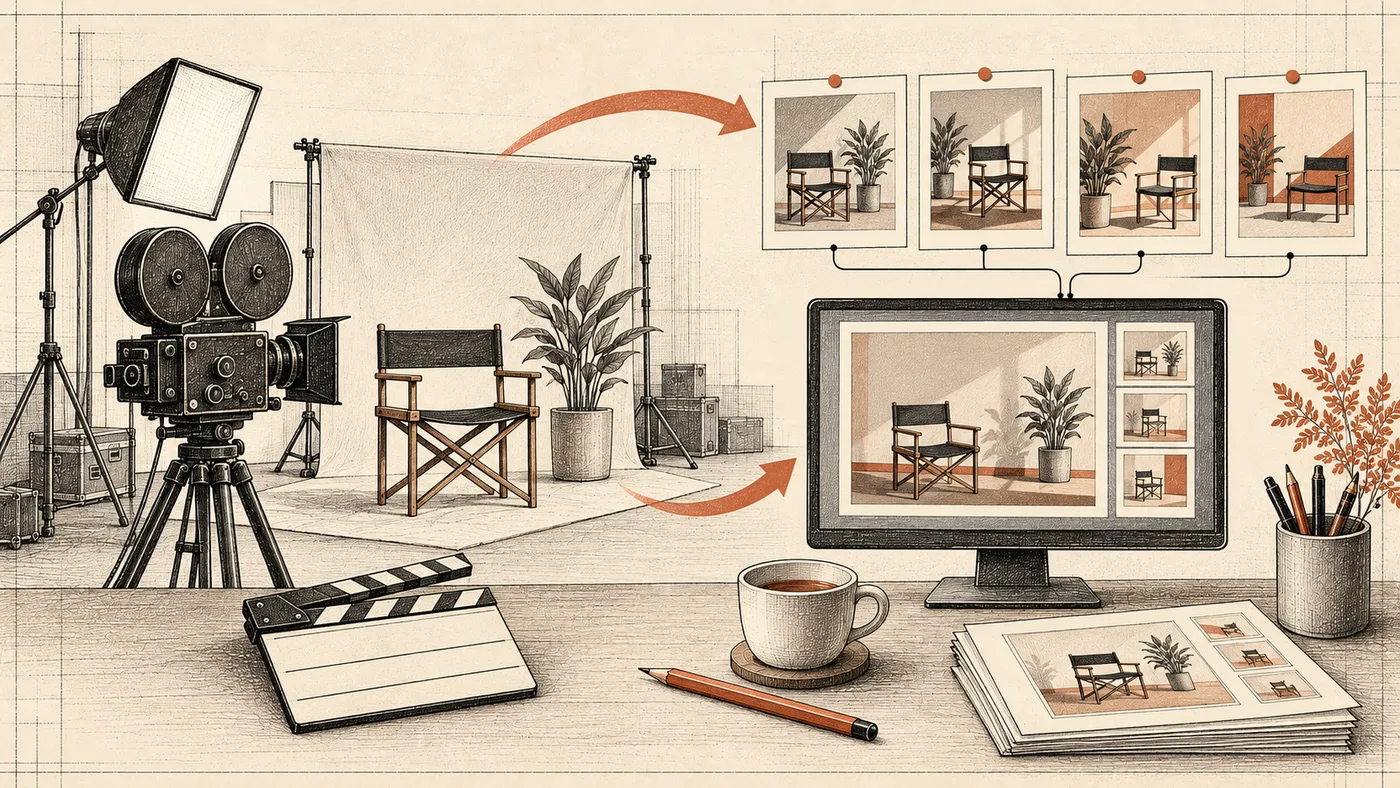
For many brands the practical answer is a mix. Film the person and the product on a simple set, then let AI change the background, add locations, build the scenes that would be expensive to shoot, and cut variants for each placement.
The brand keeps the trust that comes with real people and a real product, and saves on sets and reshoots. The same approach works for localization: shoot the master ad once, then build regional versions by swapping details in the frame.
Rights, brand, and honesty with the viewer
An AI ad goes out under your brand, so settle three things before generating anything.
- Faces and voices. Do not use a real person's likeness or voice without consent. Create characters from scratch or from an approved look.
- Brand rules. Write down tone, banned topics, risky claims, and required disclaimers before work starts, not after the first cut.
- Human review before publishing. A person checks every shot. Mangled hands, smearing text, and stray details get caught before customers see them.
If the ad runs in several markets, also check local advertising rules and each platform's policy on disclosing AI-generated content.
Five questions to decide
- Do you need real people or a specific face on screen? If yes, film or go hybrid.
- Can the scene be filmed without sets or permits? If not, use AI.
- How many variants do you need for tests and markets? More than three points to AI or a hybrid.
- Do product details matter up close? If buyers inspect them, film the product.
- When do you need the video? If it is next week, use AI.
If the answers conflict, start with a 15-second AI ad. It will show quickly whether the idea holds attention, and the big shoot budget can then go to a proven script.
Bottom line
AI production does not replace filming. It covers the jobs where a shoot is slow or expensive: complex scenes, characters, many variants, and adaptations. Real people and real products are still better filmed.
To talk through your own video, see our AI video examples and pricing. For short-form social video, our personal AI blog case study shows Reels that reached up to 10 million views.