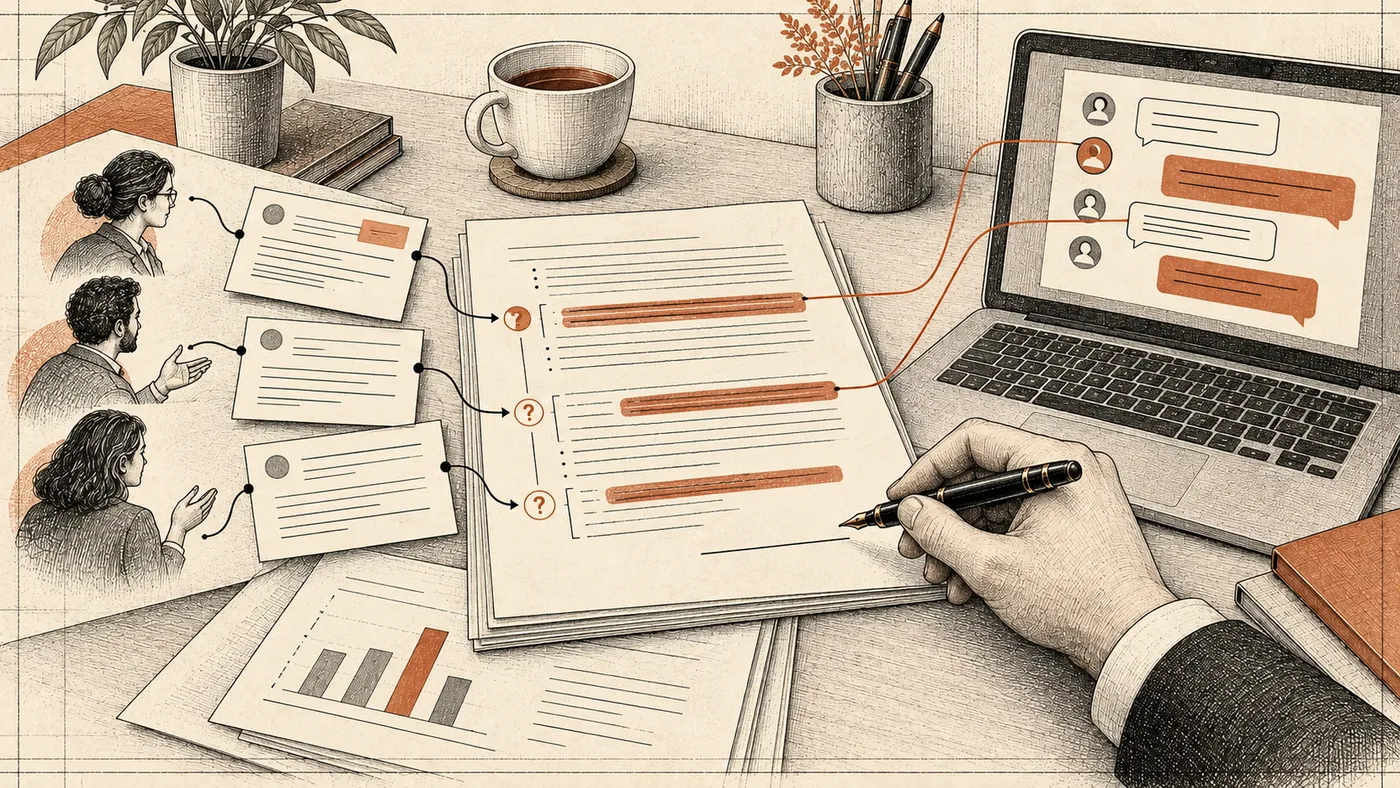
In short
An executive does not need to understand model architecture or write code. Two things matter. First, use AI in your own work at the point where a decision is still half-formed: test the idea, find the weak assumptions, question the numbers, and turn a vague thought into a clear brief for the team. Second, know what AI can do today well enough to spot work in your organization that should come off people's desks, and to hold someone accountable for the result.
Writing posts and slide decks is a side benefit. We have run sessions for business owners at Parasat Business Club, for Kazatomprom's finance leadership and for KEGOC, the national grid operator. Most of what those rooms asked came down to one question: where does AI make my decisions better, and where can I not rely on it?
This article follows one hypothetical example. The CEO of a 300-person distributor is weighing a second warehouse in another region. We go from the raw idea to a brief for the team and a first pilot, then cover what to teach the rest of the leadership team.
How executives can use AI in their own work
AI is most useful to an executive before the work reaches other people. While an idea is still in your head, testing it is cheap. Once finance, operations and sales are working on it, a badly framed question costs a week of other people's time.
At Parasat we described AI as a working layer between the owner's head and the company. Over a day it plays several roles: sparring partner, analyst, editor and the person who drafts the briefs.
Stress-test a decision and its assumptions
The CEO opens ChatGPT or Claude and types what they have: "Thinking about a second warehouse in the south. Right now we ship southern customers from our main site and delivery takes two days. Competitors deliver next day." Then they ask for questions, not advice:
I'm working through a decision, described below. Don't give me a recommendation. List the assumptions the idea depends on, and for each one say what data would confirm or kill it. Then give me three reasons this could fail.
The model surfaces what was packed into the CEO's head: that next-day delivery will grow southern demand, that rent and staff pay off at current volumes, that southern margins are no worse than at the main site. Each of these can be checked, and now it is obvious which one carries the most weight.
Good work with AI is rarely one prompt. At Parasat we called it the twenty-iterations habit: push back, ask for a different calculation, add context, compare two options, demand the risks. The first answer is like a new hire's first draft. The value shows up somewhere between round five and round ten.
Question the numbers
Next comes the money. The CEO exports a year of sales for southern customers plus delivery costs, strips out customer names, and asks the model to act as a financial analyst.
Here are 12 months of sales for southern customers and our delivery costs. Calculate monthly revenue, margin, delivery as a share of cost, and seasonality. Show the volume at which a warehouse costing $8,000 a month breaks even. Use only numbers from the file and keep the formulas visible.
ChatGPT and Claude run code for this kind of calculation instead of answering from memory. A number still becomes trustworthy only after someone checks it. At the seminar for Kazatomprom's finance directors, the room asked us to plant an error in a finished model. We added a 0.8 multiplier to the profit formula and opened the file in a fresh chat with no history. Claude found the multiplier and explained how it distorted the tax line. Executives can use the same trick: hand a finished model to a clean chat and ask it to find the mistakes. For bank statements, variance analysis and Excel work, see AI for finance professionals.
Turn the idea into a brief for the team
Once the assumptions are clear, the CEO asks for the briefs:
Based on our conversation, write three short briefs: one for the CFO, one for the head of operations and one for the sales director. For each: what they need to find out, by when, in what format, and from which data. Then list the questions I need to answer myself before the meeting.
Instead of "can someone look into the southern warehouse thing", each leader gets a specific question, a deadline and a format. The meeting a week later runs on numbers rather than impressions. The last part of the prompt is often the most useful, because it shows where the CEO has not made up their own mind yet.
Meeting prep, reports and correspondence
This is the part most "AI assistant for executives" roundups cover, and it works:
- a summary of a long report before a meeting, with questions worth asking the author;
- a read-through of a board pack: what changed since last time and where the numbers disagree;
- minutes from a meeting recording, with decisions, owners and deadlines;
- a first draft of a letter to a partner or an internal memo, which the executive then edits;
- preparation for a difficult conversation: how to phrase the feedback and what pushback to expect.
Voice input saves a lot of time here. Dictating a task between meetings is easier than typing it. At the Kazatomprom practicum, one participant set up a budget-versus-procurement reconciliation by voice.
A company knowledge base
The model does not know your company. It does not remember last quarter's pricing decision, which policy applies to regional offices, or why you dropped a supplier. For one-off work you can put that context into a ChatGPT or Claude project: policies, strategy, board minutes, the main contracts. Answers then draw on your documents.
Once the whole company needs that kind of search, you need an internal assistant with access controls and an audit log. We cover how to build one in internal ChatGPT for a company.
What to delegate to AI and what to keep
The rule of thumb: AI prepares, the executive decides.
| Hand to AI | Keep for yourself |
|---|---|
| A list of assumptions and risks behind a decision | Which risks the company accepts |
| Draft calculations, scenarios, formula checks | Signing off on the numbers and owning them |
| Summaries, minutes, draft emails | Conversations, negotiations, letting people go |
| The structure of a brief | Priorities and resource allocation |
| A market scan with sources | Judging which sources to trust |
| Prep for a difficult conversation | The conversation itself and judging the person |
Two questions from the Kazatomprom room come up in other sessions too: "Who is responsible if AI gets the report wrong?" and "Won't we forget how to think?" The first answer: whoever signed it. AI does not move responsibility, it speeds up preparation. The second: if you use the model as a sparring partner that argues and asks questions, you end up thinking more, not less. If you ask for finished answers and never check them, then yes, the skill fades.
How to choose your first AI pilot
Personal use pays off immediately. A company-level project needs a different kind of discipline. At Parasat we separated three things that tend to get mixed up in leadership meetings: personal productivity, an impressive demo, and a real project with data, access and an owner.
To pick the first project, we gave owners five questions on a single page.
- Which decision or action changes. Not "bring AI into sales" but "a rep gets a summary of each inbound lead and a suggested next step within a minute instead of an hour".
- Who owns it. A specific process owner who decides whether the output is good. Not IT, and not the vendor.
- What data exists. Where it lives, in what shape, and who grants access. If there is no data, the first pilot is about collecting it, not about AI.
- What new risk appears. What happens if the model gets it wrong, and who will notice.
- How you will know it worked. One metric with a baseline: handling time, error rate, ticket volume, hours spent on a report. Measure it before you start.
If any question has no answer, the project is not ready, however convincing the demo looks. The winners tend to be dull processes with volume and a clear cost of manual work: customer replies, document checks, reconciliations, policy search. For how to fit such a project into a month and make a go or no-go call at the end, read AI pilot in 30 days.
In the warehouse example, the first pilot would not be the warehouse itself. It might be an automated weekly summary of southern shipments and delays. Owner: head of operations. Data: an export from the ERP. Metric: hours spent on the weekly report and the number of delays caught in time.
Risks and data rules
One of the first questions leaders ask is whether they can use company data this way. The answer depends on the plan, the tool and what exactly you upload. Here are the minimum rules to set before the leadership team starts using AI:
- Use work accounts, not personal ones. Business and enterprise plans of ChatGPT and Claude do not train models on your data by default. On a personal free account you have to find that setting and turn it off yourself.
- Keep personal data out. Social security numbers, card numbers, named salaries and customer details stay out of the chat. Analysis rarely needs names.
- Write a short do-not-upload list: contracts under NDA, government customer data, deal strategy before signing. Keep it short enough that people remember it.
- Check before use. Any number from the model that goes into a board pack, a report or a spending decision gets checked against the source. A separate reconciliation sheet with control totals works best.
- Leave integrations to IT and security. Connecting AI to the ERP, CRM or company email goes through IT, with access rights and an action log. Departments don't set that up on their own.
In our training sessions we only use anonymized or synthetic data. For Kazatomprom, the coffee shop model, the P&L for the dashboard and the branch reports were prepared in advance. The tasks mirrored the finance team's real work, but none of the company's figures went into a chat.
What to teach executives and how to run leadership AI training
A lecture on AI trends gives an executive very little. Hearing about AI is one thing. Trying it on your own problem is another. Training works when the executive watches their own task get solved on screen: how it was framed, what came back and how it was checked.
What belongs in a program for senior leaders:
- what AI can do today and where it goes wrong, covering chat, an assistant with file access, and an agent that carries out steps on its own, with plain examples and no math;
- the personal habits covered above: stress-testing a decision, questioning numbers, briefing the team, preparing for meetings;
- checking the output with a reconciliation sheet, a second look in a clean chat, and a request to show sources and formulas;
- data rules: what is allowed, what is not and who decides the edge cases;
- a review of department workloads, so every leader leaves with a list of what to hand to AI now and what needs IT and security.
What works is training built on the company's own tasks. Before the Kazatomprom finance seminar we prepared the examples with two of their finance people, collected the room's own questions on day one and worked through them the next morning. In one morning the group built a three-scenario P&L model, a dashboard from an Excel file, and a consolidated report across four branches with a reconciliation sheet.
Industry context changes the program. In the KEGOC session we tied the general block on ChatGPT for knowledge, documents and management decisions to the power sector: load forecasting, grid optimization, drone inspection of infrastructure. That helped separate simple productivity wins from deeper infrastructure projects built on operational data.
The usual formats:
- A one-hour talk for owners, like the one at Parasat. It gives a frame and a few personal habits, and fits a business club, a board offsite or a strategy session.
- A one-day practicum for a mixed room of executives and managers. One worked example on the company's anonymized data runs through the day, and the afternoon goes to problems from the room.
- A two-day program: the first day on understanding and personal habits, the second on the work of one function, such as finance or procurement. That is how we worked with Kazatomprom in 2025 and 2026.
If you want this kind of training for your leadership team, see how our corporate AI training works: we build the program around your tasks and your data rules. If you would rather learn the tools yourself first, we also run AI courses.
Where to start this week
- Get a business plan for ChatGPT or Claude and check the data settings.
- Take one decision you are weighing right now and ask the model for the assumptions and the ways it could fail. Go at least five rounds.
- Before your next meeting, give the model the materials and ask for questions to put to the authors.
- Write your next brief to the team together with AI: goal, deadline, format, data.
- List three processes in the company with the most manual work and run them through the five pilot questions.
After a month you will see where AI actually saves you time and where the company needs a project rather than a personal habit.
FAQ
No. A chat tool like ChatGPT or Claude and the ability to frame a task are enough: give context, describe the result you want, ask for a check. Agents like Claude Code do not require coding either, but analysts and finance teams need them more often than executives do.
For most work, ChatGPT or Claude on a business plan. ChatGPT is handy for spreadsheets and quick calculations, while Claude handles long documents well and writes carefully. If your company already runs Microsoft 365, Copilot is worth a look because it works inside Outlook, Word and Teams.
Usually it isn't: the label often sits on the same chat with ready-made prompts. The difference appears when the assistant is connected to company documents and systems and sees policies, minutes and data, limited to what that person is allowed to access. That is a separate project with IT and security.
Executives pick up the first personal habits in a single session if it is built on their own tasks. The habit takes a few weeks of regular use. It helps when everyone leaves training with a list of their own tasks and a clear set of data rules.
Use short formats built on real work: an hour for owners, or a one-day practicum that solves the participants' own problems. Build the program in advance with two or three people from the company so the examples feel familiar.
The person who signed the report. AI speeds up preparation but does not take on responsibility. That is why your rules should say that any number from a model is checked against the source before it is used.
Bottom line
For an executive, AI is first a sparring partner and analyst that works before the task reaches other people: test the decision, question the numbers, write a sharper brief. For the company, pick pilots by owner, data, risk and metric, and set a short list of data rules. Train your leadership team on its own problems. Our corporate AI training page explains how we do that.