In short
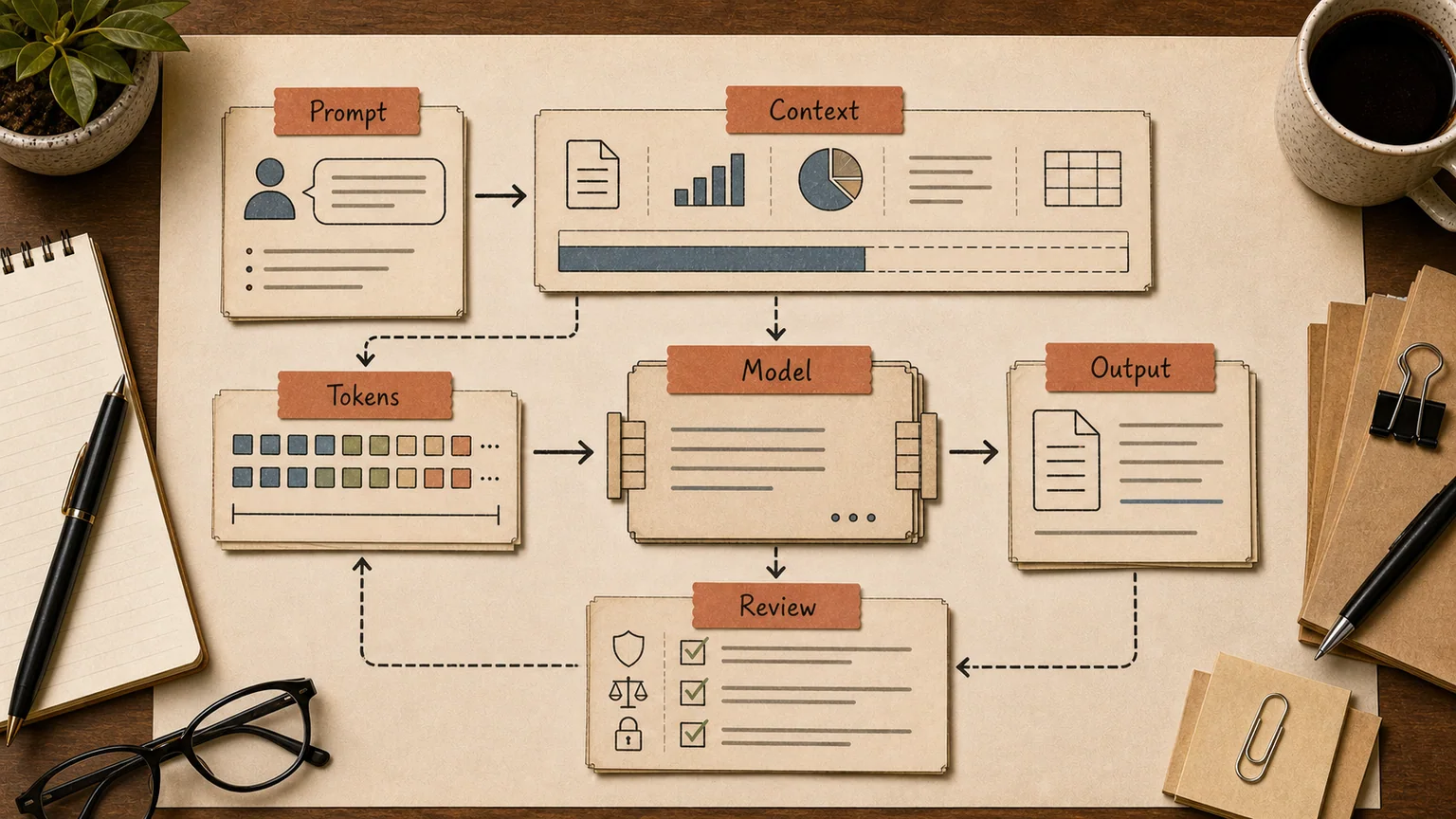
An LLM is a model trained to predict the next word in a sequence of text, at a scale large enough that the prediction turns into something that reads like reasoning, writing, and conversation. There's no understanding underneath it, no model of the world checking facts against reality. There's statistics, trained on an enormous pile of text, producing the most probable continuation.
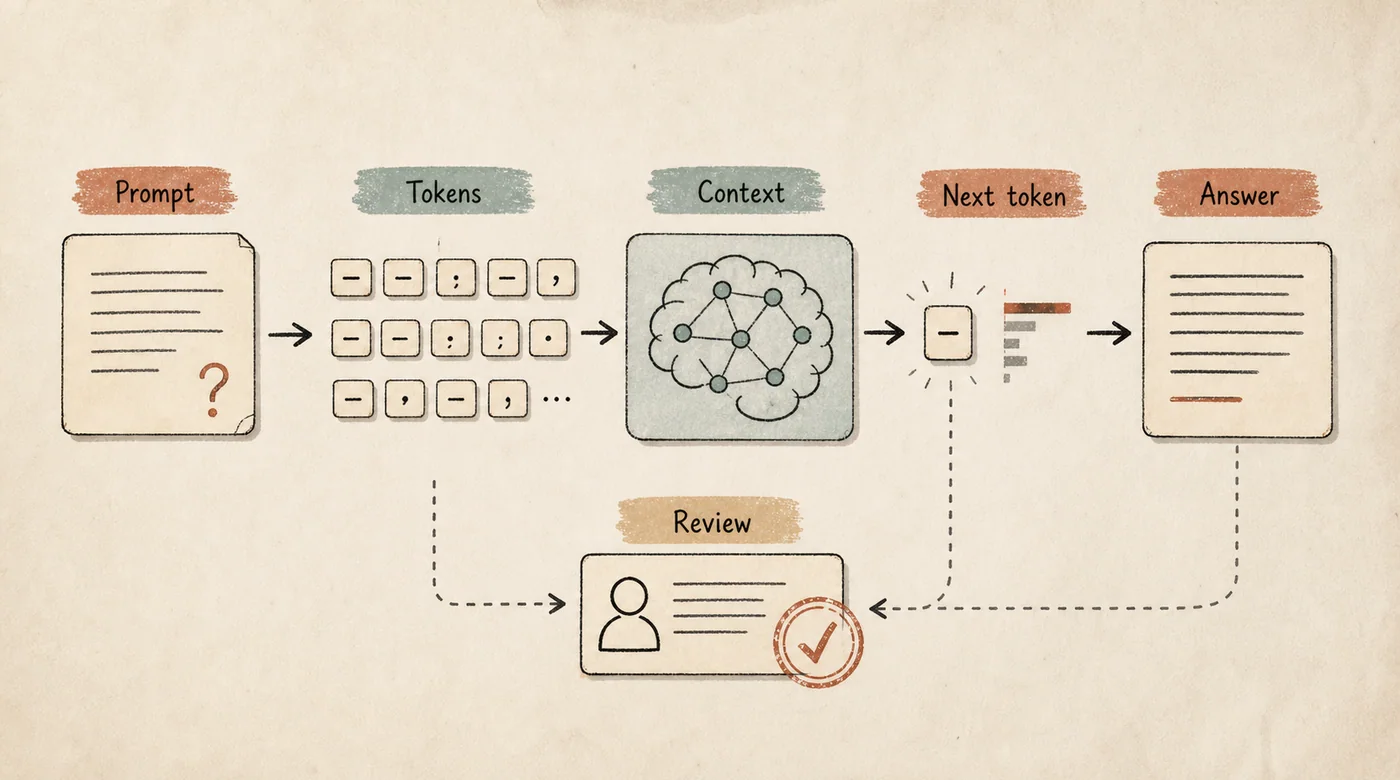
That single fact explains almost everything a business needs to know about working with one. An LLM is not a database and not an oracle. It's a text generator that is sometimes right and sometimes confidently wrong, and the gap between a useful deployment and an embarrassing one is rarely about which model you picked. It's about what data, guardrails, and human review you built around it.
How it actually works, no math required
The model learned from text: articles, books, code, forum threads, documentation. It didn't memorize facts the way a database does. It absorbed patterns — which word tends to follow which, how an argument is usually structured, what a polite refusal sounds like, how a compliance email is typically phrased. When you send a prompt, the model breaks it into tokens (word pieces) and generates a response one token at a time, each time picking the most statistically likely continuation given everything said so far.
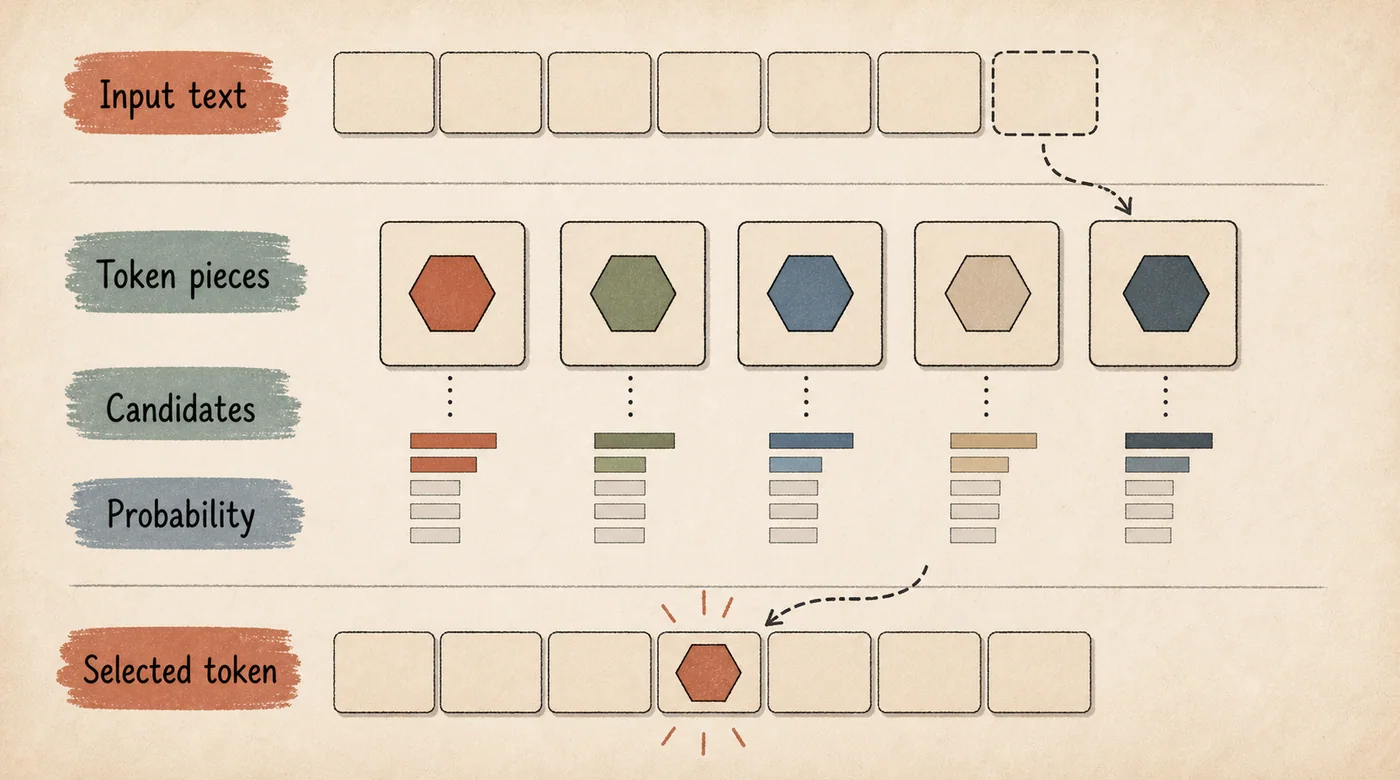
Two consequences follow. First, the model doesn't "browse the internet" or know this morning's exchange rate unless it's specifically connected to a live data source. Second, the longer and messier a conversation gets, the more likely the model is to lose the thread or start filling gaps with guesses.
Context windows and tokens, without the jargon
The context window is how much text the model can see at once: the system prompt, the conversation history, any documents you've attached, the user's question. Everything is counted in tokens, and a token is roughly four characters of English text, a bit less than a full word on average. Modern models offer context windows anywhere from 128,000 tokens (GPT-4o) to 200,000 (Claude) to a full million (Gemini 1.5 Pro) — hundreds of pages, in theory.
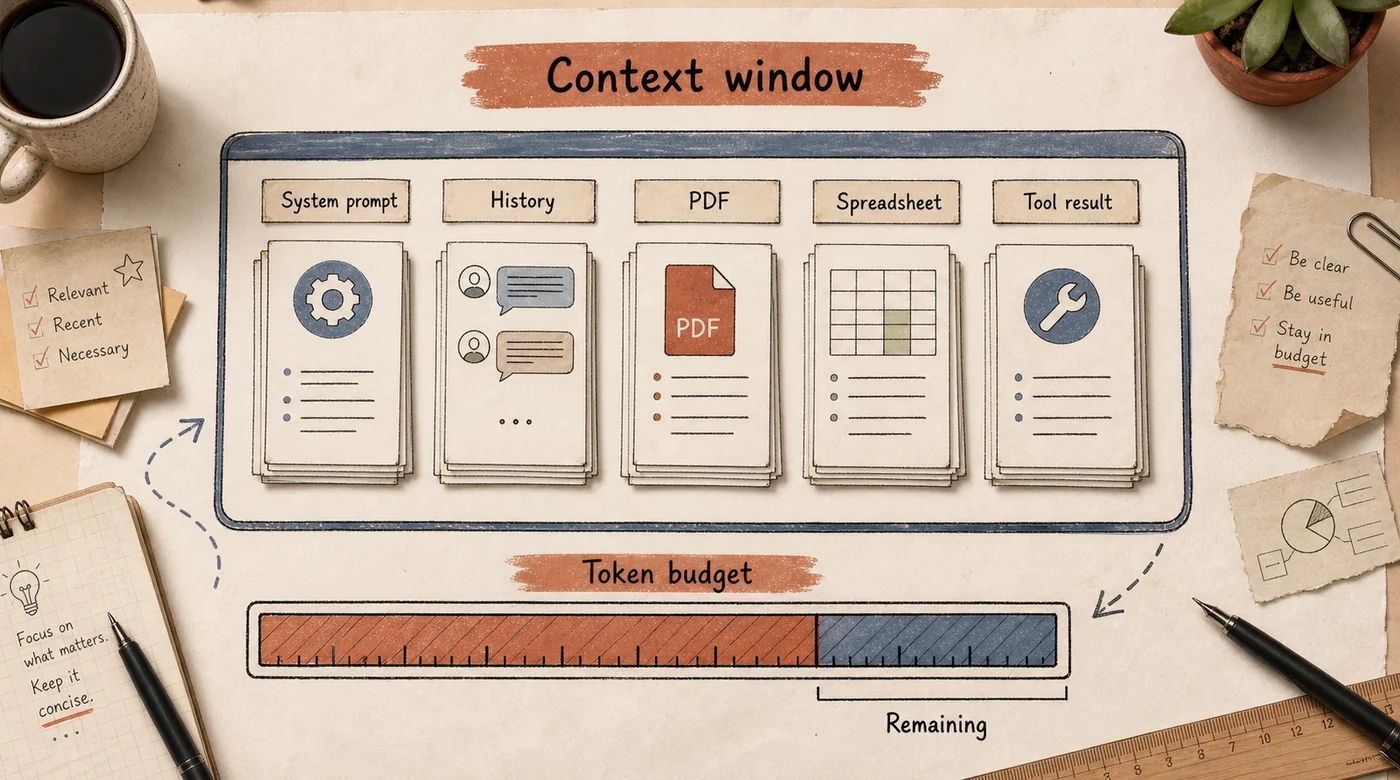
In practice the window fills up faster than that number suggests. A long support thread, three attached PDFs, and a spreadsheet of order history can eat a large share of the budget before the model even gets to your actual question. The lesson for a business system isn't "buy the biggest context window." It's "structure what you feed the model," because a model asked to find one detail buried in two years of unstructured chat history will sometimes miss it, even when it's technically inside the window.
Fine-tuning, explained without the vendor pitch
Fine-tuning means retraining a portion of an existing model on your own examples — how your company replies to customers, your internal terminology, the exact shape of a report you produce every week. It is not the same thing as "uploading your documents." Fine-tuning changes the model itself, needs a labeled dataset and real infrastructure, and mostly earns its cost when you need a consistent style or a narrow output format across a very high volume of requests.
Most businesses don't need fine-tuning on day one. What they need is retrieval-augmented generation, or RAG: the model pulls current company documents for every query and answers from those, instead of relying on whatever it happened to memorize during training. We cover this in more depth in how RAG works and why vector embeddings alone aren't enough. Fine-tuning solves a style-and-format problem. RAG solves a current-facts problem. Companies sometimes need both eventually, but RAG is almost always the right place to start — it's cheaper, faster to ship, and easier to walk back if it doesn't work.
Where hallucinations actually come from
A hallucination is the model stating something false with exactly the same confidence as something true. It isn't lying and it isn't guessing in the way a person guesses — it's generating the statistically likely next words, and sometimes the likely continuation is factually wrong. The clearest public example remains Air Canada's chatbot, which invented a bereavement-fare refund policy that never existed; a Canadian tribunal ordered the airline to honor the policy its own bot had made up.
For a company, this isn't a theoretical risk. A model can confidently cite a contract clause that isn't in the contract, invent an order number that was never issued, or reference a policy that doesn't exist in your handbook. Three things reduce hallucination rates: grounding the model in verified sources instead of trusting its memory (this is what RAG is for), instructing it explicitly to say "I don't know" instead of guessing, and keeping a human in the loop wherever the cost of an error is high — money, contractual commitments, medical or legal advice.
What LLMs are genuinely good at
Summarizing long documents into something a person can actually read. Answering questions against an uploaded knowledge base, as long as that base is current and reasonably well organized. Rewriting text for tone — formal, casual, aimed at a non-technical reader. Classifying incoming messages: billing question, complaint, technical issue, sales lead. Drafting emails, product copy, and support macros a human then edits. Reading and explaining code. Handling more than one language in the same conversation, which matters more than people expect once you're supporting customers across regions.
Where LLMs fall short, or shouldn't be trusted alone
Precise calculation without a tool attached — a calculator is more reliable than a model for anything beyond simple arithmetic. Final decisions with legal or medical consequences. Answering questions about current events or live data without a connected source; the model has no built-in sense of "this week" unless you wire one in. Serving as the only check before money moves or a contract goes out for signature. And, less obviously: LLMs are bad at saying "I'm not sure" by default. Left alone, most models would rather answer confidently than admit a gap, which is exactly the failure mode that produces expensive mistakes.
Where this fits inside a company
Front-line customer support on chat and email, where the model handles routine questions and hands off anything ambiguous to a person. An internal assistant for policies, HR handbooks, and IT procedures, so employees stop hunting through a shared drive for the current version of a document. Document processing for invoices, claims, and intake forms, where the model extracts fields and a person still signs off before anything moves into a financial system. Draft outreach and proposal copy for sales teams. Support-ticket analytics: what customers actually ask about, which complaints keep recurring, where the FAQ is out of date.
Testing these use cases before they touch real customers means building a dedicated set of test cases, not assuming "the model is smart enough to figure it out." We've written about that approach in why AI projects need evals.
Why the generic explainer isn't enough
Search "what is an LLM" and the results are dominated by IBM, AWS, Salesforce, and Wikipedia — accurate, well-written, and aimed at the widest possible audience. None of them tell you how a model should behave when a support ticket switches languages mid-conversation, which fields actually matter in your CRM export, or who on your team signs off on an AI-drafted response before it reaches a customer. A generic page explains the technology. It can't tell you what to do with it inside your specific stack, your specific data, and your specific risk tolerance. That gap is where implementation work actually lives.
Running a first pilot
Pick one narrow process — not "automate all of support," but "answer order-status questions from the last 90 days of tickets." Pull 50 to 100 real examples and measure what share the model handles correctly without help. Connect it to a live, current data source rather than general knowledge. Keep a human reviewing output for the first few weeks, not for appearances but to actually catch what breaks. Track accuracy, escalation rate, and response time. After a month you'll have numbers instead of impressions, and you can decide whether to expand the pilot based on those numbers rather than on how confident the demo looked.
FAQ
Is an LLM the same thing as ChatGPT?
No. ChatGPT is a product with a chat interface, built by OpenAI on top of an LLM (currently a GPT-series model). LLM refers to the underlying technology class — there are dozens of models, from GPT and Claude to open alternatives like Llama and Mistral.
Can we trust LLM output without checking it?
For low-stakes tasks — a first email draft, a document summary — a quick human skim is usually enough. For anything where an error costs money or damages trust, you need either human review or grounding through RAG against verified data.
Do we need our own model, or is an off-the-shelf one enough?
Almost every business is better served by an existing model (GPT, Claude, Gemini) accessed through an API and wrapped around your own data. Training a model from scratch is expensive and rarely justified outside a handful of specialized cases.
How much does it cost to put an LLM to work inside a company?
It depends heavily on scope — a simple document assistant costs very differently from an agent wired into a CRM and internal systems. We break down ranges and cost drivers in what AI implementation costs in Kazakhstan.
If you want a working session on where to start, what to connect first, and how to measure whether it's paying off, corporate AI training is built for that. For a system already scoped and ready to build, GPT integration is the next step.