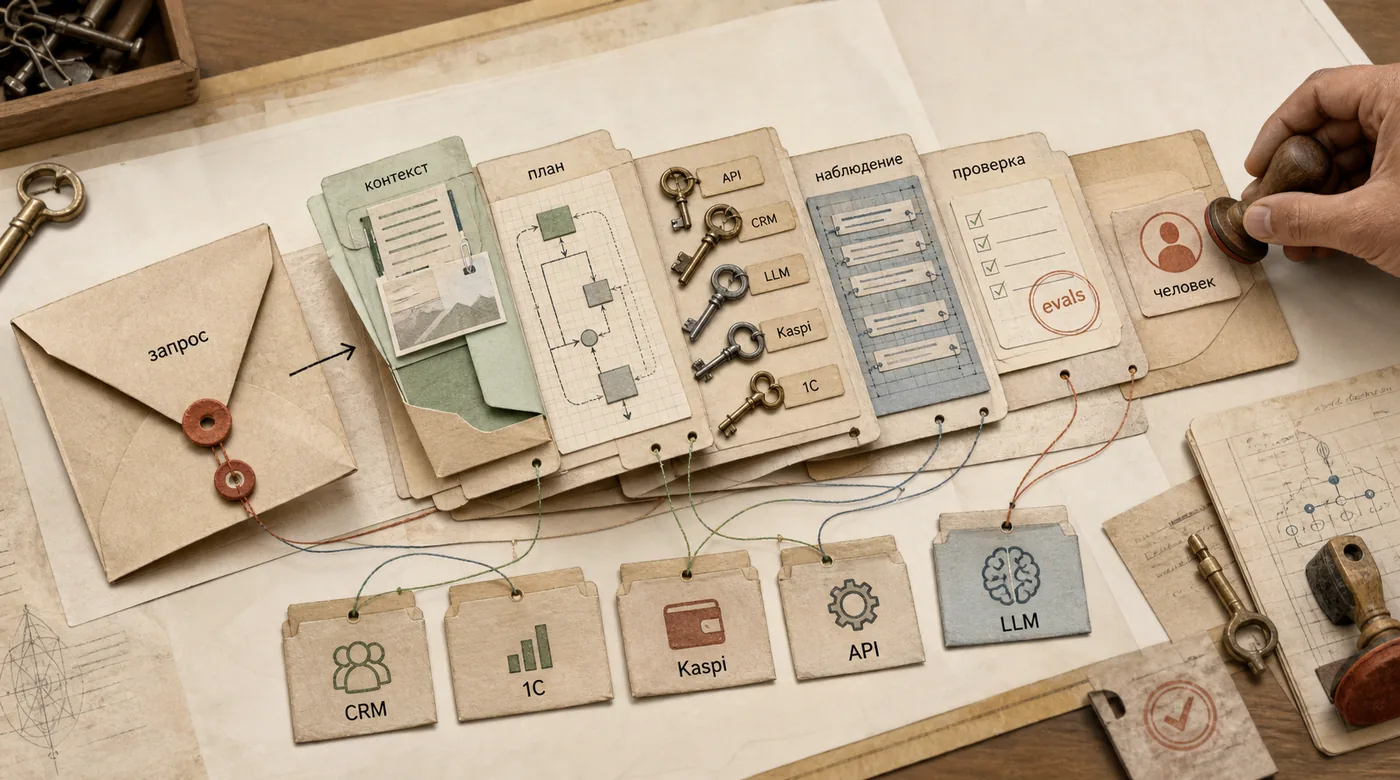
In short
An AI agent is software you give a goal to, not a script. From there it decides what to do: ask the customer for missing details, look up the right record, call an integration, write the result back, and stop when it hits something risky. A chatbot answers a message. An agent does a piece of work inside your systems.
The difference shows up in one example. A customer types "book me for tomorrow afternoon if there's a slot." A chatbot returns a menu or says "an agent will be with you shortly." An AI agent checks the calendar, finds an open slot, asks for a name, creates the booking, sends confirmation, and hands the chat to a human the moment the question turns into a refund dispute. It does not just talk. It acts.
This is the part most "what is an AI agent" articles skip. They define the term, list ten industries, and move on. The useful questions are narrower: what an agent actually is, where it pays for itself, what breaks in production, and how to know you need one at all rather than a simpler tool.
If you specifically want the format comparison — when a chatbot is enough, when a workflow is safer, and when an agent is justified — that is a separate piece. This one is about the thing itself and the work it removes.
What an AI agent actually is
The easiest mental model is a new hire scoped to one job. A plain script needs every step written out: "if the message contains 'price', send the price list." An agent gets a goal and a set of tools instead: here is the product database, here is the CRM, here is the calendar, here is the rule for when to call a human. It chooses the order of actions for the specific message in front of it.
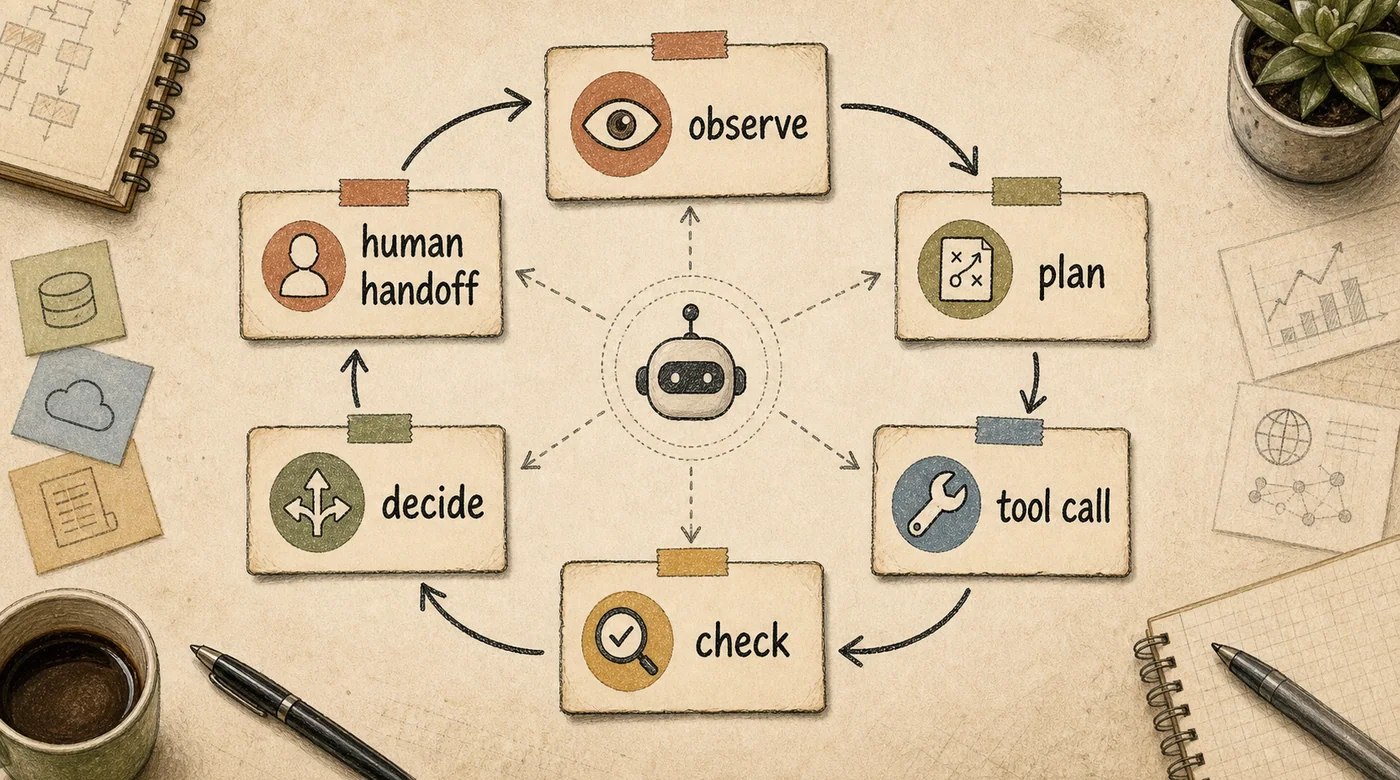
An agent has three things a plain bot does not. First, tool access: it can call an API, read stock in the inventory system, create a deal in the CRM, open a ticket in Zendesk. Second, working memory for the task: it remembers the customer already gave their address and does not ask again on the fifth message. Third, the ability to judge a result and decide the next move: an empty search result triggers a reformulated query; an ambiguous case triggers a stop.
Under the hood this is usually an LLM (a large language model like GPT or Claude) wrapped in code that hands it those tools and manages the loop. But that detail matters to the buyer about as much as the engine matters to someone ordering a delivery. What matters is that the agent closes a slice of work end to end instead of returning one reply.
How it differs from a chatbot
The formal line is simple: a bot replies, an agent completes a task. The practical difference is the blast radius when something goes wrong.
A bot with a bad answer annoys a customer. An agent acts on a bad answer, and that is a different order of magnitude. Air Canada lost a case to a passenger after its chatbot promised a bereavement discount that did not exist; the tribunal held the airline responsible for what its bot said. While a system only talks, an error costs an unhappy customer. The moment it creates an order, applies a discount, or changes a deal stage, an error costs money and disputes.
That is why I give agents autonomy in stages on every project. First it only reads and proposes, and a person approves. Then it earns harmless writes with a clean rollback. Only after testing does it get actions the customer sees or actions that move money.
Where AI agents actually help a business
Generic "10 use cases" lists are useless. What helps is looking at the places where a business loses time every single day.
Customer support that resolves, not just replies. The classic first win is support: the agent reads the order, checks the policy, issues the refund, updates the record, and escalates the messy case. Platforms like Salesforce Agentforce, Zendesk, and Intercom's Fin all push the same shift, from answering to resolving. The catch is the same everywhere: the agent is only as good as the systems it can read. A pretty chat over a stale database will confidently lie about stock.
Sales and lead handling. Leads arrive from the website, email, ads, and social. Someone has to qualify them, log them in the CRM, assign an owner, and not drop them. An agent pulls the name, company, product, and intent from the thread, creates the deal, asks the clarifying question, and hands a hot lead to a person. That is closer to our AI for sales work: the agent takes the routine, the humans keep the relationship and the close.
Voice and retrieval over a live database. On our AI CRM project for a US car-dealership network, callers ask where their car is in service, when a part arrives, and whether a part fits. The answer lives in the dealer's DMS and changes by the hour. One retrieval engine serves both async queries and live voice, and an agent on top runs the dialog, calls tools, and writes back to the CRM. The hard part was never the chat. It was retrieval quality and a strict latency budget on voice.
High-volume hiring. In retail, food, and delivery, recruiters drown in applicants. The Magnum HR agent picks up a candidate, runs a short structured interview, matches them to the nearest location, and gives the recruiter a clean card instead of another raw chat. The point was not to let AI hire people. It was to stop losing candidates while recruiters were buried in manual follow-up.
What an agent looks like inside
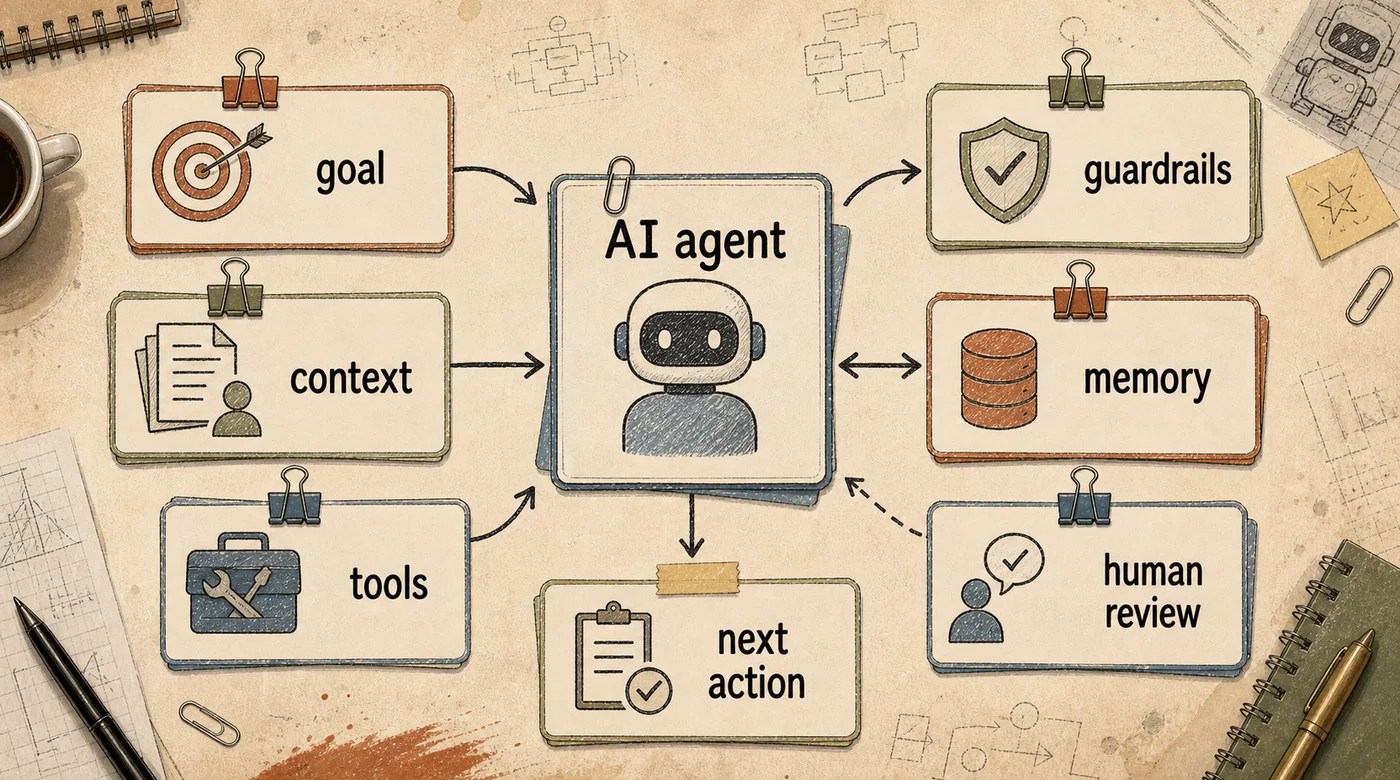
From the outside it is a chat. Inside it is several connected parts, and those parts are what separate a working agent from a demo that answers nicely and does nothing.
There is a goal and a boundary: what the agent may do on its own and where it must call a human. There are tools: access to the CRM, the order system, the calendar, the knowledge base. There is task context, so it does not re-ask what it already knows. There are escalation rules, so disputed terms, complaints, and anything touching money or a person's livelihood go to a human. And there is a log: a record of what the agent asked, what it found, what it did, and where a person approved or corrected it.
Without the log, an agent is a black box you cannot trust with actions. With the log, you can see which step went wrong and fix that step instead of the whole system.
Data and integrations, or there is no agent
The most common failure is not the model. It is the data. An agent is exactly as good as the sources it is wired into, and no better.
Support needs the live order and policy, not last week's export. Booking needs the real calendar. Sales needs a writable CRM. Employee questions need current policy documents that have an owner. If someone dropped a year-old PDF into a folder and nobody maintains it, the agent will hand out stale rules with total confidence.
Language and messy input are their own test. Real conversations bring typos, voice transcriptions, half-finished sentences, and one-word replies like "yes tomorrow" or "the north one." Run these through evals — tests on real examples before launch instead of hoping the model figures it out. Fragmented real messages are what break the demo that worked perfectly on the clean sentences in the slide deck.
What breaks in production
Hallucinations. The model can confidently invent something that is not there: a discount, a product in stock, a rule. For a chatbot that is annoying. For an agent that creates an order off the invention, it is an incident. The fix is a constraint: answer only from verified sources and admit when the data is missing.
Stale data. The agent honestly read the table, but the table is a week old. Technically it did not err; the customer still got a wrong answer about availability. This is why a live integration matters more than a polished dialog.
No owner. A month after launch, prices, hours, and policies change. If no single person maintains the sources and reviews errors weekly, the agent quietly drifts onto old rules and degrades.
Too much autonomy too fast. The temptation is to let the agent do everything on day one. Gartner expects that over 40% of agentic AI projects will be canceled by the end of 2027 on unclear value, rising costs, and weak risk controls. The projects that fail usually start with "let it do everything" instead of "let it close this one painful slice."
Do you need an agent, and when does it pay off
An agent is not always the right answer. Sometimes a plain bot or an explicit workflow is enough, cheaper, and more reliable.
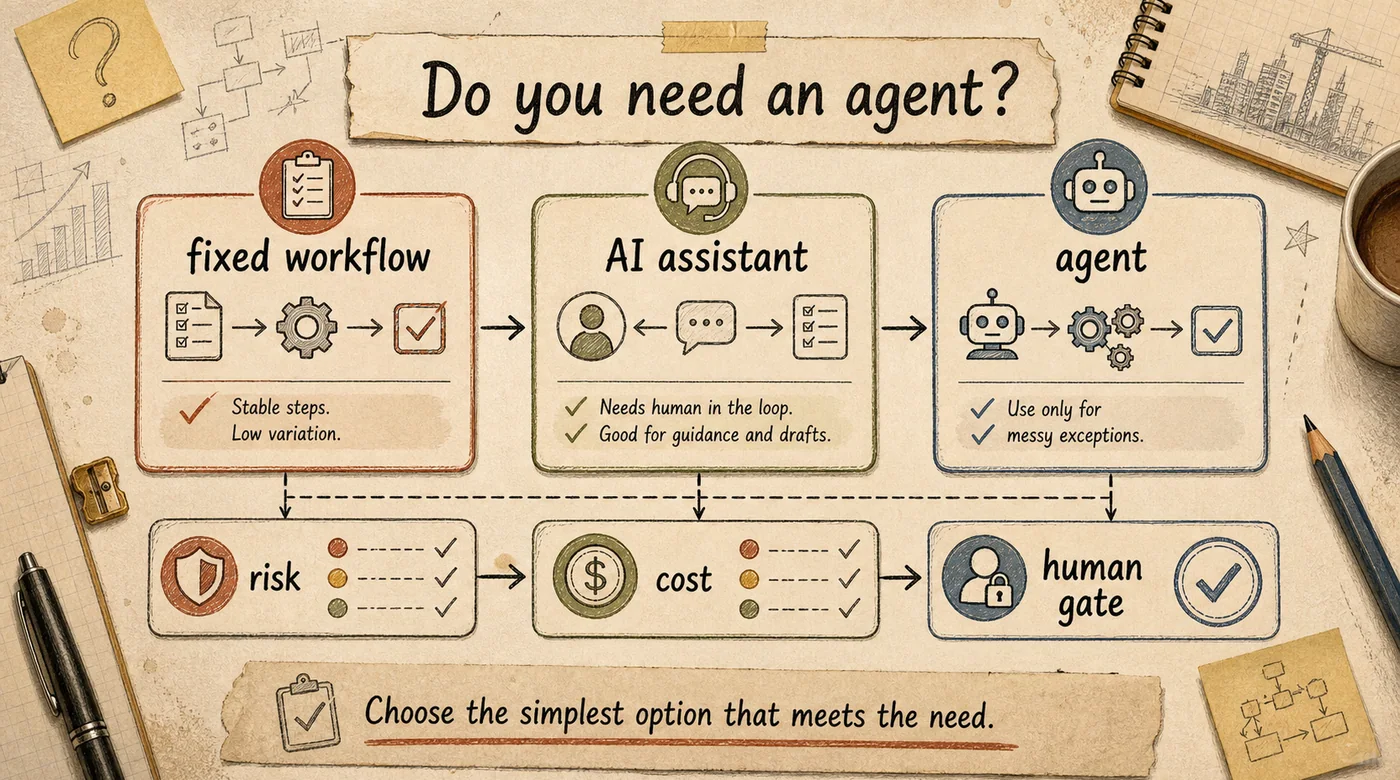
Size it by volume of routine. If repetitive requests are few — a dozen a day — a person is cheaper. An agent starts paying off when the stream of repeat tasks is large, each one costs real handling time, and the answer logic is reproducible. Support, e-commerce, clinics, high-volume hiring: those are the fit.
A second honest filter: can you draw the task as a flowchart? If you can and every branch is known, you probably want a workflow, not an agent. An agent earns its cost where the path is not visible in advance — free-form customer phrasing, many possible sources, the need to clarify and retry. The price gap is real, so do not overpay for autonomy where a process would do. Gartner also expects 40% of enterprise apps to include agents by the end of 2026, up from under 5% a year earlier. The wave is real, but the winners are the teams that closed a specific slice, not the ones that bought "an agent" in the abstract.
How to run a 30-day pilot
Week one is not about the model. It is about real conversations. Pull recent chats, tickets, and employee questions. Mark what repeats, where time leaks, and where customers get confused. The design comes from that evidence, not from imagination.
Week two puts the agent in copilot mode. It summarizes, drafts replies, and flags missing fields, but it sends nothing to the customer on its own. The team marks what helps and what annoys.
Week three is a narrow live slice. One stream: bookings for a single location, or answers to buyers in one product category. A narrow process is easier to measure and safer to fix.
Week four is measurement. Time to first response, share of requests closed without a human, bookings, handoffs, complaints. If it got faster but customers are confused, that is not a win — fix the design instead of celebrating the speed.
For this kind of build you do not want a bot builder. You want a custom AI agent for the workflow: it has to read data, update statuses, hold context, hand off to a human, and leave a trail.
FAQ
What is the difference between an AI agent and a chatbot?
A chatbot answers messages inside a conversation. An AI agent completes a task inside your systems: it checks data, calls integrations, creates a record, and escalates the disputed case. The bot talks; the agent acts.
How much does an AI agent cost?
It depends on how many systems it connects to and what it is allowed to do. An agent that only reads a knowledge base is cheaper than one that writes to your CRM, order system, and payment flow and takes real actions. The honest measure is not the sticker price but the volume of routine it removes and the payback period.
Will an agent replace employees?
On repetitive routine, it takes the first line. But decisions with consequences — rejecting a customer, granting an exception, moving money — are better left with a person. The right shape is: the agent gathers facts and prepares the next step, a human approves.
What is the best first use case?
Whichever process is high-volume and bounded in risk: support intake, lead handling, booking, or employee policy questions. It is measurable and safer than handing an agent broad autonomy on day one.
If you have one painful process with a large stream of near-identical requests, start there. The quick win never comes from "an AI agent" in general. It comes from a careful agent on one concrete job.