
In short
A registered business in Kazakhstan can sell on Wildberries and Ozon without setting up a Russian legal entity — both marketplaces onboard Kazakhstani sole proprietors and LLPs directly, and Ozon runs its own Kazakhstan subsidiary for local sellers. The harder part starts after registration: choosing between operator-run and self-run fulfillment, landing goods at a warehouse across a border, and working out a tax position that a standard e-commerce accountant may not have seen before. This is the operator's version of that setup, not the marketing pitch about market size.
The reason this matters beyond Kazakhstan: it is a live case of a smaller domestic market (Kaspi.kz-dominated, roughly $4 billion in online retail) feeding sellers into a much larger neighboring one, where Wildberries and Ozon process the bulk of online retail across Russia and the wider CIS. Any seller expanding from a smaller regulated market into a dominant regional platform — the way an EU seller expands onto Amazon — will recognize the shape of the problem, even where the specific rules are local.
Registration: two platforms, two different paths
Wildberries lets a Kazakhstani sole proprietor or LLP register directly as a tax resident of Kazakhstan, through the WB Partners portal — no Russian entity required. New sellers from Kazakhstan are typically assigned an account manager who handles the country's seller base specifically, and reaching out early avoids a slower default support queue. There is a modest registration license fee, and missing the payment window voids the application, so it needs handling in the first two weeks. A refundable deposit also goes toward the seller's ad account balance, not general revenue — worth knowing before it shows up as an unexplained line item.
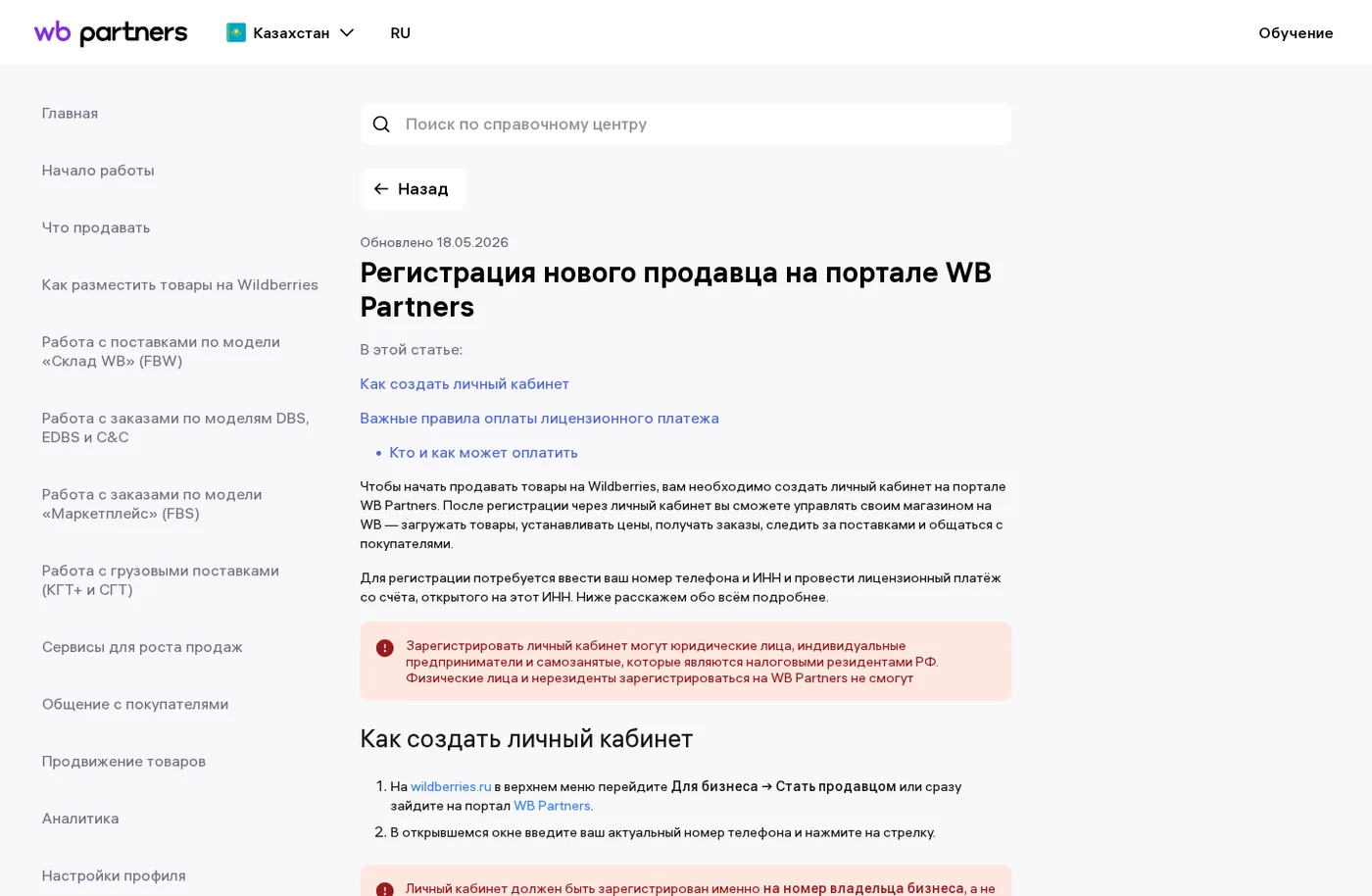
Source: the official Wildberries seller instruction for Kazakhstan registration, public page captured in July 2026.
Ozon's Kazakhstan operation is more straightforward on paper: the platform runs a local subsidiary, "Ozon Marketplace Kazakhstan" LLP, and onboarding is a short in-app flow with no annual fee. The practical difference shows up in payouts — Ozon Kazakhstan settles in tenge, while Wildberries pays out only to ruble-denominated accounts, and banks sometimes reject tenge transfers from the platform for reasons that are not always well documented. That single detail is worth confirming with a bank before the first shipment, not after a payout gets stuck.
Fulfillment: operator-run vs. seller-run
Both platforms offer the same basic choice under different names. Operator fulfillment (FBO) means goods sit in the marketplace's warehouse and the platform handles picking, packing, and delivery. Seller fulfillment (FBS) means the seller holds inventory and ships each order to a sorting center as it comes in, with the platform handling delivery from there.
For a Kazakhstan-based seller, the real decision is logistics, not theory. FBO removes daily fulfillment work, but requires getting stock to a warehouse — increasingly one of the platforms' own logistics hubs near Almaty or Astana rather than a facility deep inside Russia, which shortens the supply chain. FBS costs less to hold inventory under, and suits products with unstable demand or a long tail of SKUs where operator storage fees add up fast, but it turns daily pick-and-ship into a job the seller has to staff.
Ozon's logistics pricing for Kazakhstan-based sellers scales with product volume and price and varies significantly by category — on low-ticket items, logistics alone can absorb most of the margin, which is worth running through the platform's calculator before listing a product, not after the first batch ships.
Commissions and what actually reaches the seller
Commission on both platforms is category-based rather than a flat marketplace fee, closer to how Amazon's referral fee varies by category than to a single blended take rate. Apparel and home goods commissions tend to run higher on Wildberries than the equivalent Ozon categories; electronics and higher-ticket goods typically sit lower on both. Commission is deducted from the sale price, not added on top — build that into pricing up front, or the gap only becomes visible in the payout.
Delivery and reverse logistics on returns are billed separately from the core commission on both platforms. On lower-ticket goods, returns do not just erase margin on the returned order — they drag down unit economics for the whole SKU if the product gets ordered for fit or comparison more than it gets kept.
The tax change that catches sellers off guard
The most disruptive change for 2026 is not a marketplace rule — it is a Kazakhstani tax rule affecting how marketplaces can account for purchases from small sellers. Wildberries has told Kazakhstani sellers to move off the simplified tax regime and onto the general regime, because a counterparty above a certain turnover threshold can no longer expense purchases from sole proprietors on simplified taxation or a patent. For an affected seller, that means corporate income tax and VAT instead of a flat turnover-based rate — commonly a 10-20% increase in overhead compared to what the original margin model assumed.
Export currency control has also tightened: starting in 2026, confirming the zero VAT rate on exported goods requires a fuller documentation package — contract, transport documents, an acceptance act. A generic accountant is usually not enough here. Get one who has already handled Wildberries or Ozon sellers, because classifying the income itself — the amount the platform transfers versus a partner's reported compensation — does not map cleanly onto standard bookkeeping categories.
How this compares to selling on Kaspi.kz
The comparison usually gets reduced to commission rates, but the mechanics are different in kind. Kaspi.kz is the domestic Kazakhstan market end to end: tenge settlement, Kaspi Red installment financing built into demand, and a seller rating calculated entirely on local order performance. We covered the operating detail of that cabinet separately in the Kaspi Merchant guide — API token, commission structure, order status timing — and much of that logic will look familiar to anyone already selling there.
Wildberries and Ozon are a different market by scale: the same product competes against hundreds of thousands of Russian sellers, not a domestic shortlist. The upside is real reach — Kazakhstani sellers on Wildberries can sell into Russia and the wider CIS, not just at home. The downside is that platform rules, currency control, and logistics policy are set in Moscow, with less local support infrastructure than Kaspi provides.
For most sellers with a fitting product range, the practical answer is running both rather than picking one: Kaspi for stable local demand and installment-driven conversion, Wildberries and Ozon for access to Russian market volume. Keeping inventory and pricing in sync across three seller cabinets is a separate operational problem, and it becomes a bottleneck faster than most sellers expect.
Where sellers lose money
A few patterns repeat across new sellers regardless of platform: listing a product without re-running logistics and commission math for that specific item, then finding negative margin after the first few sales; running inventory in a spreadsheet on one device and failing to sync it across three storefronts, so orders come in for stock that no longer exists; missing the general-tax-regime deadline and getting a payout hold instead of a warning. There is also a volume problem specific to running several platforms — once daily orders cross roughly 50-100 spread across three cabinets, manual status handling and buyer questions consume the whole day, leaving no time to expand the catalog.
When to automate
The first automation target is not the marketplace interface itself — it is the connection between the warehouse and three separate seller cabinets. If stock lives in a spreadsheet or an ERP and orders arrive from Wildberries, Ozon, and Kaspi at the same time, manual syncing eventually fails: a listing stays active at zero stock, and that hits seller rating on more than one platform simultaneously. The operational shape of this problem is close to what we cover in how to run AI alongside 1C, WhatsApp, and Excel — multiple systems of record feeding one operational layer.
The second target is buyer messaging and exception handling: confirming delivery address on FBS orders, answering return questions, resolving damage disputes. The same principle applies here as on Kaspi: not a rules-only chatbot, but an AI agent that reads order status through the platform API, answers routine questions, and routes anything unusual to a person. We built a similar operating layer for marketplace sellers in sellerbox.ai — order and inventory workflows wired into the actual seller process, not a chat widget bolted on top.
Run the pilot narrow: one channel first — FBS order questions on a single platform, for instance — over two to three weeks, measured on first-response time and the share of orders handled without a person. If rating holds and the load on the team drops, extend to a second cabinet. The budgeting logic for a pilot like this follows the same shape as any AI implementation cost planning: narrow scope first, deeper integration only once the narrow version proves out.
FAQ
Does a Kazakhstani seller need a Russian legal entity to sell on Wildberries?
No. A Kazakhstani sole proprietor or LLP registers directly as a Kazakhstan tax resident through WB Partners. Payouts, however, go to ruble-denominated accounts, which is worth confirming with a bank before the first shipment.
FBO or FBS — which fits better?
FBO is operationally simpler but requires getting stock to a marketplace warehouse and paying storage fees. FBS avoids storage cost but makes daily pick-and-ship the seller's job. Unstable or long-tail product ranges tend to fit FBS better; steady sellers usually do better on FBO.
Why is Wildberries pushing sellers off the simplified tax regime?
Starting in 2026, counterparties above a certain turnover threshold can no longer expense purchases from sellers on simplified taxation or a patent. Affected sellers move to the general regime, which raises overhead — worth modeling before the deadline, not after a payout hold.
Is it worth selling on Kaspi and Wildberries/Ozon at the same time?
Usually yes, if the product range and logistics support it. Kaspi covers stable domestic demand with installment financing; Wildberries and Ozon open up Russian and CIS market volume. The bottleneck is keeping stock and pricing synced across all three cabinets, and it's worth planning for before order volume outgrows manual tracking.
If sales already run across two or three platforms, the first fix is usually consolidating stock and order status in one place — before manual syncing starts costing more than automating it would.