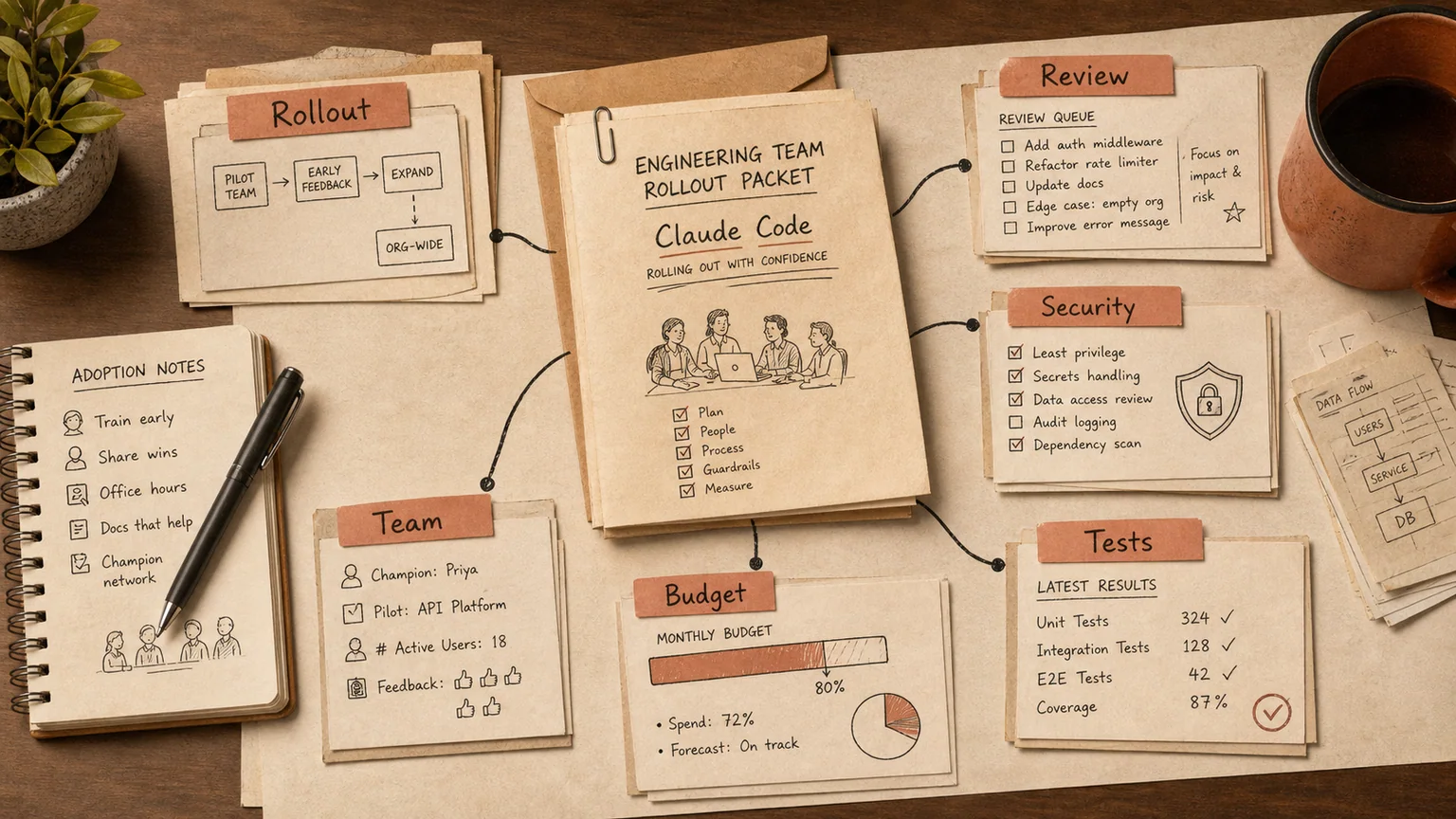
In short
Claude Code is Anthropic's agent that lives in your terminal, reads the repository, edits files, runs tests, and commits. It is not editor autocomplete. It is a task executor that plans the work, touches the code, checks the result, and hands it back. We use it daily, so this is written from our own scars rather than a vendor deck.
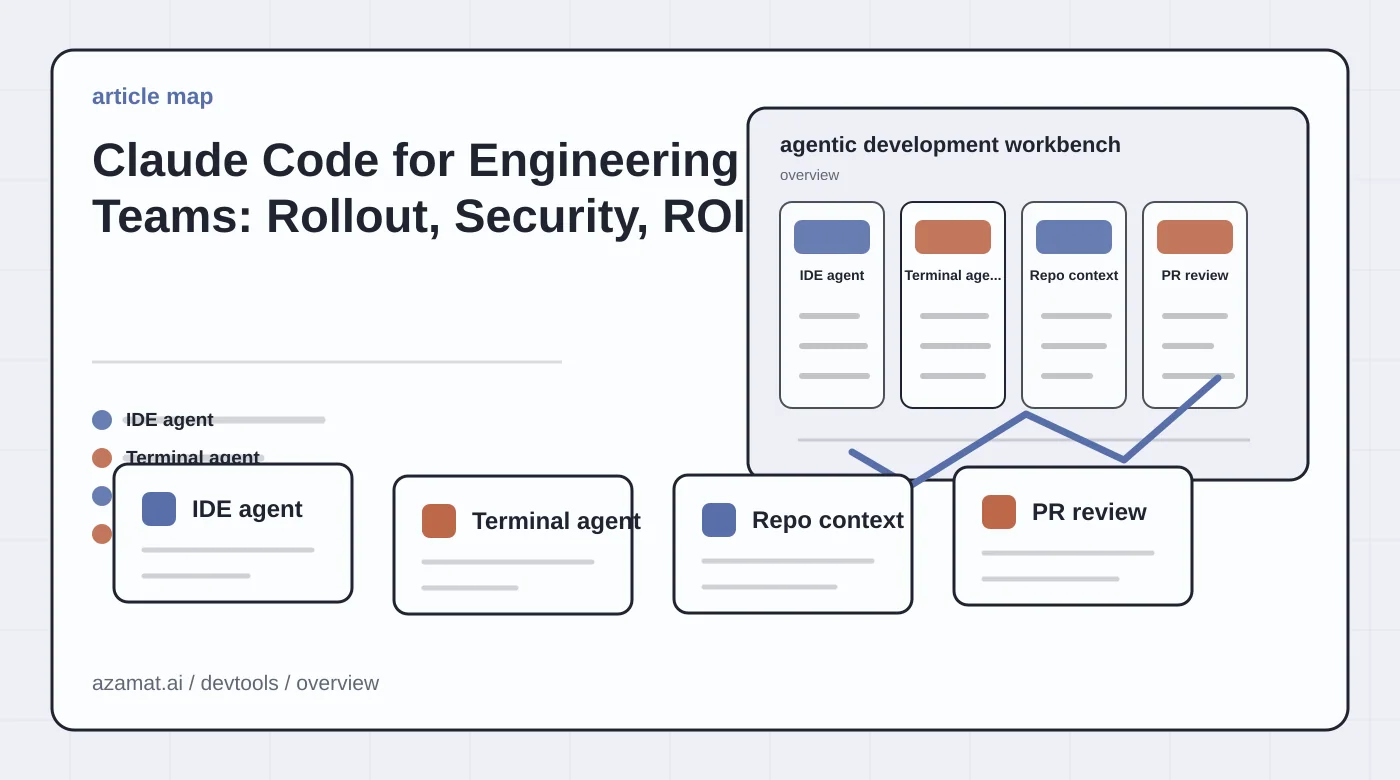
Rolling out Claude Code for engineering teams is not "buy seats and celebrate." It is three separate questions: who can reach which code, what the agent is allowed to touch, and how you know it paid off. Skip any one and you get leaked secrets, a pile of code nobody read, or a token bill with no visible effect. This is a practical walkthrough of all three, with the uncomfortable part kept in: the return does not land for everyone, and rarely on day one.
What Claude Code is, and why it is not autocomplete
Copilot-style assistants finish the line you are typing. You still drive; they suggest the next turn. Claude Code is a different class of tool: you describe the task in words, and it decides which files to open, what to change, which commands to run, then returns a finished result with an explanation. The gap between those two modes is a gap in accountability, not just capability.
That is the real shift for a team. With autocomplete, a developer owned every line because they typed it. With an agent, they own code they did not write by hand but did read and approve. This changes the job, not just the tooling: value moves from typing speed to framing a task well and reviewing work you did not author. Teams that never say this out loud end up with reviewers who click approve without reading.
If you have not settled on a tool yet, we put the hands-on comparison of Claude Code, Cursor, and Copilot in a separate breakdown. This article assumes the choice is made and covers the rollout.
Access control: who reaches which code
The first question is not about AI at all. It is about where your data goes. By default, Claude Code sends the contents of the files it reads to Anthropic's API. Anthropic states it does not train models on business-tier customer data, but for a CTO that is a contract clause to read, not an article of faith.
A sane access model looks like this. Corporate accounts through SSO rather than personal developer logins, so you can revoke access when someone leaves and see who ran what. Repository-level separation, so the agent working on the frontend does not need to see billing code or payment gateway keys. And managed configuration pushed centrally, instead of every machine assembled by hand however the developer felt that day.
Treat the tooling itself as attack surface. In early 2026, researchers disclosed a flaw where the ANTHROPIC_BASE_URL environment variable could silently redirect Claude Code traffic to an attacker-controlled server and exfiltrate keys and conversation content. The lesson generalizes: agentic tools are part of your supply chain, and their configuration deserves the same rigor as production, not the casual trust you give a utility a developer installed on their own.
Code and secret policy
This is where most teams break. An agent reads files to do its job, which means anything in the repository will, at some point, be read and sent to the API. The first rule is old and boring: no secrets in the code. Keys, tokens, database passwords belong in environment variables and a secret manager, and .env files and dumps belong in an ignore list the agent physically cannot read.
The second rule is about what the agent is allowed to run. Claude Code asks for confirmation on sensitive operations by default: deleting a file, running a shell command, reaching the network. Nobody should disable that permission "because it slows me down." A developer who tells the agent to act without asking will eventually get an rm in the wrong directory or a secret committed into history.
The third is MCP servers. These are how Claude Code connects to external systems: databases, trackers, internal APIs. Each server is a new door. In 2026, Snyk counted hundreds of public extensions leaking credentials and dozens carrying outright malicious payloads. So the list of approved MCP servers should be governed and pinned centrally, not "found one on GitHub, plugged it in, works." When the agent needs to reach real internal data, it is safer to route that through a governed GPT integration with logging and scoped permissions than through a random connector.
CLAUDE.md: where the team negotiates with the agent
CLAUDE.md is a file at the repository root where you explain the project rules to the agent: how the architecture is laid out, how the build runs, which commands run the tests, what not to touch, which style to follow. The agent reads it at the start of every session. It is the same onboarding document you would hand a new junior, except a machine reads it, and reads it literally.
What actually works in our practice:
Keep the file short. Anthropic recommends staying near 200 lines; a long file burns context and, paradoxically, is followed less well because the agent drowns in instructions. Write specifics, not "write good code": the build command, the test command, forbidden directories, the checks required before a commit.
In a monorepo, use nested CLAUDE.md files per package. Shared rules at the root, module specifics next to the module. Otherwise a frontend rule leaks into the backend and the agent applies it where it does not belong.
Separate shared from personal. The team CLAUDE.md in the repo is the standard that binds everyone. A developer's personal habits, favorite aliases, local paths, live in their own config, not imposed on the team through the shared file.
Most important: make the agent show evidence instead of reporting success. "Tests passed" without the test output means nothing. A line in CLAUDE.md like "before you say done, show the output of the command you ran" saves hours of re-checking. It is the same principle as evals for AI projects: do not take the model's word, verify against concrete scenarios.
Metrics: how you know it works
The first trap is measuring lines of code. The agent will generate as many lines as you want, and that says nothing about value. Worse, extra code is not an asset. It is future debt someone will read and maintain.
Measure other things. Time from task assignment to a merged PR, and whether it drops. The share of tasks the agent carried to review without rework. Review time, where you have to watch for the reverse effect: if juniors ship piles of machine code, seniors start spending more time reviewing, not less. Reporting in 2026 put senior engineers at 20-35% more review time where juniors lean heavily on AI. If that is your picture, you did not get faster; you moved the work from one set of shoulders to another.
And count the money honestly. The seat license is not the only line item. Agentic tools burn tokens, and per active developer that runs into a meaningful monthly figure. ROI models that use only the subscription price overstate the return by tens of percent. The honest industry picture in 2026 is more modest than the marketing: real savings on routine work, almost none on hard problems.
Where the ROI is real, and where it is not
A McKinsey study across thousands of developers found AI tools cut roughly 46% of the time on routine tasks, boilerplate, tests, documentation. On high-complexity work the gain drops below 10%, and that is the honest ceiling most "10x productivity" decks crash into.
So it is clear where Claude Code pays off. On routine work: migrations, test coverage, rewriting legacy against a known pattern, orienting inside an unfamiliar repo, draft integrations. Here the agent genuinely takes hours off the plate. A large Pragmatic Engineer survey in early 2026 put Claude Code among developers' favorite tools for agentic work, and not by accident.
Where it does not pay off: tasks that need domain understanding the code does not contain, product decisions, non-trivial architecture, debugging race conditions and subtle failures. Places with no tests and no review, where the agent simply produces unverified code faster. And juniors left unsupervised: 2026 research shows newcomers with AI sometimes work slower while feeling more confident in code that is actually flawed. AI-written code carries noticeably more issues on average than hand-written, and some vulnerabilities pass unit tests but fail in production.
The conclusion is not "the tool is bad." It is that ROI lives in the pairing of a routine task, tests, and sane review, not in the act of buying seats. When 84% of professional developers now use or plan to use AI coding tools, the differentiator is no longer access; it is the discipline around it.
The CTO fears, and what to do about them
"Our code leaks and trains a competitor's model." Read the business-tier terms, not the free-tier ones. Separate what the agent can even reach: critical repositories can stay off-limits entirely. Secrets stay out of code regardless. That is hygiene, not paranoia.
"The team atrophies and forgets how to program." A real risk if people stop reading code. The cure is not a ban but a rule: the agent writes, the human reviews and owns the result. Reviewing machine code is a skill to train, not retire. If 80% of the time goes to prompting and 20% to reading, you are losing your engineers.
"We drown in unreviewable code and tech debt." Also real. 2026 estimates put a significant rework share on machine code, and without discipline the maintenance cost of that code climbs sharply by the second year. The defense is tests, review, and a hard rule against merging what nobody read. The agent does not remove engineering discipline; it raises the price of not having it.
"We spend the budget and see no effect." The most common outcome when you launch without metrics. 2026 surveys name lack of ROI clarity as a top complaint about AI in general. So run a pilot on a narrow slice and measure before and after, rather than believing.
How to run the pilot
Do not roll it out to the whole team at once. Take two or three developers already comfortable with tooling and one legible slice: migrations, tests, one specific module. A narrow perimeter is easier to measure and safer to fix.
Week one is perimeter setup: SSO access, a secret ignore list, a starter CLAUDE.md, an approved MCP list. Nothing production-critical goes to the agent yet.
Weeks two and three are real work on the chosen slice with review on every PR. Collect numbers, not feelings: time to merge, rework share, reviewer load, token spend.
Week four compares against the before. Faster with no debt growth and no senior overload means expand to a neighboring slice. Faster but review is jammed means fix the CLAUDE.md and the process, not buy more seats. Same logic as any AI implementation pilot: prove value small, then scale.
If a team is picking up Claude Code from scratch, it lands faster through team training tailored to your workflow than through the whole roster collecting scars alone. Wiring the access, the CLAUDE.md, and a safe boundary can also run alongside development on your own stack when you are short on internal hands.
FAQ
Is Claude Code safe for proprietary code?
As safe as the perimeter you set. Secrets out of code, access through corporate accounts and SSO, an approved MCP server list. On the business tier, read the terms on training. Without that hygiene no agent is safe, not only Claude Code.
Will Claude Code replace developers?
No. It removes routine and speeds up typical work, but accountability for the code stays with a person. The job changes: less typing, more task framing and review. A team that does not review machine code does not win; it accumulates debt.
What does Claude Code cost for a team?
Beyond the subscription, count tokens; per active developer that is a meaningful monthly figure. ROI models based on the license price alone overstate the return. Honest ROI comes from a pilot with before-and-after measurement, not the price sheet.
What goes in CLAUDE.md?
Build and test commands, forbidden directories, required pre-commit checks, style, and a demand to show command output instead of reporting success. Keep it short, around 200 lines. In a monorepo, use nested files per package.
If you want to start without risk, take one narrow slice, set the perimeter, and measure the effect honestly. The value does not come from "we adopted Claude Code." It comes from a careful pairing of the tool, tests, and review on a concrete task.