
In short
Most founders don't ask "do we need a CTO" in the abstract. They ask it after something specific breaks: a vendor blows through a third deadline, nobody can explain why the app goes down every Friday deploy, or an investor asks "who owns your technology" and the honest answer is nobody, exactly.
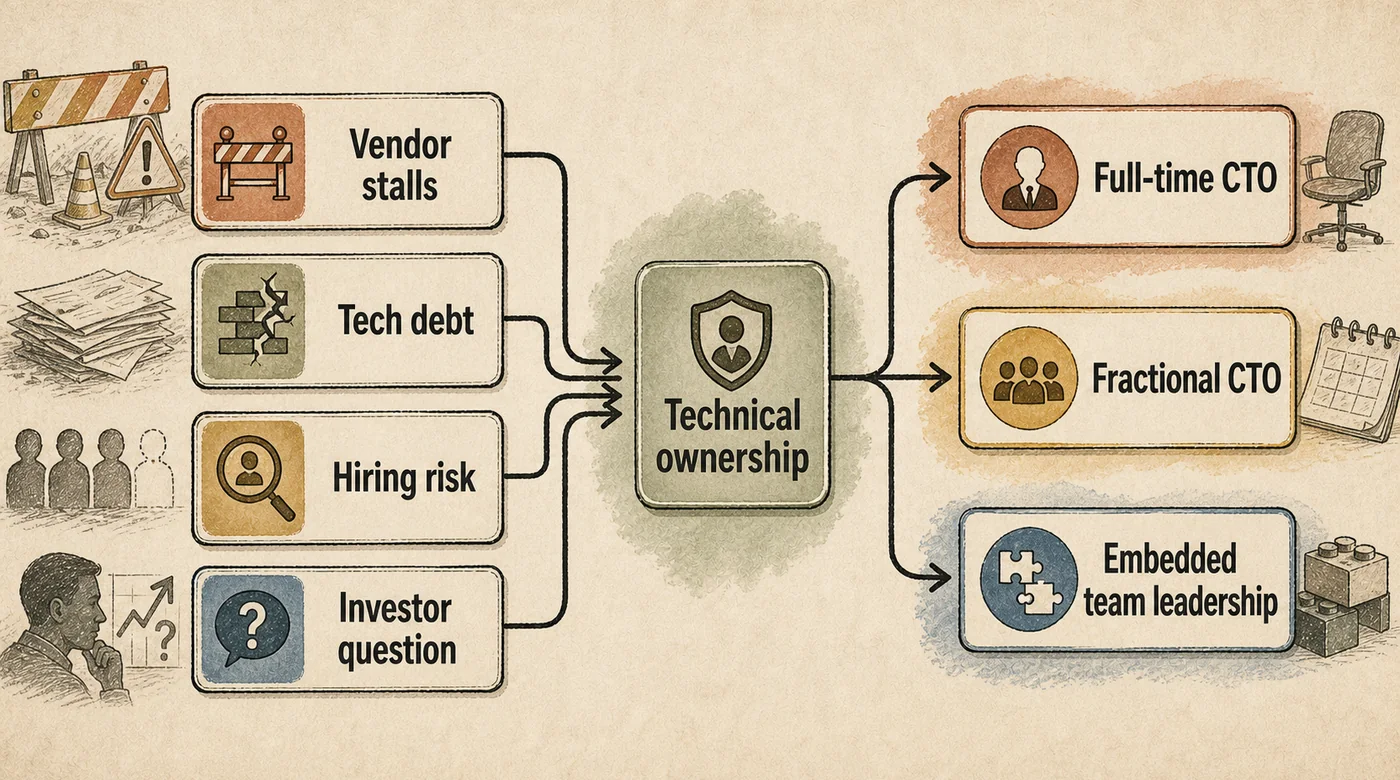
Hiring a CTO isn't about filling an org-chart box. It's about the point where technical decisions have become frequent enough, and expensive enough to get wrong, that they can't be managed on gut feel anymore. Below that point, a strong tech lead, a contract architect, or a development team whose senior engineers already carry technical ownership will usually do the job for less money and less risk.
Three signs the moment has arrived
Vendors keep stalling and you can't tell why. The first sign rarely announces itself as "we need a CTO." It shows up as "this contractor isn't working out, let's find another one." Two vendor swaps later, the pattern repeats: timelines slip, the architecture gets rebuilt from scratch each time, and nobody gives you a straight answer about why. That's usually not bad luck with vendors. It's that evaluating a technical vendor requires someone who understands the domain — without that, you're buying the same blind bet from a different seller.
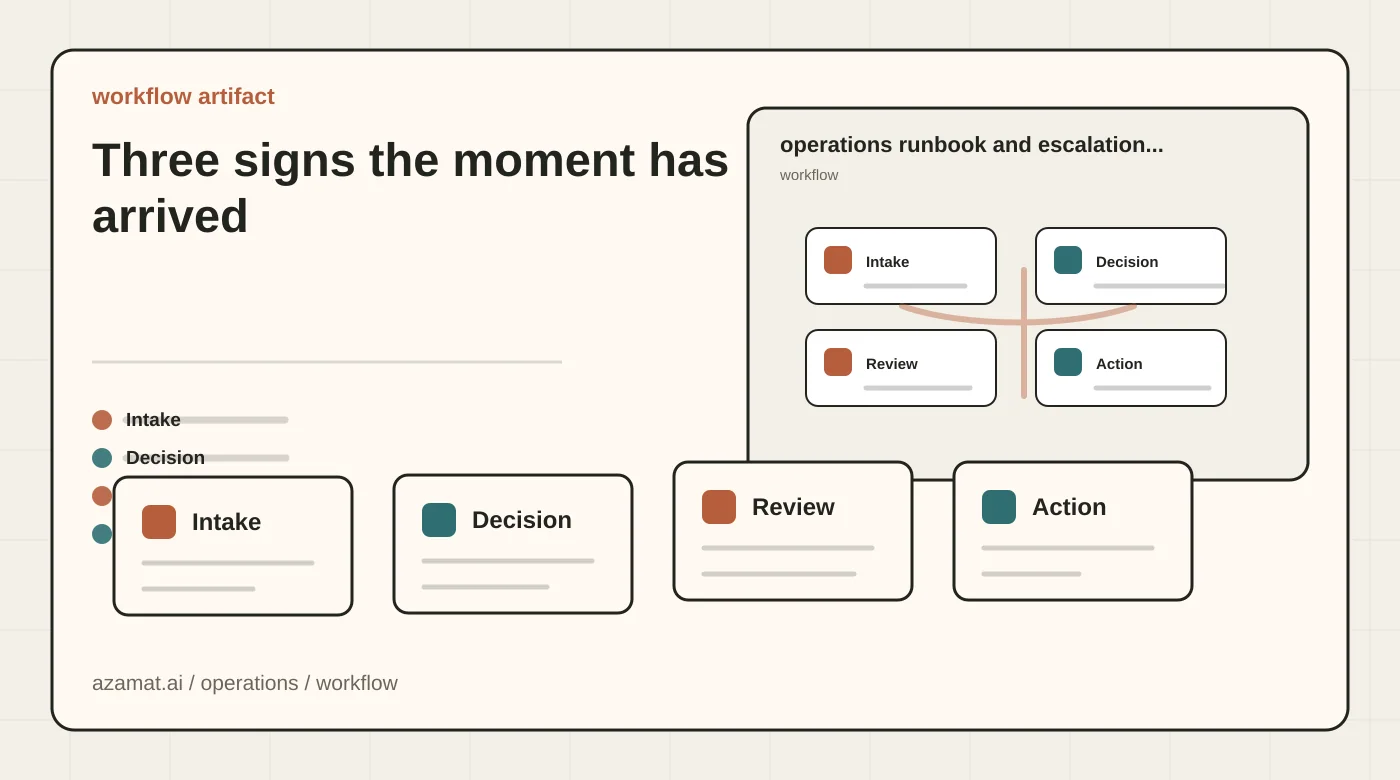
Tech debt has become a recurring agenda item. Early on, almost any code works. The trouble starts when each new feature takes longer to ship than the last one, with the same team size. Engineers start saying "that part's fragile, nobody's touched it in months," releases get delayed, and bug fixes spawn new bugs. Without someone accountable for the system as a whole, not just their own corner of it, tech debt compounds faster than the product grows.
Hiring has started, and nobody can evaluate the engineers you're hiring. The first one or two engineers can be hired on referral and instinct. That stops working around hire three: you need someone who can tell whether a candidate's resume matches their actual skill, set up code review, and agree on engineering standards. Hiring engineers without an engineer in the loop is a bet with rising stakes — the cost of a bad hire grows with the salary attached to it.
There's a blunter version of this signal too: if an investor asks who owns your technology in a pitch meeting and you can't name a person, that's an answer in itself.
CTO vs. tech lead vs. architect
Part of why this decision gets delayed is that the three roles get used interchangeably, and none of them substitutes for the others.
An architect designs the system: what services exist, how they talk to each other, where data lives. That's deep technical work, and it's largely finished once the system is designed and built.
A tech lead runs the team day to day: assigns tickets, runs code review, resolves in-sprint conflicts, and watches for burnout. That's an operational role inside engineering — it doesn't extend into the boardroom.
A CTO operates above both. The job is deciding where the company's technology goes over the next year or two: which stack won't become a liability, which teams need to grow, which work should stay outsourced, what technical risk costs in dollar terms, and how to explain that to a board that isn't technical. A good architect isn't necessarily equipped to talk to an investor about risk and budget. A good tech lead isn't necessarily the person who should decide whether to rewrite the core system. A CTO is the point where a technical call becomes a business call, and back again.
The practical test for a non-technical founder: if the answer to "what do we do about our technology next" keeps coming from whoever happens to be in the Slack thread that day, the CTO function doesn't exist yet — even if someone on the team carries the title.
Full-time, fractional, or founder-led
The second question isn't whether you need the function. It's what form to buy it in. Three options cover most stages.
Full-time CTO makes sense once technology is the product, the engineering team has grown past ten people, and decisions need to be made weekly rather than quarterly. This is an expensive hire — a CTO with real scaling experience commands a package comparable to the rest of the executive team, and you have to retain them through a stretch where the company grows slower than their ambitions do.
Fractional CTO — typically one or two days a week — covers the stage where strategy and architecture are needed continuously but not at full capacity. It's cheaper and faster to bring on than a full-time hire, but it has a ceiling: a fractional CTO isn't building your team day to day, and isn't necessarily reachable when production breaks on a Wednesday night.
Founder-led technical leadership inside a development partner is the option founders often overlook, and it covers the early and mid stage just as well. In practice, this means there's no in-house CTO, but a senior engineer or the founder of the development team building your product carries technical ownership from day one, rather than as an afterthought. Architecture decisions, code review, and translating engineering trade-offs into business terms happen inside one accountable team, instead of being split between you, a vendor, and an outside advisor who sees the system once a week.
For an MVP or an early-stage product, that's often the more sensible bet than hiring a full-time CTO against uncertain product-market fit — betting on a person you'd have to let go if the hypothesis doesn't pan out costs more than betting on a team you can scale up or down with the product. This is how we build MVPs at azamat.ai: product launches run with senior engineers who own architecture directly, rather than waiting on a technical hire from the client side. The sellerbox.ai case is one example: an engineering team owned the product logic and architecture end to end, with no separate CTO hired on the client side.
How to decide if you're still unsure
If you've read this far and you're still not sure, here's the order to check your assumptions in.
Start with decision frequency. If a technical call needs to be made roughly once a quarter, a fractional CTO or a vendor with an embedded tech lead will cover it. If technical decisions are happening weekly and revenue depends on them, start budgeting for full-time. Weigh that number against what an AI or software build actually costs — a full-time CTO's first-year package can easily exceed the budget of the pilot you're trying to hire them to run.
Then price the cost of getting it wrong. A technical lead who picks the wrong stack for an MVP costs you a few lost weeks. A technical lead who mis-designs the system behind a product handling transactions and user data costs months of rewrites and a reputational hit. The higher that price, the earlier you need someone personally accountable for it.
And don't confuse hiring a CTO with fixing a vendor problem. If your current development team can't explain its own architecture, keeps missing deadlines, and gives you vague answers to direct technical questions, swapping in a new vendor with the same selection criteria won't fix anything. Before hiring a CTO or churning through another agency, it's worth revisiting how to actually evaluate a development or AI implementation vendor — a chunk of what a CTO would catch gets caught earlier, at the vendor-selection stage.
The first month, if you decide to hire
If you land on full-time or fractional, spend the first month on three things rather than searching for the perfect candidate. Write down which technical decisions cost the most over the last six months — that tells you what real experience the hire needs to have. Run the technical interview with an outside engineer in the loop if nobody in-house can judge competence; otherwise you're hiring blind again. And agree upfront on what the CTO is accountable for by the end of one quarter — not "clean things up," but specific numbers: deploy frequency, incident rate, time to ship a feature.
If that exercise shows there isn't quite a full-time role's worth of work yet, but you need hands on the product now, that's a reasonable moment to look at a build partner where technical leadership is part of the team, not bolted on separately, rather than left to the founder to cover alone.
FAQ
Can a company get by without a CTO at all?
Yes, if technology isn't core to the business or the product is simple — a marketing site, basic automation, a couple of off-the-shelf integrations. A strong contractor or an outsourced tech lead covers the function, and the founder makes strategic calls with occasional outside advice.
Can a tech lead grow into a CTO?
Yes, if they grow into the business side of the role too — budgets, risk, talking to a board — and that doesn't happen by default. It takes deliberate stretching into a wider mandate, not just a new title on the same job.
How much does a fractional CTO cost?
It varies widely by experience and time commitment, but the reference point is a day or two a week versus a full-time executive salary. As a rule of thumb, fractional makes sense while the decision load fits into a few hours a week rather than a full working day.
How do you tell if a vendor is already functioning as your CTO?
If a vendor's senior engineer is proposing architecture unprompted, explaining trade-offs in plain terms, joining product planning, and taking ownership of technical calls, the function is already covered in practice — no title required.
If you're reading this after a third missed deadline, don't jump straight to a full-time CTO hire. Figure out first whether the failure is a missing technical function or simply the wrong team for the job.