In short
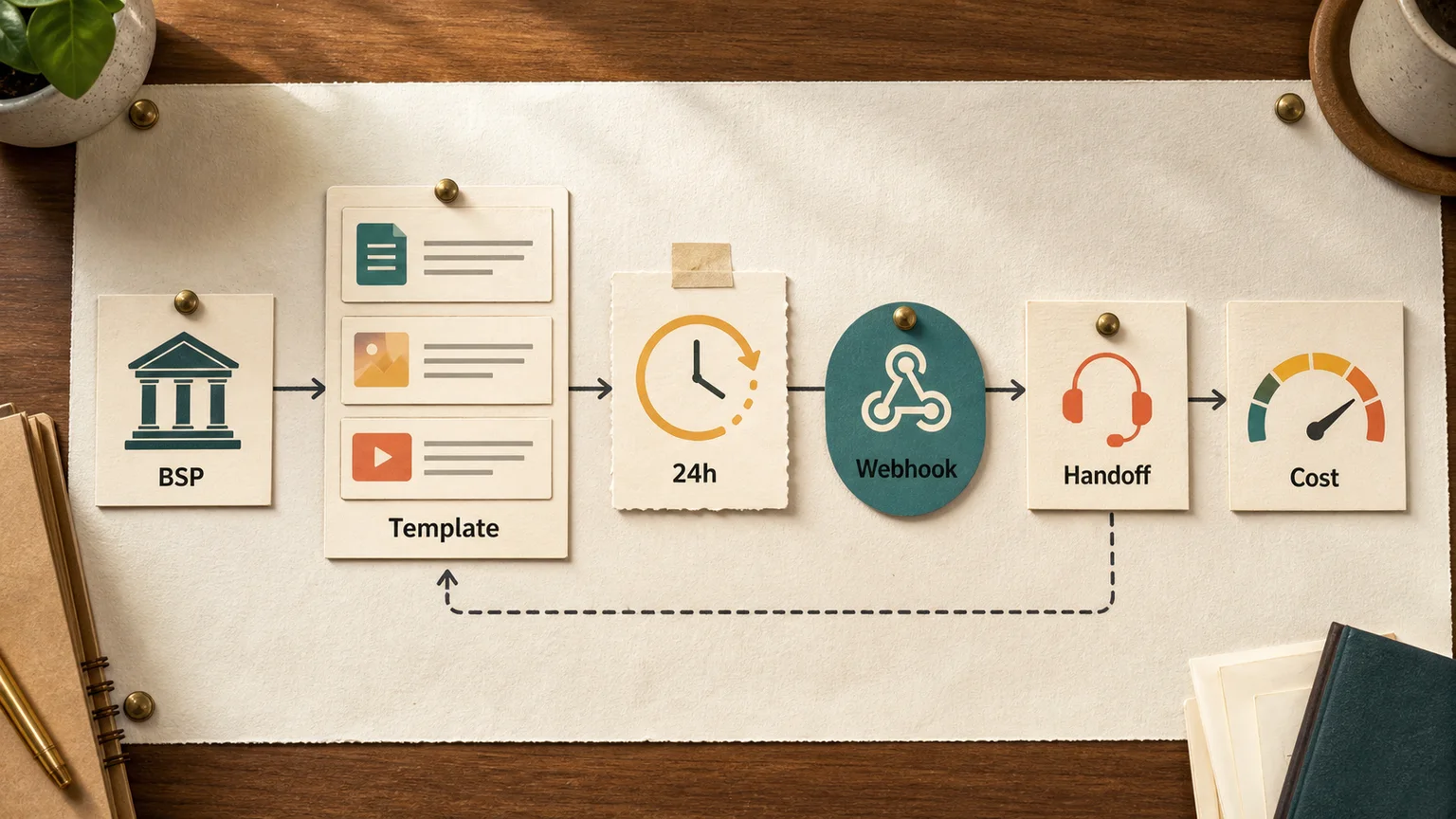
The WhatsApp Business API is not an app you download. It is a programmatic channel that lets a business send and receive WhatsApp messages from a server instead of a phone, with multiple agents, a CRM, or a bot behind the same number. You cannot sign up for it directly with Meta unless you build your own infrastructure on top of the raw Cloud API. Almost everyone goes through a Business Solution Provider, or BSP, that handles onboarding, template tooling, and billing on Meta's behalf.
The mechanics are simpler than most vendor pages make them sound: register the business, verify it, get a phone number approved, submit message templates, and pay per delivered message according to one of four categories. What actually determines cost and reliability is which category your messages fall into and which BSP is sitting between you and Meta.
API vs the WhatsApp Business app
The free WhatsApp Business app is tied to one device and one person answering. It works fine for a single owner-operator. The API removes that ceiling: the number lives with a provider, multiple agents or a bot can respond through the same number, and messages move through webhooks instead of a phone screen.
The practical differences show up in three places. The app cannot send unsolicited messages to a customer list without risking a ban; the API has an approved-template mechanism built for exactly that, with its own rules. The app has no official multi-agent support; the API does. And the app is free beyond your phone bill; the API has a real per-message cost that scales with volume.
How a BSP connection actually works
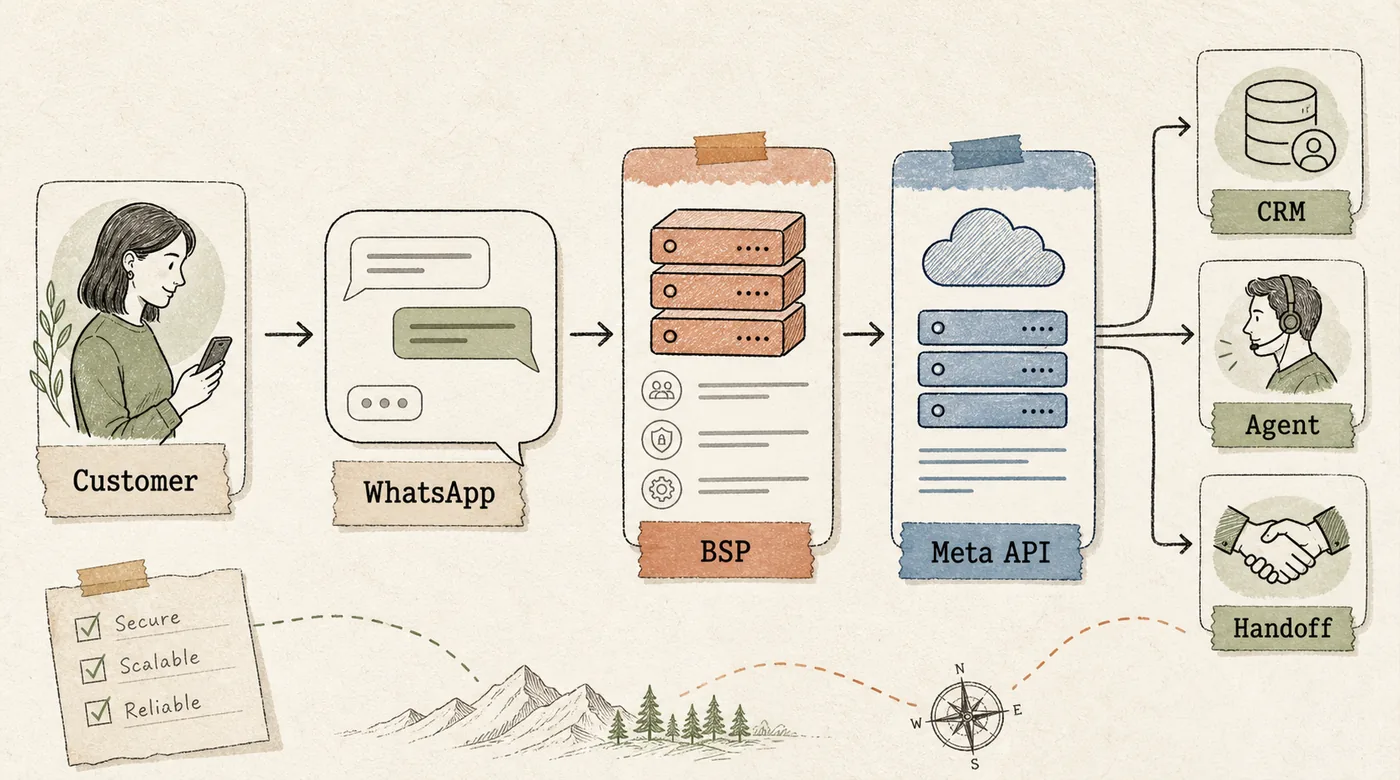
The chain looks like this: business → BSP → Meta. The provider supplies the technical layer — API access, a dashboard, usually CRM connectors — and handles the parts of onboarding that would otherwise require you to talk to Meta directly, which most small and mid-size businesses never do.
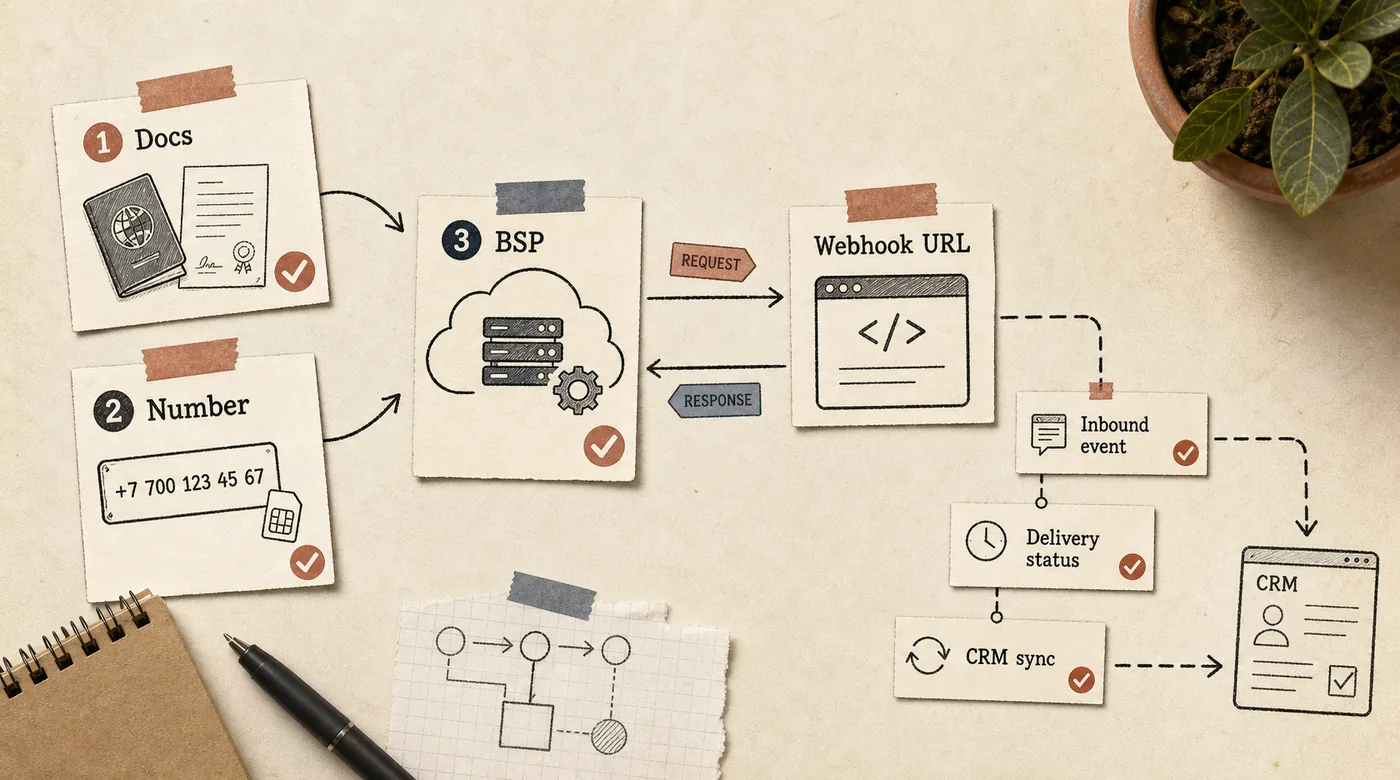
The typical sequence: register the business in Meta Business Manager and verify the legal entity (registration documents, sometimes a utility bill or bank statement matching the business name exactly). Then attach a phone number — ideally a fresh one that has never run the consumer WhatsApp Business app, since migrating an existing number means unlinking it first and losing message history in the process. The BSP then requests number verification from Meta and wires up webhooks for inbound and outbound messages. You also need at least one approved template before you can message anyone who has not messaged you first.
With documents ready, the whole flow usually takes a few business days. The slowest step is almost always business verification, especially if the legal name on file does not match the name submitted letter-for-letter.
Business verification and the checkmark
Meta Business Manager verification is required just to activate the API, and it has nothing to do with the checkmark next to your business name in chat. Basic verification (legal entity plus phone number) is enough to go live. Official Business Account status is a separate, higher bar: at least 30 days on the platform, no recent policy violations, and — the part that surprises most applicants — evidence that the brand is independently notable, typically three or more press mentions in outlets that did not run the story as paid coverage.
For most companies, chasing the checkmark is not worth the timeline. It does not unlock template sending, bot logic, or delivery status — it is a trust signal, not a technical gate. Ship on basic verification and revisit the badge later if brand recognition genuinely calls for it.
Message templates: categories and what gets rejected
Any message you send before the customer has messaged you must use a template pre-approved by Meta. A template is fixed text with variable slots — name, order number, amount, date. Once approved, the copy is locked; changing it means submitting a new template and waiting through review again.
Meta sorts templates into four categories, and the category drives both price and the rules that apply:
Marketing covers promotions, re-engagement, and broadcast campaigns. It is the most expensive tier, and as of 2026 every marketing template needs a clear opt-out — a quick-reply button like "Stop promos" — or review increasingly rejects it outright.
Utility covers transactional updates tied to something the customer already did: order confirmation, shipping status, appointment change. It costs a fraction of marketing.
Authentication covers one-time codes for login and verification.
Service is not a template at all — it is a free-form reply inside the 24-hour window that opens after the customer messages first, and Meta does not bill for it.
Template review usually clears in minutes to about a day. Most rejections are not about wording — they are about picking the wrong category, often a marketing message dressed up as utility to save money. Since April 2025, Meta has started reclassifying repeat offenders without the standard 24-hour warning window, which used to give businesses a chance to fix a template before enforcement.
What the API actually costs
Since July 2025, Meta bills per delivered template message rather than per 24-hour conversation window. If you are comparing prices against an older article, the billing unit has changed — factor that in before trusting a stale cost estimate.
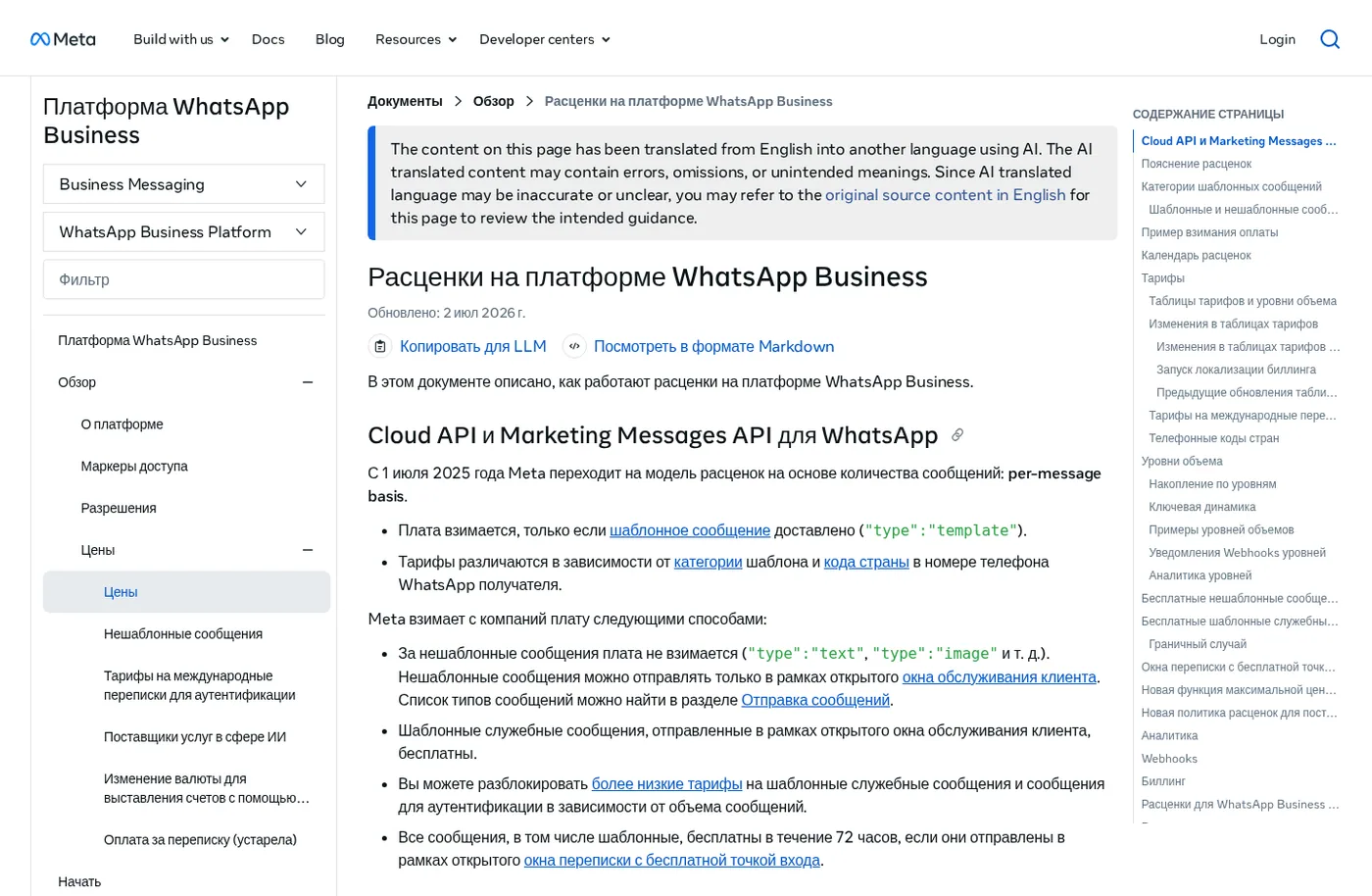
Source: Meta official WhatsApp Business Platform pricing documentation, public page captured in July 2026.
Rough order of magnitude by category: authentication and utility sit at the low end — commonly a cent or less per message in many markets — while marketing runs several times higher, and service replies inside the free 24-hour window cost nothing. 360dialog's comparison of BSP markups is a reasonable reference point: at roughly a million marketing messages a month, a flat per-message markup on top of Meta's own fee can add thousands of dollars before you have paid for any actual tooling.
On top of Meta's fee sits the BSP's own pricing, and this is where the real variance lives. Some providers pass through Meta's cost plus a flat platform fee and nothing else. Others add a per-message markup on top of Meta's rate, which erodes savings fast at volume. Ask directly which model a provider uses before signing — a small per-message surcharge sounds trivial until you multiply it by six figures of monthly messages.
There is also a genuinely free window: once a customer messages you, the next 24 hours are unrestricted and unbilled regardless of category. That window extends to 72 hours if the conversation started from a click-to-WhatsApp ad.
Choosing a BSP: Twilio, 360dialog, and the rest
For engineering-heavy teams already on Twilio for SMS, staying in the same console and auth model is convenient, though Twilio's flat per-message markup gets expensive at high volume compared to leaner pass-through providers. 360dialog markets itself as the low-markup option — Meta's rate plus a flat monthly fee, no dashboard or bot logic included, which means you build the conversational layer yourself. Providers like Wati or Respond.io trade a higher monthly fee for a ready dashboard, template builder, and basic automation out of the box, which suits teams without engineering capacity.
None of these solve the actual product question, which is what happens inside the conversation. The API is the pipe and the billing meter. The logic — what to say, when to hand off to a human, how to read order status from a backend system — has to be built on top, either as a simple templated flow or as an AI agent that reads free text and pulls real data instead of matching keywords.
The limits nobody puts on the pricing page
You cannot message someone first without an approved template — that is enforced, not a suggestion, and disguising a marketing push as a "close enough" utility template gets caught and throttled. You cannot edit an approved template's copy on the fly; variables are editable, structure is not. And you cannot ignore block rates: if too many recipients report or block a number, Meta lowers that number's messaging limits, which shows up as a quality-rating drop that throttles new conversations regardless of template approval.
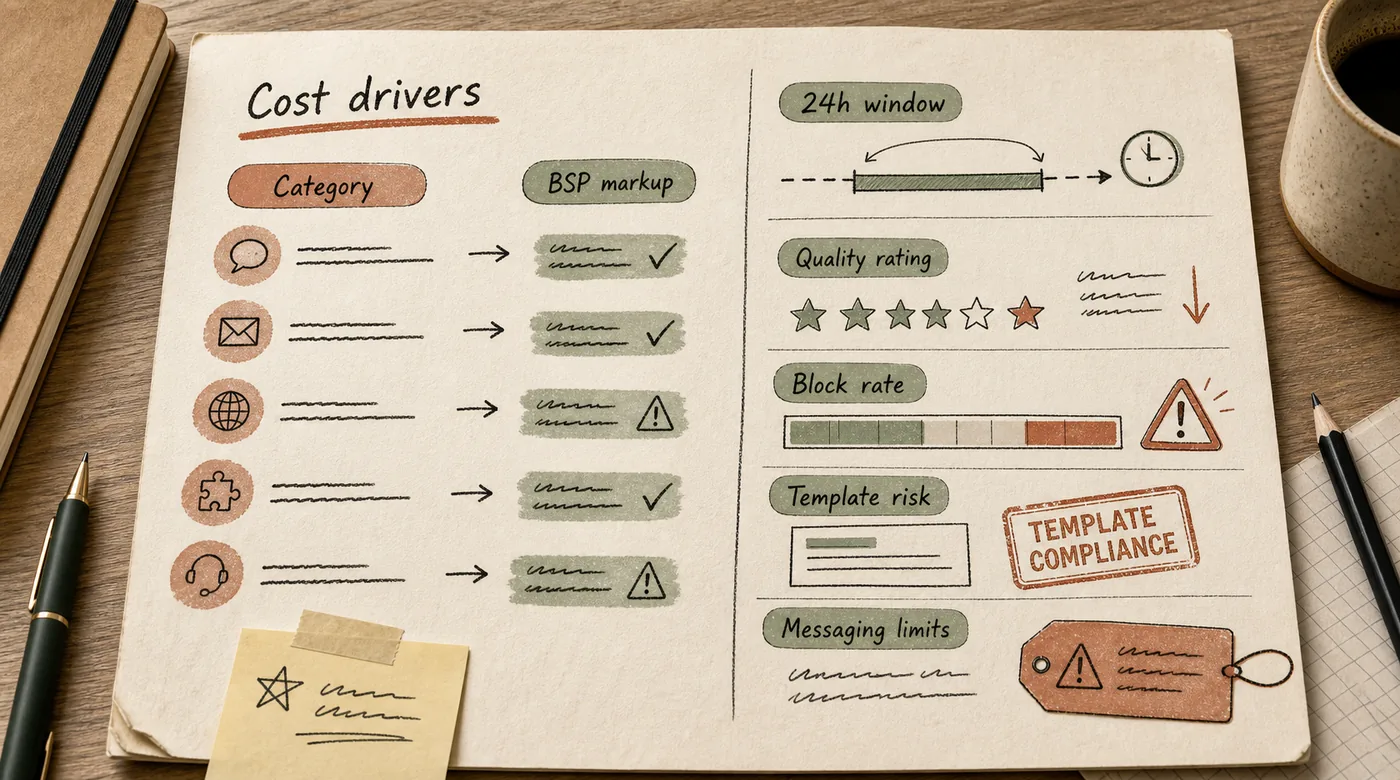
Multilingual traffic is its own failure mode. A template approved in one language does not cover a customer who replies in another — that needs a separate approved template and, usually, separate bot logic, not a live auto-translate layer bolted onto the API.
Where this goes next: templates alone are not a product
The API by itself is a pipe. What happens in a conversation is decided by whatever logic sits on top of it. Order confirmations and shipping alerts fit inside a template and a script; campaign and reactivation traffic also has to respect the limits covered in WhatsApp broadcasts without a ban. Sales questions, availability checks, and anything that requires reading current data from a CRM or backend system need more than a fixed template — they need a system that can read free text, check a real source of truth, and know when to stop and hand the thread to a person, which is closer to how our WhatsApp AI agent work in Kazakhstan is scoped for clients running high message volume through the same channel.
We wired a version of this for a retail chain in the Magnum notifications project: the API supplied the channel and the billing meter, but the actual decisions — who answers, when to escalate, what to send on a repeat contact — had to be built separately on top, and that layer is what decides whether the integration pays for itself or turns into one more dashboard nobody maintains.
FAQ
Can I use the WhatsApp Business API without a BSP?
Technically yes, through Meta's Cloud API directly, but then you own all the infrastructure — message handling, template storage, billing reconciliation, number quality monitoring. For most businesses that is not worth the engineering cost; a BSP exists precisely to absorb it.
How much does the WhatsApp Business API cost per month?
Two line items: what Meta charges per delivered message by category, and what the BSP charges for its dashboard and connectors. At moderate volume, Meta's bill is often smaller than people expect; the BSP's platform fee or per-message markup is usually the bigger variable.
Do I need business verification if I already run the free WhatsApp Business app?
Yes — the number has to be detached from the app and reconnected through a provider. Existing chat history does not carry over automatically, which is worth planning for before the switch.
What happens if a marketing template gets submitted as utility to cut costs?
Meta catches this in review or through user complaints and can downgrade the number's quality rating or reclassify the template outright. Since April 2025, repeat violations skip the standard warning window entirely.
Once the provider and templates are sorted, the real question is who — or what — answers inside that channel. That decision is what turns WhatsApp from one more inbox on a manager's phone into an actual sales channel.