In short
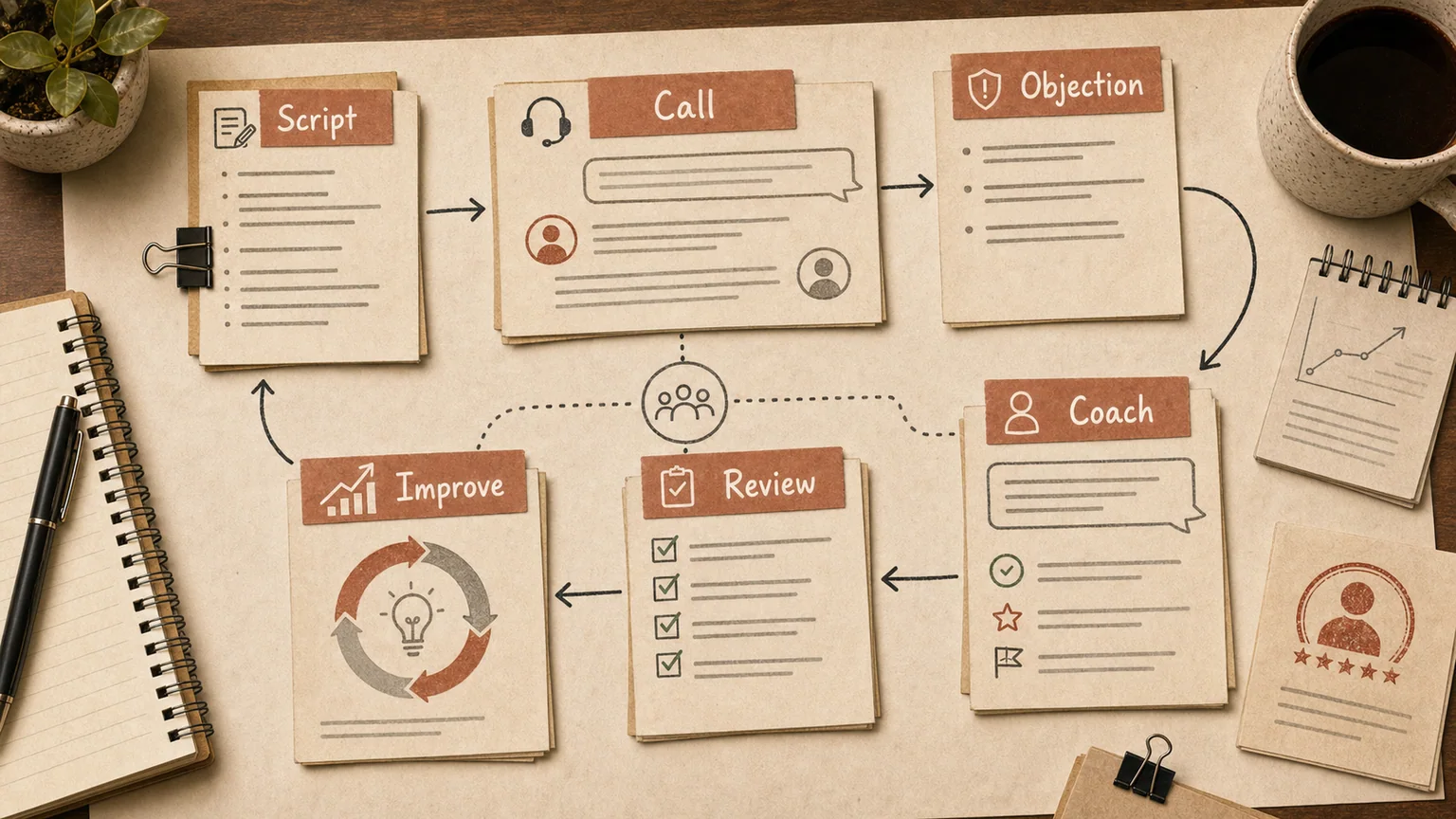
AI sales scripts work best as a decision tree, not a page a rep reads word for word: opener, qualifying questions, branches for the objections that actually come up, and a clear next step. AI is useful on both ends of that job. It can draft a first version from real call transcripts instead of a manager's best guess, and it can then check recordings to see whether reps actually followed what got written.
The usual failure mode is a script written once and never touched again. Six months later it still quotes an old price and has no answer to the objection buyers raise most now. AI fits neatly into that gap: it reads hundreds of real calls, finds where reps lose the buyer, and drafts language close to what already works for the strongest performers on the team. Then it checks the next batch of calls against the script instead of leaving that to a manager's spot checks.
What a script needs to actually hold up on a call
A bad script is a monologue the rep has to recite. A good script is a structure with decision points built in.
Five parts do most of the work. The opener buys the right to keep talking: who you are, why you're calling, a check that now is a reasonable time. Qualifying narrows down who you're actually talking to and what to lead with — role, current situation, urgency, budget range where relevant. Skip this and the rep pitches the wrong thing to the right person.
The pitch itself should map to what qualifying just surfaced, not recite every feature the product has. Objection handling covers the four or five things buyers say most often — Gong's analysis of 300M+ cold calls found that a small handful of objection categories account for the majority of pushback, so a script that handles those well covers most real calls. The last piece is a next step with a date attached: a demo Tuesday at 3pm, a contract to review, a follow-up call after the buyer checks with their boss. "We'll circle back" is not a next step. It's a lost deal wearing a disguise.
A script should also say out loud where a rep can improvise and where they can't. Price, delivery timelines, legal terms, and discounts are not places for on-the-spot creativity, no matter how close the deal feels.
Drafting a script from real calls instead of a template
The common mistake is asking a model to "write a cold call script for a SaaS company" and getting back something generic enough to apply to any company and specific enough to help none of them.
The better process starts with 30-50 real conversations: closed-won calls, calls that went nowhere, chat transcripts where the buyer eventually converted and ones where they went quiet. AI can process that batch and surface which openers held attention, which qualifying questions got useful answers, and how the team's best reps handled the objections that show up most.
From there the model can draft two or three phrasings per section — not one canonical script to memorize, but variations a sales lead edits rather than writes from scratch. That beats the classic two-hour whiteboard session, and it's grounded in what your own reps already said on calls that closed, not a framework borrowed from an unrelated industry. If a team already has a call recording archive, a first draft can come together in a day or two instead of two weeks of shadowing top performers. It's the same logic behind AI for sales teams generally: the model formalizes what strong reps already do and makes it available to everyone else.
Example: a script for a B2B discovery call
Here's a short version for an inbound lead requesting a product demo.
Opener: "Hi [name], this is [name] from [company] — you requested a demo through the site. Do you have two minutes?"
Qualifying: "What's driving the timing on this? Who else would be involved in a decision like this? Is there a rough budget range you're working with, or is this more exploratory right now?"
Pitch: if the answer points to a specific pain point, lead with the one feature that solves it, not the full product tour.
Objection — "we already use a competitor": "Got it — what's working well with that, and what isn't? A lot of teams keep both running for a quarter before they decide, so I'm not asking you to switch today." Then a pause, not a push.
Next step: "I'll send over a two-pager today. Are you free Thursday for a 15-minute call to see if this is worth a longer look?"
Notice what's missing: no final price, no delivery commitment. Those stay outside what the rep decides alone, on purpose.
Where scripts break down: chat and messaging
Increasingly the first real conversation with a buyer happens in chat, not on a call — live chat, SMS, or a messaging app depending on the market. A chat script needs different pacing: shorter lines, one question at a time, more white space, because the buyer is typing between other things, not sitting on a call.
A lead comes in asking about pricing for a project management tool:
Buyer: "How much is the team plan, and does it work with our existing setup?"
Rep (per script): "Team plan starts at $12/seat/month, billed annually. What are you using now, out of curiosity? A lot of teams migrate from spreadsheets or from a tool that's outgrown their headcount."
Buyer: "We're on a competitor, it's just gotten expensive as we've scaled."
Rep (objection branch — "cost at scale"): "That tracks — a lot of the teams we talk to hit that wall around 40-50 seats. Happy to send a side-by-side on pricing at your headcount if that's useful."
Next step: "Want me to put that together, or would a 15-minute call be faster?"
The difference from a call script is visible: shorter turns, one question per message, and a pause after any number gets mentioned. A chat script that reads like a transcribed sales call feels like a form letter, and it usually underperforms. It's the same tension covered in how AI answers customers in chat: the channel sets the tone and pace as much as the script itself.
How AI checks whether the script actually gets used
Writing the script is half the job. The other half is knowing whether reps follow it once the training session is over.
The old way was a manager listening to a handful of calls and filling out a checklist by hand. That typically covers somewhere between 2% and 5% of calls — the rest goes unreviewed. AI that transcribes and parses call recordings can push that coverage close to 100% without adding headcount to quality assurance.
The mechanics are straightforward. Speech gets converted to text, then a model checks the transcript against the script: did the opener match the required format, were the qualifying questions asked, does the objection response match an approved answer, is there a next step with a date attached, did the rep promise a discount or delivery date that isn't authorized.
The output should be a specific flag, not a vague score. "Call quality: 7/10" tells a manager nothing useful. "Call #482: budget question skipped, 15% discount offered without approval, no next step logged" tells them exactly what to review. The same check can run on chat transcripts if those live in a shared system rather than a rep's personal phone.
One caveat matters here: tone is a bad proxy for quality. A buyer can sound annoyed and still be ready to close once their actual problem gets solved, or sound perfectly polite with no budget at all. AI should surface what was said, what wasn't, and what got promised — not hand out a mood score.
For the broader picture of turning calls, CRM data, and messages into a manager's daily view, see how AI helps manage a sales team.
What shouldn't be fully automated
AI is good at drafting scripts, spotting recurring objections, and checking whether required steps happened on a call. It shouldn't be the system that decides a rep gets written up or let go for going off-script — that call stays with a manager, and the criteria the model checks against should be visible to the whole team, not a black box.
There's also a difference between a script and a cage. A script should support a rep, not turn them into someone reading lines in a flat voice. Good reps go off-script when the buyer needs something different, and that's fine as long as the underlying logic — qualify honestly, handle the real objection, land on a next step — still holds.
For companies selling across languages or regions, test the monitoring system on messy real conversations, not the clean examples in a vendor demo: accented speech, code-switching, short replies, badly transcribed voice notes. A system that only works on textbook calls will look great in a pilot and fall apart in week three.
Running a first pilot in a month
Week one is data collection, not model selection: pull 30-50 real calls and chat transcripts, won and lost deals both, and mark with a sales lead what worked and what didn't.
Week two is drafting: build a first script for calls and a separate one for chat. Have two or three experienced reps review the phrasing and flag anything that sounds unnatural out loud.
Week three is a narrow rollout: one segment, one product line, inbound leads only. Turn on call transcription and run the first compliance pass in parallel.
Week four is measurement: compare the share of calls with a logged next step, the count of unauthorized promises before and after, and response time in chat. If the script gets revised weekly instead of once a quarter, the process is healthy.
Building this well usually means pairing call transcription and CRM data with a working GPT integration rather than buying an off-the-shelf script generator — the script needs to update against real outcomes, not sit in a shared drive nobody opens after the training session. Teams that want the whole loop built end to end, scripts plus compliance checks plus a manager dashboard, usually fold this into a broader AI for sales engagement rather than a one-off tool purchase.
FAQ
How long does it take to draft a script with AI?
A first draft from real call data usually takes a day or two if a recording archive already exists. Without one, plan on a week to collect 20-30 conversations manually first.
Can the same script work for both calls and chat?
The underlying logic can: qualify, handle objections, land a next step. The wording can't. Chat needs shorter turns, one question per message, and a pause after any price gets mentioned.
How do we tell if reps are ignoring the script on purpose?
Look at outcomes, not just deviation. A rep who goes off-script and closes more deals is a signal to improve the script itself. A rep who goes off-script and loses deals on objections the script already handles is a coaching conversation.
Do we need a CRM overhaul before monitoring compliance?
Not at the start. A first pilot just needs call recordings and access to whatever channel reps actually use with buyers. Wiring results into a CRM dashboard can wait until the process has proven itself on one segment.
If a sales team is running on inconsistent scripts or none at all, the fastest way in is not buying another script generator. Pull 30 real calls first. That's usually enough to see what the script actually needs to cover, and what's worth checking for once it's live.