In short
If you searched for amoCRM, the first thing to know is that it was renamed. The product is now called Kommo on the global market, though the underlying platform is the same one that ran under the amoCRM brand for years. Under either name it is a messaging-first CRM: the pipeline is built around conversations, not forms. A lead lands, it becomes a deal on a stage, a rep moves it, and the system nags about the next step.
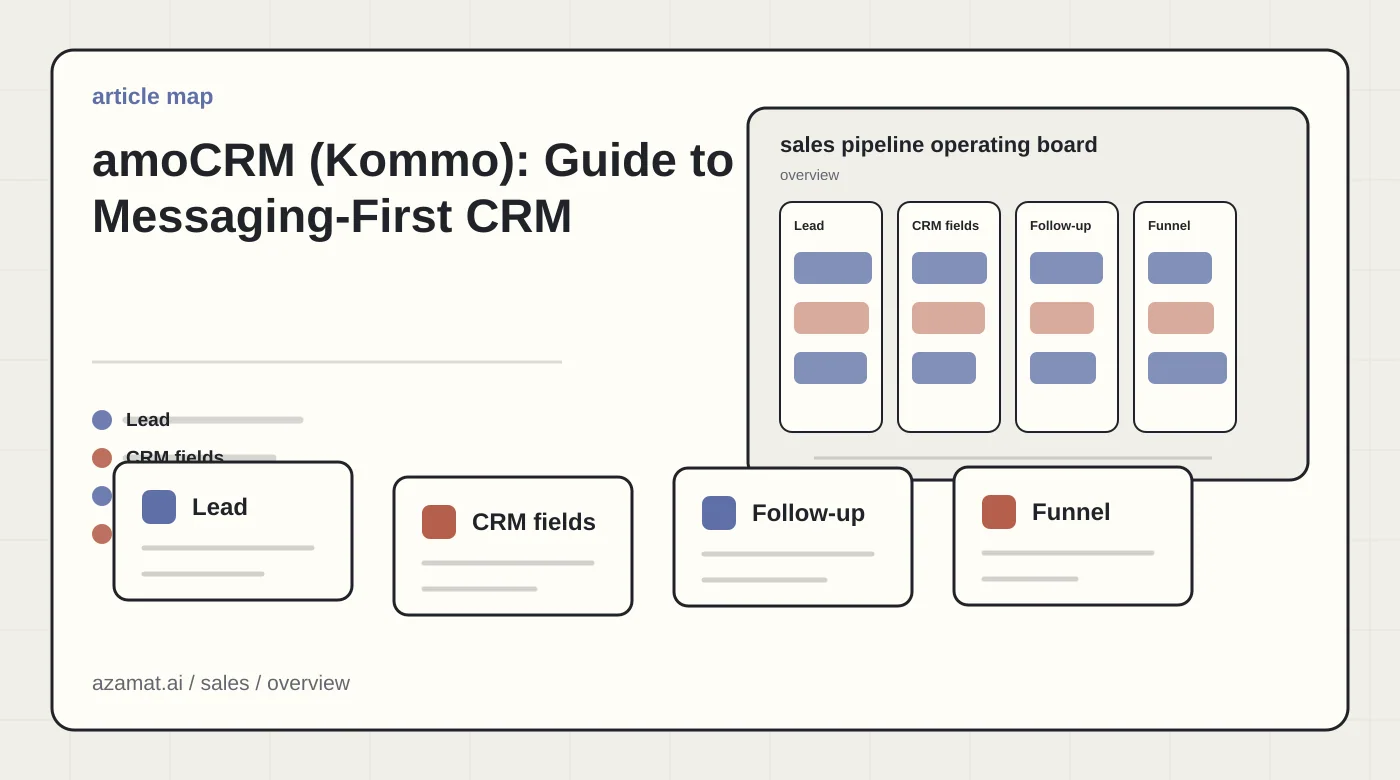
That framing is the whole point. Kommo is not trying to be an all-in-one marketing suite. It is trying to win the deals that happen in WhatsApp, Instagram DMs, and Telegram, where a generic sales CRM makes reps copy-paste between apps and lose half the context. If your buyers live in chat and your reps prospect by email, that difference decides whether this tool fits you at all.
This guide covers what the platform does, what it costs in 2026, how the WhatsApp setup actually works and bills, how it stacks up against Pipedrive and HubSpot, and the implementation mistakes that quietly kill most rollouts.
What amoCRM (Kommo) actually is
Kommo is a cloud CRM designed around selling through messengers. Its strength is not analytics or marketing automation. Its strength is that a rep can hold the entire conversation inside the CRM while the deal advances through a visual pipeline, with bots and tasks handling the routine steps.
That shape fits businesses where the sale is a dialogue: home services, dental and aesthetic clinics, car dealers, real estate, online schools, agencies, and any store that sells through Instagram or WhatsApp. It fits poorly where the transaction closes in one touch at a register, or where a large team needs deep territory management, forecasting, and revenue reporting. For those, a pipeline-first or enterprise CRM will feel more natural.
One practical note that trips people up: this is a subscription, not a one-time purchase. You pay per user, every month, for as long as you use it. Reps who expect a boxed product they "install once" tend to resist the ongoing cost, which matters later when you are trying to get them to actually work in the system.
amoCRM (Kommo) pricing in 2026
Kommo charges per user, per month, on three main tiers. Base runs about $15, Advanced about $25, and Pro about $45 per user each month, with Enterprise priced on request. The tiers differ by active-lead caps (roughly 2,500 / 5,000 / 10,000 per user), automation depth (Salesbot, broadcasting), and the AI features bundled into the higher plans.
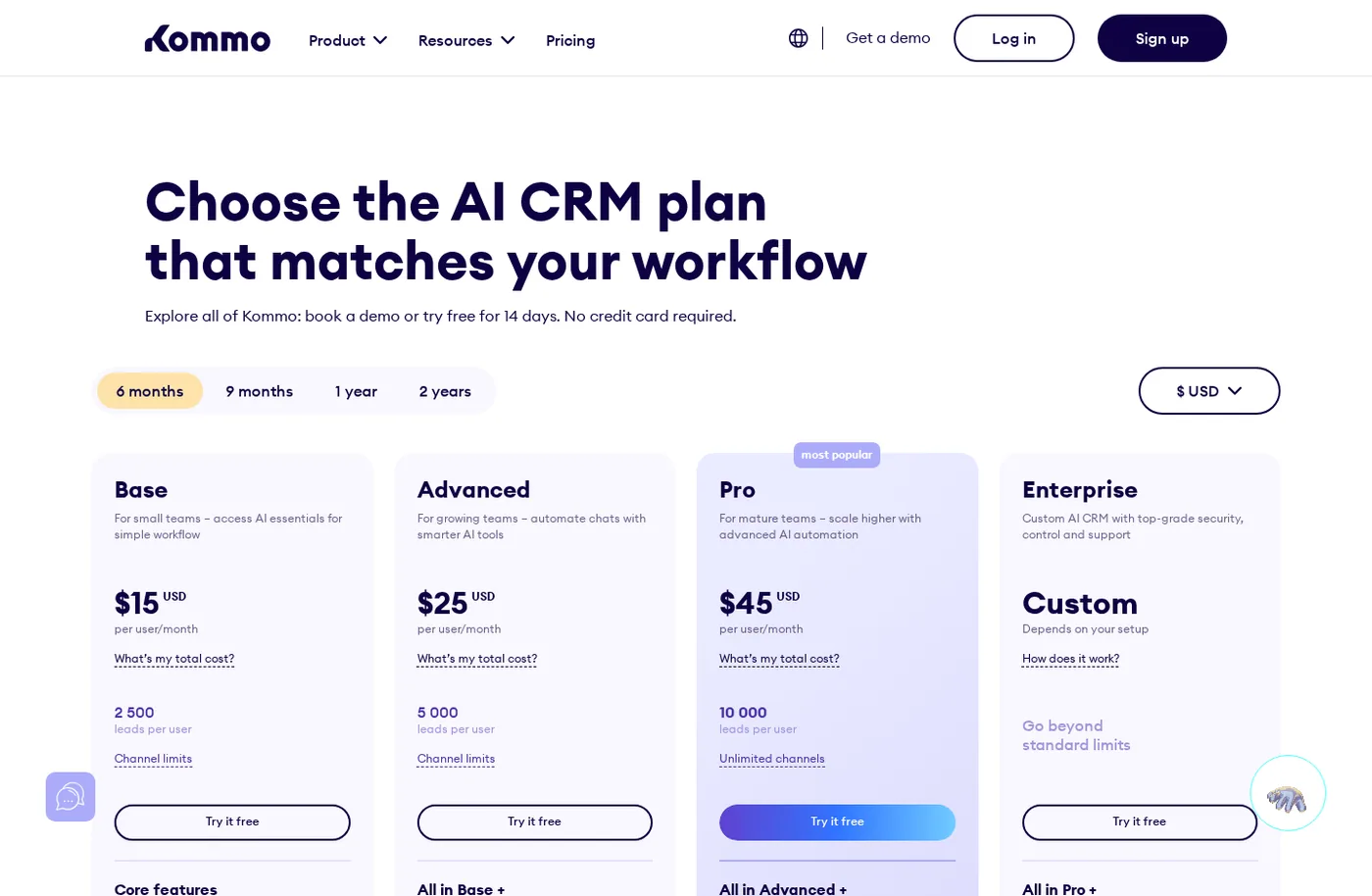
Source: the official Kommo pricing page, public page captured in July 2026.
Two details are worth planning around. First, the minimum subscription is six months, billed up front, on the logic that setting up a pipeline and training a team takes time. Longer commitments of 9, 12, or 24 months carry discounts. Second, and more important: the license fee is not your total cost. The subscription buys access to the platform. Everything that makes it useful, configuring the pipeline, wiring integrations, and training people, is separate work with its own price tag. A license with no setup is an empty account your reps will avoid.
How the WhatsApp integration works and bills
WhatsApp is the reason many teams pick this CRM at all, so it is worth understanding the mechanics. Kommo includes one WhatsApp number and one Instagram account on its plans, and chats land directly in the deal card. The rep replies from inside the CRM, the history stays with the account instead of a personal phone, and a manager can see who messaged whom and when.
The billing is the part people underestimate. WhatsApp runs on Meta's Business API, and Meta charges conversation-based fees on top of your CRM subscription. Depending on volume, that can add anywhere from roughly $50 to a few hundred dollars a month, entirely separate from what you pay Kommo. Before you commit, estimate your conversation volume and price the Meta side too, or the "included WhatsApp" line will surprise your finance team.
The integration also has a maintenance cost that is easy to miss. Platform migrations, like the shift to the Cloud API, have been known to reset automations, so treat any WhatsApp change as something to test, not something to assume keeps working.
amoCRM vs Pipedrive vs HubSpot
The honest way to choose is by asking where your deals actually happen.
Kommo fits when your team sells in chat. Native WhatsApp, Instagram, and Telegram inboxes, bots on top, and a pipeline built for conversation-led selling. If a rep's day is answering DMs and nudging warm leads, nothing here fights you.
Pipedrive fits when you sell by email and phone and want a clean, visual pipeline. It was built by salespeople for pipeline discipline, so outbound-heavy B2B teams should test it against their actual follow-up process. The catch is messaging: Pipedrive has no native WhatsApp, so you bolt on a third-party tool or a Zapier workaround.
HubSpot fits when you want one platform for marketing, sales, and support with strong built-in email. It scales, but it is heavier and pricier than a team that only needs a messaging pipeline usually wants.
There is no universal best. A WhatsApp-led store is miserable on Pipedrive; an outbound SaaS team is under-served by a chat-first CRM. Match the tool to your channel before you look at feature lists.
Implementation mistakes that kill the rollout
Most dead CRMs are not killed by the software. They are killed by how it was rolled out. The patterns repeat:
Adopting it with no goal. Nobody defined the problem it solves or what success looks like, so six months later it is an empty account on autopay while reps work the old way.
Overloading the deal card. Twenty required fields per deal, so reps either skip them or fill them with junk, and the dashboards report noise. Fewer required fields produce more honest data.
Skipping the integrations. Leads get copied in by hand, some get lost, and reps keep chatting from personal phones. The CRM floats in a vacuum, disconnected from where customers actually are.
No owner. The system needs a person, a sales lead or a dedicated CRM manager, who watches the pipeline, permissions, field hygiene, and what broke this week. Without an owner it drifts within a month and stops reflecting reality.
No training. Reps were never shown how to work the pipeline and tasks, never understood what was in it for them, and reverted to notebooks. Implementation is maybe 30% configuration and 70% getting people to change habits. Ignore the second part and you are paying for an empty account.
Where AI belongs on top
Kommo on its own is rules-based automation. Salesbot answers by script: if the customer sends X, reply Y. That is fine for predictable questions like price or location, but it stalls the moment a real conversation drifts off-script, mixes languages, or arrives as a voice note.
That gap is where an AI agent earns its place. It reads free-form text, pulls answers from your knowledge base, holds a genuine conversation, and hands off to a human when it hits its limit. I covered how to add that layer to an existing CRM in the piece on AI CRM integration.
The sequence matters. Clean up the CRM first, pipeline, fields, integrations, training, then add AI on top. AI on a broken process just generates chaos faster. Once the base is solid, an AI layer for sales can qualify leads, answer WhatsApp around the clock, and prompt reps inside the deal card. When you need an agent shaped to your own process rather than a scripted bot, that is custom AI development territory, and roughly how our AI-CRM project is built.
FAQ
Is amoCRM the same as Kommo?
Yes. amoCRM rebranded to Kommo for the global market. It is the same platform and account structure under a new name, so older tutorials and reviews that say "amoCRM" still describe the current product.
What does amoCRM (Kommo) really cost per month?
Budget two numbers separately. The license is roughly $15 to $45 per user per month depending on tier, billed six months up front. Then add WhatsApp: Meta's conversation-based fees on top, often $50 to a few hundred a month by volume, plus whatever a partner charges for setup and configuration.
How does it compare to HubSpot?
HubSpot is an all-in-one marketing, sales, and support platform with strong email; Kommo is a focused messaging CRM. If your growth runs through WhatsApp and Instagram, Kommo is lighter and cheaper to run. If you want marketing automation and support in one system, HubSpot fits better.
Can a small team set it up alone?
Technically yes. Building a pipeline and connecting WhatsApp is doable in-house. But self-installs are also where most rollouts die, because it is easy to overload cards, skip process design, and neglect training. If budget allows, do the process mapping with someone who has seen many of these projects.
The short version: this CRM does one thing well, pull every conversation into one place so deals stop leaking. Start with an honest look at how you sell and one channel, not a full rollout. Analytics and AI come later, once the team actually works in the system instead of filling it out for show.