In short
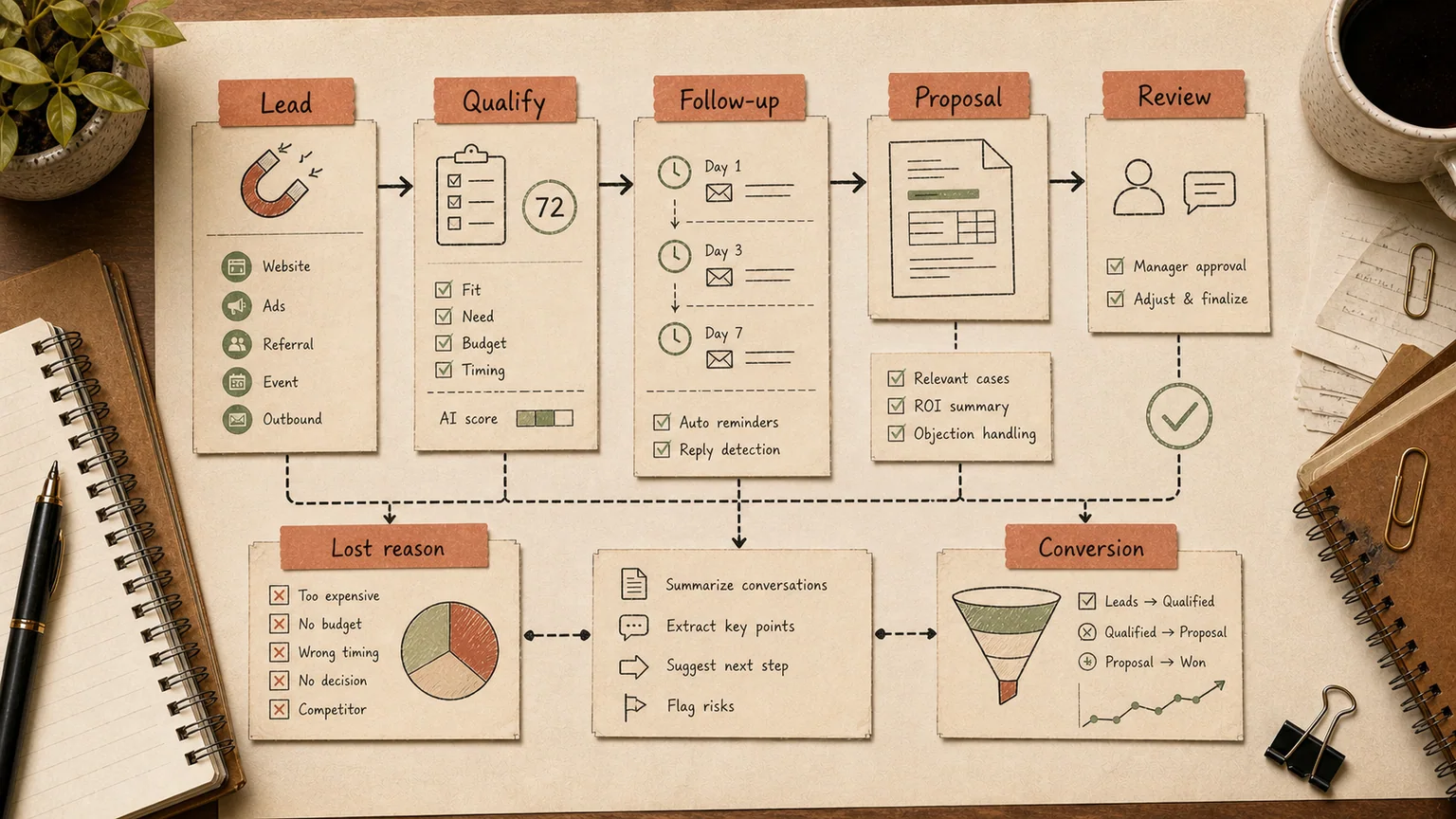
The sales funnel is not a new idea: awareness, interest, qualification, proposal, objection handling, close, retention. The stages have not changed. What changed is that most of them can now run partly on AI instead of purely on a rep's memory and typing speed.
This is a stage-by-stage breakdown of where AI actually earns its place in the funnel, not a pitch for "AI that closes deals for you." At each stage, I'll say what the system should do, what it should never touch, and what breaks when teams skip the boring setup work first.
If your funnel is a slide in a deck rather than a set of measurable stages with real conversion numbers, start there before adding AI. Automation on top of an undefined process just makes the mess move faster.
Stage 1: awareness and first contact
A lead arrives from a form, an ad, a referral, or a cold inbound message. Speed matters more here than almost anywhere else in the funnel. HubSpot's own data on AI-powered sales workflows shows teams using AI across funnel stages typically see 30-50% more qualified pipeline without adding headcount, largely because leads get a real response before they lose interest or move to a competitor.
AI's job at this stage is narrow: respond immediately, capture the source and channel accurately, and push a structured record into the CRM instead of leaving the conversation to live only in an inbox or a rep's head. A bot that answers fast but writes nothing useful back to the CRM has only solved half the problem.
Stage 2: qualification — gather facts, not run an interrogation
Classic qualification is BANT: budget, authority, need, timeline. A rep normally spends five to ten minutes of a call extracting this. It matters because qualified leads close at roughly 40% versus around 11% for unqualified ones — nearly a four-to-one difference, which is the entire reason qualification exists as a step.
AI handles this stage well only if it avoids turning into a ten-question form before a human shows up. A workable pattern is one or two clarifying questions inside a natural exchange, covering:
- the problem or job the buyer is trying to solve;
- rough budget range, where it's appropriate to ask directly;
- timeline and how firm it is;
- who actually signs off — the person you're talking to, or a committee;
- what they use today, if this is a replacement purchase.
The output should be a short brief for the rep, not a raw transcript: "Inbound from the pricing page, evaluating a replacement for their current vendor, decision involves a VP and procurement, timeline is end of quarter, main complaint is support response time." That gets the rep into a real conversation instead of five questions the prospect already answered in a form.
Stage 3: scoring — who gets attention first
Once lead volume outpaces rep capacity, sequencing becomes the problem. Scoring assigns weight to behavior and firmographic signals: pricing page visits, repeat email opens, company size, industry fit, engagement recency. Leads then land in hot, warm, or cold buckets.
Rule-based scoring used to be set once and left to rot. AI-driven predictive scoring trains on outcomes — which signals actually correlated with a closed deal, not which ones seemed logical when someone wrote the rules two years ago. Companies using AI-powered predictive scoring report an average 38% higher lead-to-opportunity conversion rate compared to static models, according to recent adoption surveys.
The practical effect: a rep doesn't scroll through 200 near-identical records. The system surfaces who's actually ready to buy now. That doesn't replace judgment — scores should be explainable ("high score because: third pricing-page visit this week, mentioned an urgent rollout, fits target segment"), not a black box a rep has to trust blindly.
Stage 4: proposal and objection handling
This is where AI's role should shrink, and that's correct — a human owns the decision here. AI can still draft a first-pass proposal from CRM data, past won proposals, and pricing sheets, pull a relevant case study for the buyer's industry, and prepare a first response to a common objection.
From call transcripts, AI can summarize something more useful than "discussed pricing and next steps": what the rep actually promised, which objection has come up for the third time this month (a pattern worth training against, not a one-off), and where a rep went quiet on a pricing question instead of answering it.
Final price, discounts, and non-standard terms should never come from the model directly — only material a rep or manager reviews and approves. This is the exact boundary that turns into a bad story fast: an agent that quietly commits to a discount in a chat thread creates an obligation the company then has to honor.
Stage 5: follow-up — where most funnels quietly leak revenue
The most underrated stage isn't the first touch or the close. It's the silence in between. A prospect says "let me think about it," a rep promises to follow up tomorrow and forgets, a proposal goes out and nobody checks if it landed, and "let's reconnect next week" evaporates because it was never a task with a date attached.
AI works here as insurance against forgetting: it creates a dated task right after a call or thread, drafts a follow-up message, nudges a rep when a deal has gone quiet past an agreed window, and flags when a prospect asked for pricing and never received it. McKinsey's research on B2B sales AI makes the same point from a different angle: the highest-value use cases sit across the whole seller journey, but they only pay off when the data foundation is solid, not when a tool gets bolted onto a broken process.
Automated follow-up should default to draft mode: AI writes, a person reviews before sending. Full autopilot is reasonable only for narrow, low-risk cases — confirming a meeting time, sending an already-approved resource, thanking someone for a form submission.
Stage 6: close and retention
By the time a deal reaches close, AI has usually already done most of its useful work: qualification notes, a score, a proposal draft, a record of what was promised. What's left is paperwork, contract, and handoff to onboarding or support.
Retention is where this connects back to revenue. If a customer bought once, AI can flag the right moment for a renewal conversation, suggest an adjacent product based on order history, or surface an account that's gone quiet longer than usual and might be worth a check-in. For subscription and repeat-purchase businesses, this stage often moves more revenue than another push at the top of the funnel.
Analytics: where the funnel actually leaks
The other real benefit of AI in the funnel isn't text generation — it's visibility. Funnel conversion rate is a simple ratio: closed deals divided by total leads. That number alone tells you almost nothing about where deals actually die.
Stage-level analytics can show something specific: 60% of leads from one channel reach qualification but only 15% reach a proposal, while a different channel converts at 40% through the same stage. Or: deals sit in "proposal sent" for more than seven days three times more often than average, and it's almost always the same rep's deals. Finding that manually takes weeks of spreadsheet archaeology. With stage-level logging, it's one report.
It's also worth tracking how many open deals have no next step and how many tasks are overdue. This isn't about watching reps — it's about a manager seeing risk before a deal quietly dies in "in progress" status.
What AI should never do in the funnel
AI in the sales funnel needs an explicit boundary. It can qualify, score, draft, summarize calls, create tasks, and flag risk. It should never commit to a discount on its own, change a price, mark a deal closed-won, confirm non-standard delivery terms, or send a proposal without human review.
Crossing that line is usually exactly how a useful pilot turns into the story everyone tells about "the AI promised the client something we don't actually offer." The boundary isn't bureaucracy — it's the only mechanism that lets a team extend the agent's autonomy gradually, as it proves out predictable behavior.
Running a one-month pilot
Don't try to automate the whole funnel at once. Pick one stage where the pain is already visible — inbound qualification or post-call follow-up are usually the best starting points. Pull 50-100 real conversations and mark which rep responses were good and which weren't. Run the agent as a copilot first, then hand it a narrow slice of the pipeline — one product line, one region.
After three to four weeks, compare time to first response, the share of leads with complete fields, follow-up turnaround, and the number of deals sitting with no next step. If the sales manager sees less CRM chaos and fewer dropped commitments, that's the signal to extend the agent to the next stage.
Building this well usually means CRM integration and a custom AI agent working against real pipeline data, not a generic chatbot demo. Off-the-shelf bot builders handle simple flows fine, but they struggle once qualification logic gets specific to how your team actually sells — see bot builder vs. custom AI agent for where that line falls.
FAQ
Which funnel stage should we automate first?
Inbound lead qualification and post-call follow-up are usually the best starting points — both are measurable and show time savings quickly without touching pricing or commercial decisions.
Will AI replace sales reps?
No. AI handles the mechanical parts well — qualification, scoring, drafts, reminders. Decisions on discounts, terms, and closing the deal stay with a person.
How fast will funnel conversion improve?
It depends on where the bottleneck actually was. If the problem was response speed or dropped follow-ups, the effect shows up within the first month. If the problem is the product or the price, AI won't fix that.
Do we need an enterprise CRM to start?
No. A pilot works fine on HubSpot, a lean Salesforce instance, or even a well-structured spreadsheet. Deeper integrations with phone systems and finance tools are worth adding once the narrow pilot has proven the workflow.
Running AI through the funnel doesn't make the funnel smarter by itself. It gets smarter when each stage hands off a specific piece of manual work to the agent, leaves a clean record in the CRM, and stops exactly where a human decision should start.