In short
Digital transformation is not a new CRM license or a cloud migration. It is a rework of how a company routes decisions and work between people, with the assumption that some of that work can now move to software and AI. Kazakhstan's government has named 2026 the year of digitalization and AI, which will push a fresh wave of vendor pitches at local companies. Most of those pitches will still solve the wrong problem.
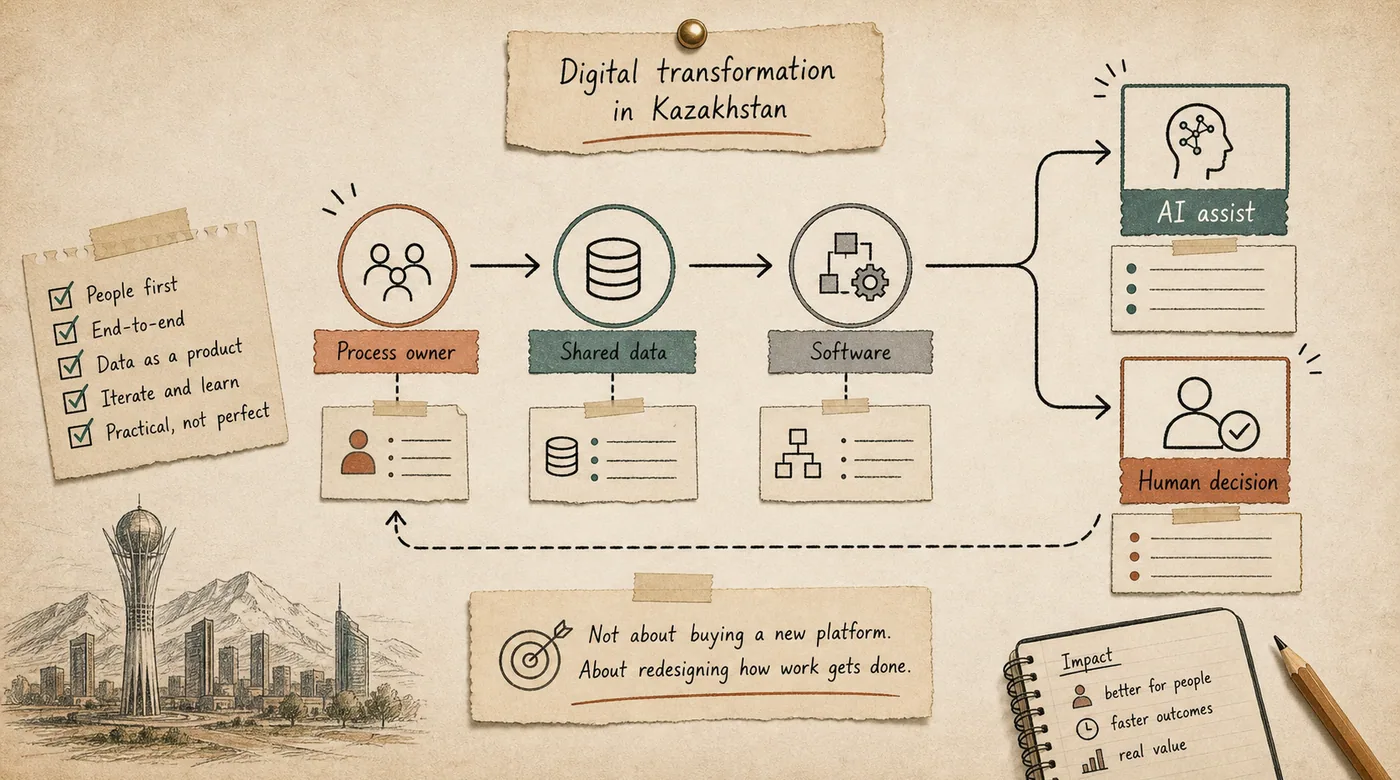
A finance team buys a new system but never redesigns the process around it. The accountant still enters data into the ERP, still copies it into a spreadsheet for the CFO, still repeats it a third time in a status message to another department. Three versions of the same fact, three places for errors to creep in. That is not a technology problem. Nobody decided who owns the data and in what order decisions get made.
Why bother at all
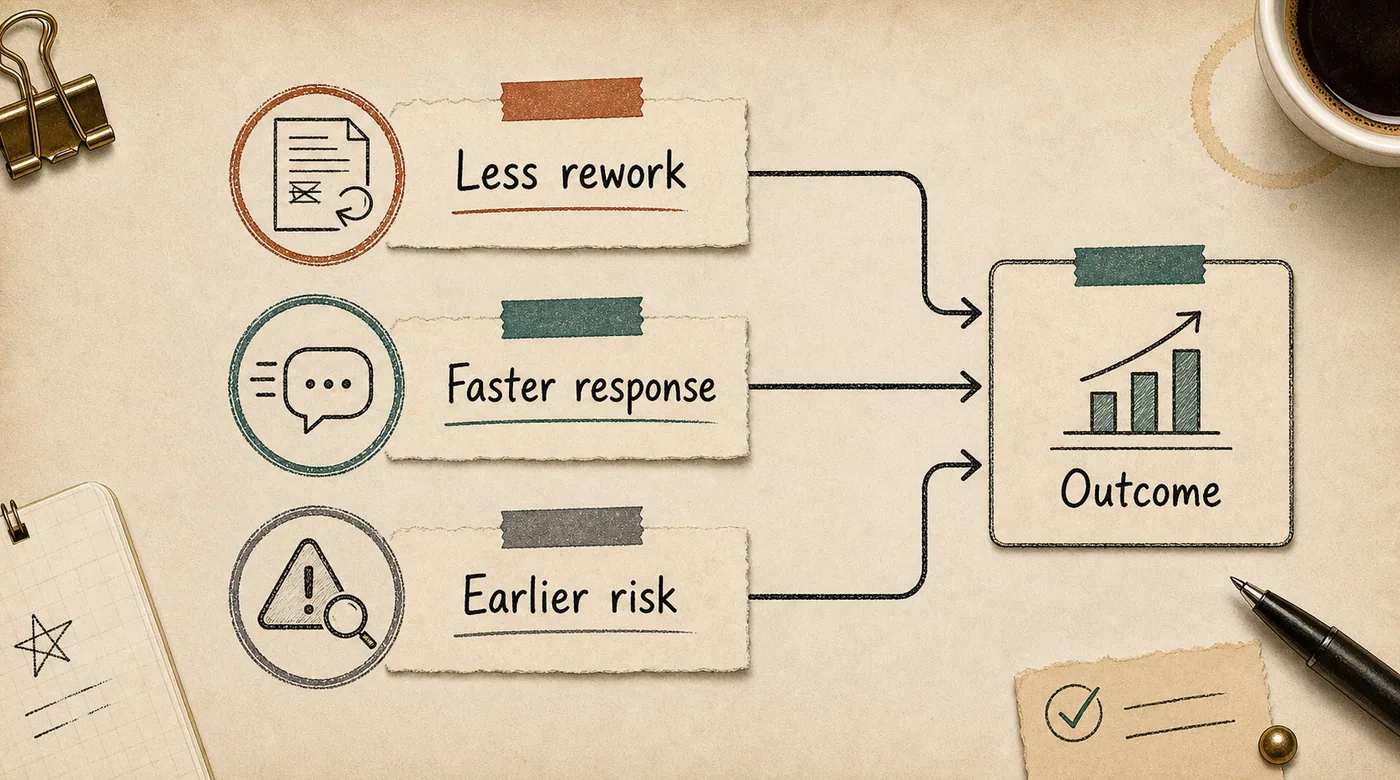
The point is not to look modern. The point is money and speed. A company either spends less on manual rework (reconciliation, re-entry, chasing approvals), responds to customers faster (an answer in minutes instead of a day), or sees problems earlier (a stuck invoice, an overdue account, a shipment nobody is tracking). If none of those three outcomes is visible on the table, it is too early to start a transformation program — figure out first what the business is actually losing money or time on.
The pattern that actually pays off looks the same across industries: leadership agrees on a business outcome first, picks a small and measurable win, and only then commits budget to a platform. That is the opposite of how most transformation budgets get spent — vendor selected first, outcome defined after the fact.
Start with process, not software
The most common failure mode is buying the platform before understanding the process. A vendor demo looks clean, procurement signs off, and six months later the software sits there while the team keeps working around it in email and spreadsheets, because nobody redesigned how work actually flows.
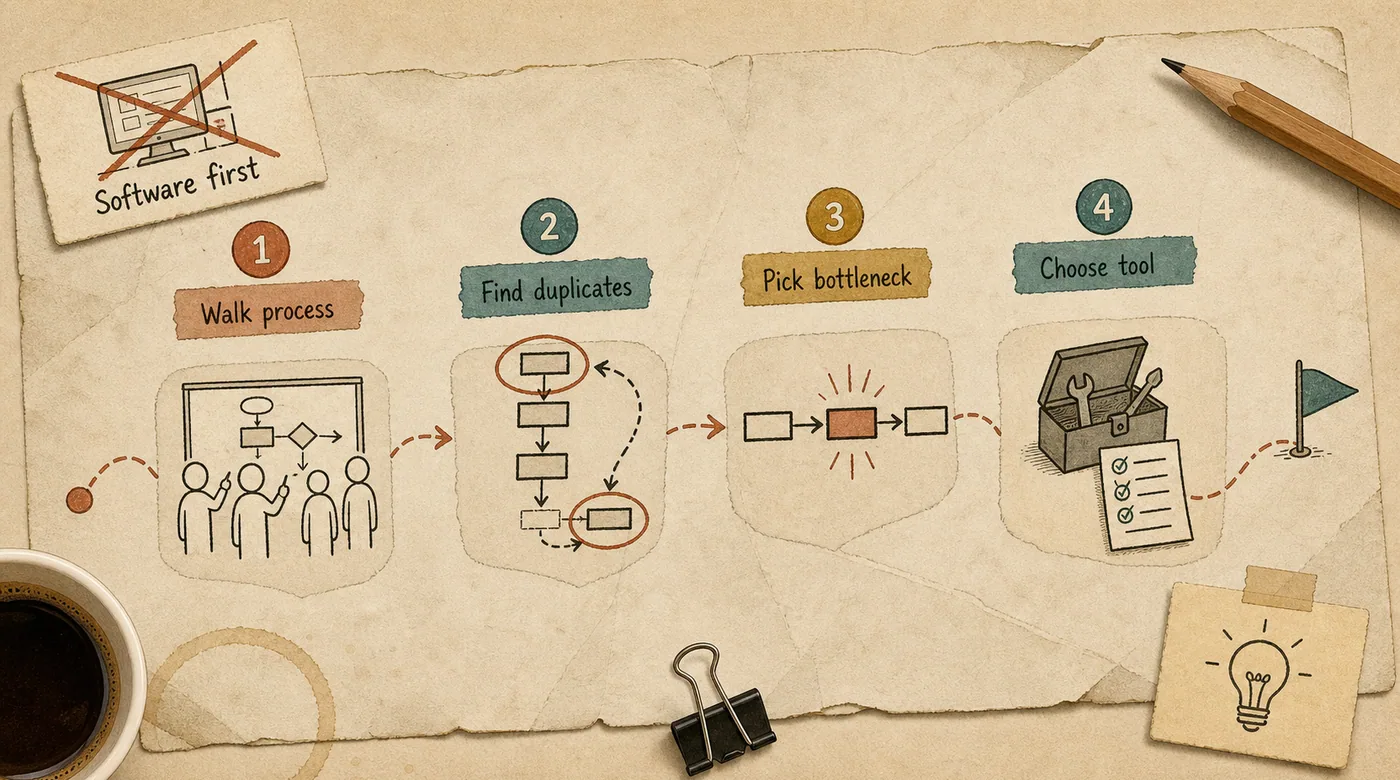
The right order runs backward from that.
Pick one process end to end — quote to cash, application to hire, purchase order to warehouse receipt — and walk it with the people who actually do the work, not the org chart. You will almost always find steps that duplicate each other, steps that exist only because "that's how it's always been," and steps that depend entirely on one person who is out sick this week, at which point the whole process stops.
Then decide what to digitize first. Not the most visible piece of the process, but the one eating the most hours and the one where a mistake is most expensive. For retail operations that is usually inventory reconciliation and order handling. For professional services it is scheduling, reminders, and contract renewals. For logistics and manufacturing it is approvals and status visibility. If it is unclear where to start, a useful reference is this breakdown of which business processes are actually worth automating with AI, organized by department: support, sales, HR, documents, finance.
Only after that does it make sense to evaluate tools: ERP customization, a chat layer, an internal knowledge base, an AI system built around the actual process rather than a template. Technology gets selected to fit the process, not the other way around.
Where AI actually fits
AI in a digital transformation program is not a standalone "let's add a chatbot" initiative. It is a layer on top of processes that are already mapped. It works well anywhere a system needs to read text, a document, or a conversation quickly and propose the next step. It works badly when it is asked to make a judgment call that should belong to a person.
The entry points that tend to pay for themselves within a quarter: answering routine customer questions — stock availability, delivery timelines, order status — instead of routing everyone to "contact an agent." Reading incoming invoices and purchase orders instead of someone retyping numbers into the ERP. An internal knowledge base so a new hire stops interrupting senior staff ten times a day. First-pass triage of support tickets so people only handle the cases that need judgment.
The final call — reject a claim, terminate a contract, write off a debt — should stay with a person. AI prepares the material for that decision: it gathers facts, shows its reasoning, and proposes an option. If an agent starts acting on that judgment without a human sign-off, it eventually costs a real customer or real money.
For many companies the first visible win is a support agent that handles first-line questions across chat and email, because customers are already writing in through those channels — the difference is whether a tired agent answers, or a system that can actually see order status and inventory.
What usually goes wrong
Failure rarely looks like an explosion. It looks like a quiet fade: the system gets purchased, training happens once, and three months later half the team has drifted back to the old spreadsheet because it is faster and more familiar.
Three recurring patterns show up across most stalled projects.
The first is handing the whole initiative to IT. Leadership signs the budget and checks back only at the quarterly review. Without a business-side owner accountable for the outcome, not just the rollout, the new system becomes an expensive tool nobody actually uses for its intended purpose.
The second is skipping data readiness. A company wants to automate claims processing, but claims have lived for years in inconsistent spreadsheets with no agreed format and no clear owner for the status field. Any system built on that foundation will produce confident-looking garbage. Before adding AI or a new platform, it is worth working through this readiness checklist — data, access, and a named process owner, specifically.
The third is forcing change from the top without explanation. People rarely sabotage a new system on purpose. They keep doing what they already know because nobody showed them why the new way is actually better. A single training session does not fix this — someone needs to be reachable for questions and complaints in the first few weeks, not just on launch day.
What this looks like in practice
A retail chain with locations across several cities usually goes through this in stages, not one big-bang rollout. First it fixes inventory and order-status accuracy between the ERP and the warehouse floor — without that, anything built on top of the data will lie convincingly. Next it moves from a shared broadcast channel to targeted notifications: a customer gets their own order-status update, a warehouse worker gets their own shift change, instead of everyone scrolling through the same group thread looking for the one line that applies to them. A similar pattern shows up in this retail notification automation case: not a one-off blast, but a system triggered by actual status changes that does not flood people with duplicates.
After that, an AI agent enters at a specific point — wherever the same conversation repeats at volume. High-volume hiring is a common example: an agent collects applications, confirms availability and location, and hands the recruiter a ready summary instead of a raw chat thread.
How to tell if it is actually working
Without metrics, "digital transformation" turns into a conversation about technology for its own sake. Track three things: how long the process takes before and after, how the error and rework rate changed, and how many people are still using the new tool after three months, not just during the week after training.
If people have drifted back to the old spreadsheet after a quarter, the system usually is not the problem — the process was not fully mapped, or the data was not ready. Running this as a 30-day pilot rather than a year-long roadmap makes that easier to catch and correct, because a short cycle is cheap to stop and redo.
FAQ
Is digital transformation the same as automation?
No. Automation is software doing one specific task instead of a person. Transformation is broader — it is rethinking how the process works and who owns which decision. Automation is one tool inside a transformation effort, not a synonym for it.
Which department should a smaller company start with?
Whichever one eats the most of the owner's or a key employee's personal time. In a smaller company that is often sales or customer support, and results show up fastest there.
Does this require a large budget?
No. The first pilot should run on one process with one tool, without a platform-wide purchase. Budget should grow once value is proven, not before.
How long does transforming a single process take?
A few weeks to a couple of months for a narrow pilot. Projects that stretch across a year without an intermediate result are usually trying to change too much at once.
If the organization has a vague sense that "we need to do something about digital transformation" but no clear starting point, start by mapping one real process on paper before evaluating any platform. From there it becomes clear what should be automated, what AI can realistically help with, and what just needs cleaner data.