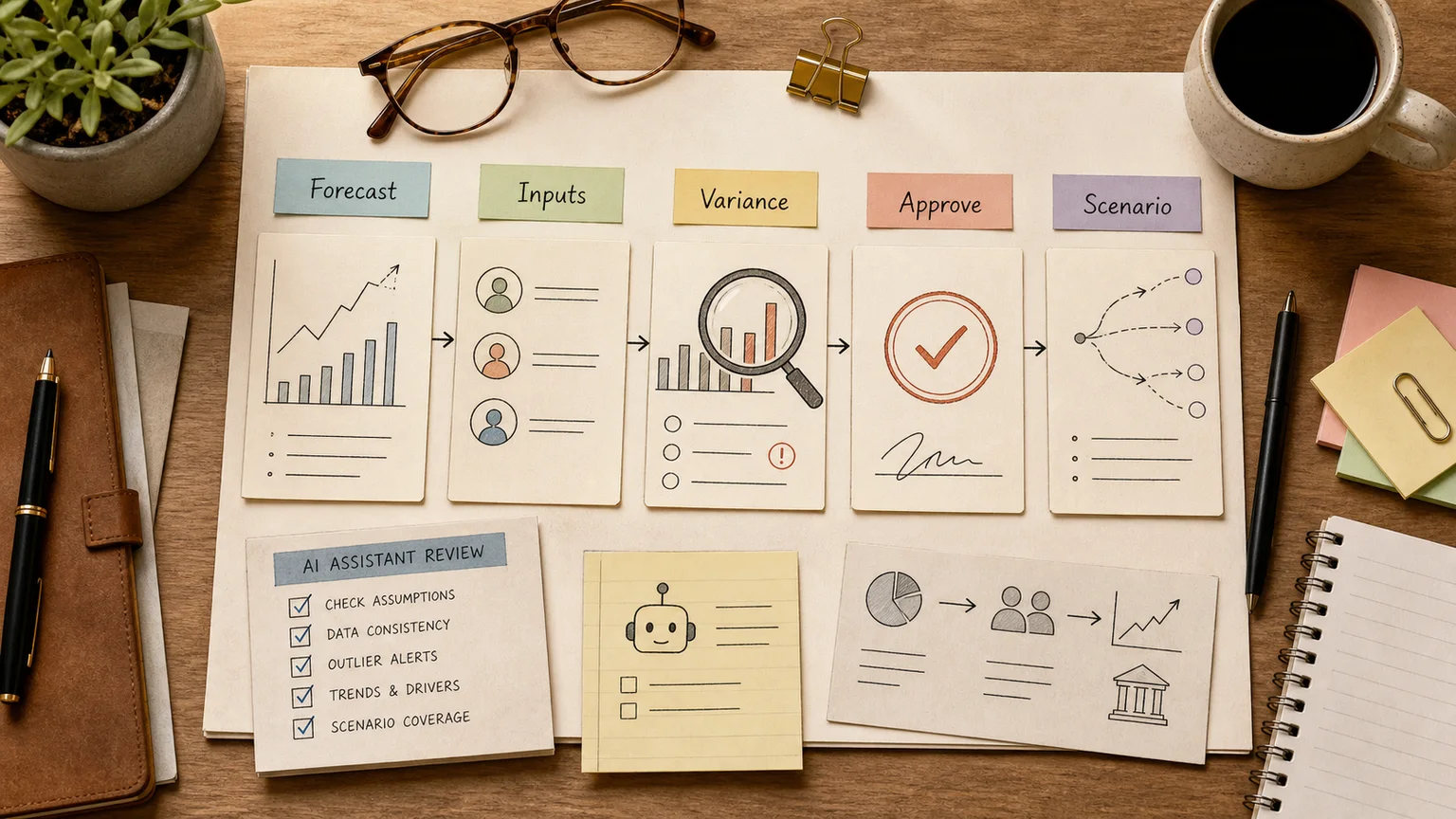
In short
A mid-size company's annual budget cycle usually runs eight to twelve weeks: finance sends out a template, department heads fill it in, then FP&A spends most of a month reconciling versions and negotiating numbers before the board signs off. About three-quarters of companies report their annual budget is materially disconnected from actual conditions by mid-year, because the assumptions were locked in months before anyone acts on them.
AI does not replace the CFO in this cycle and does not invent numbers on its own authority. It takes over three jobs: consolidating submissions from a dozen departments into one model, recalculating scenarios in minutes instead of a day of spreadsheet surgery, and drafting a first-pass justification for why a line item looks the way it does. Deciding how much to spend on paid acquisition next quarter, or whether headcount growth is justified, still belongs to the person who owns the outcome.
Where the budgeting cycle actually loses time
The standard cycle looks similar everywhere: leadership sets targets, finance distributes a template, department heads submit requests, FP&A consolidates everything into one model, there's a negotiation round, the board approves, and final limits get pushed back down to spenders. On paper that's four to six weeks. In practice it stalls in the same three places.
First, the template itself. Finance sends an Excel workbook to fifteen department heads; two weeks later fifteen files come back with different row structures — someone added a column, someone changed a formula, someone typed in a manual total instead of letting the sheet calculate it. Reconciling that into one model is its own multi-day project before any actual planning happens.
Second, version control. While the budget is under negotiation, "Budget_v3_FINAL_revised.xlsx" circulates by email while someone in sales is still editing v2 because they never got the update. In any company that consolidates a budget from spreadsheets across departments, versions diverge faster than anyone can reconcile them by hand.
Third, justification. A department head asks for a 30% increase in the logistics line, and FP&A has to figure out whether that's real volume growth or padding ahead of the negotiation — pulling history, comparing to last year, waiting on answers, for every department, every cycle.
What AI speeds up in scenario modeling
Scenario modeling means recalculating the budget when a driver changes: FX rate, input cost, borrowing rate, hiring pace, sales conversion. By hand, that means finding every linked cell and not missing a dependency — miss one and half the report shows the new number while the other half quietly still shows the old one.
An agent layered over the budget model holds drivers — volume, price, FX, rate — as explicit variables instead of formulas scattered across a dozen tabs. Change the FX assumption and everything downstream recalculates: imported input costs, FX-denominated debt, foreign-currency payroll where it exists. What took an analyst most of a day now takes minutes to recalculate and an hour for a human to check.
The second effect is running scenarios in parallel without them drifting apart — base case, downside, upside — as three versions of one model sharing the same dependencies rather than three files that inevitably diverge. The CFO sees, on one screen, which line items get cut first if revenue drops 15%, and where cash can go if it grows 20% without adding headcount.
AI is also useful for stress-testing assumptions. If a department head projects 40% sales growth with no change in headcount, the model can surface that the last two comparable growth periods required at least a 25% staff increase. That doesn't make the plan wrong, but it gives the CFO a reason to ask where the number came from before the negotiation round, not during it.
What changes in version control and approvals
The biggest practical win from AI here isn't the forecast — it's cleaning up how versions and approvals work. An agent accepts submissions in whatever format a department uses — Excel, a form, a Slack message with numbers in it — and maps them into one structured model against a shared chart of accounts, flagging where a submission doesn't line up. Nobody has to manually confirm which version is current: there's one model with a change history, and a draft can always be rolled back.
A draft justification is another point of leverage. A department asks for a budget increase; the agent drafts a rationale from spend history and prior-period comparisons, and FP&A edits it and decides whether the argument holds. The agent doesn't decide whether a request is justified — it removes the need to manually pull history for every submission.
Cross-department spending limits work the same way. If travel budget is approved centrally but branches quietly negotiate exceptions over chat, nobody can say six months later what the real limit is. A well-built agent treats an approved limit as a rule, so any deviation becomes visible instead of disappearing into a thread.
Where AI gets it wrong, and why that's expensive here
A model that generates text predicts the most likely continuation — it doesn't check a fact, it fills a gap with something plausible. In a variance report that flaw surfaces fast, because there's a source document to check against. In next year's budget it's worse: there's no source document, only an assumption. If the model confidently proposes an unbacked growth number and nobody checks it, that number becomes the official plan.
A second mistake is letting the model work from incomplete historical data — building a forecast on eight months of prior-year data because the last four haven't been exported yet extrapolates a trend from an incomplete, wrong sample. That's a process failure, not the model's: check data completeness before trusting a scenario output.
A third mistake is turning a driver-based model into fifty variables because "let the model account for everything." The more drivers, the harder to explain the number and the easier for the model to compound an error in one dependency. Three to five real drivers per business unit works better, everything else a fixed assumption a human can override. It's also worth auditing what the agent learns from: if last year's budget was padded out of caution, an unreviewed model will treat that padding as the new norm.
That split defines the division of labor: the agent consolidates submissions, reconciles versions, recalculates scenarios, and drafts justifications. The CFO keeps the final call on contested line items, judges whether an increase reflects real need or padding, owns the methodology, and signs the number that goes to the board.
How to pilot this without derailing the current cycle
Week one: don't touch the live budget. Pull last year's full cycle — files, threads, final versions — and run it through the agent retroactively to see where it struggles on messy real data. Week two: pick one department and run a real submission through the agent alongside the normal process. Week three: add scenario recalculation for one driver, say FX exposure, and reconcile against what used to be done by hand in Excel. Week four: measure the effect — days saved consolidating versions, discrepancies caught before the negotiation round instead of during it, how often a drafted justification needed a full rewrite versus a light edit.
If the pilot shows real time savings without a loss of accuracy, it's worth rolling out across the full cycle. That usually calls for an AI agent that reads from source systems and spreadsheets on an ongoing basis, not a one-off macro on top of Excel. Getting the finance team comfortable with the tooling matters just as much: corporate AI training is often more useful for FP&A leads than for the IT team, because they decide whether to trust a number or double-check it.
How to tell if it paid off
Compare three things after the first full cycle with an agent in the loop: how many weeks the cycle took versus last year; how many version conflicts got resolved before the negotiation round instead of during it; how many times the model's number needed a substantial rewrite rather than a light edit.
A good sign of a mature process isn't raw speed — it's that FP&A stops manually re-checking the consolidated model before the board meeting, because discrepancies are already flagged. A bad sign is a faster cycle where department heads no longer understand where their limits came from. Speed without traceability costs more than a slower process people actually trust.
The same logic applies to AI for the finance department more broadly: invoices and variance commentary follow the same pattern of consolidation and human sign-off, just on actuals instead of a forward plan. If budget versioning is a mess, the actuals side is usually not much cleaner.
FAQ
Can AI own the final budget number?
No. The model can consolidate submissions, recalculate a scenario, and draft a justification. Deciding how much to allocate to a line item, and whether a request reflects real need or padding, stays with the CFO and business unit owners.
Where do we start if the budget is assembled from a chaos of spreadsheets every year?
Not with a new planning platform. Start with one cycle: run last year's budget through an agent retroactively and see where versions actually diverged. Add one business unit at a time rather than converting the whole process at once.
How is AI-driven scenario modeling different from recalculating in Excel?
Drivers — FX, volume, rate — exist as explicit variables with defined dependencies instead of formulas scattered across dozens of cells. One recalculation instead of manually fixing every linked row.
Should we move from an annual budget to rolling forecasts?
If the market moves fast enough that the annual plan is stale by mid-year, a rolling forecast updated monthly or quarterly gives a more honest picture. AI matters more here because frequent recalculation is the most labor-intensive part of running a rolling model by hand.
If your budgeting cycle reliably takes two months and ends in an argument about which spreadsheet version is correct, the fix isn't a new template. It's putting structure around how submissions get collected, versioned, and recalculated — once.